Schelling Point BA Opens with Focus on Coordination and Decentralized Governance
Schelling Point BA Opens with Focus on Coordination and Decentralized Governance
🎯 Coordination conference begins


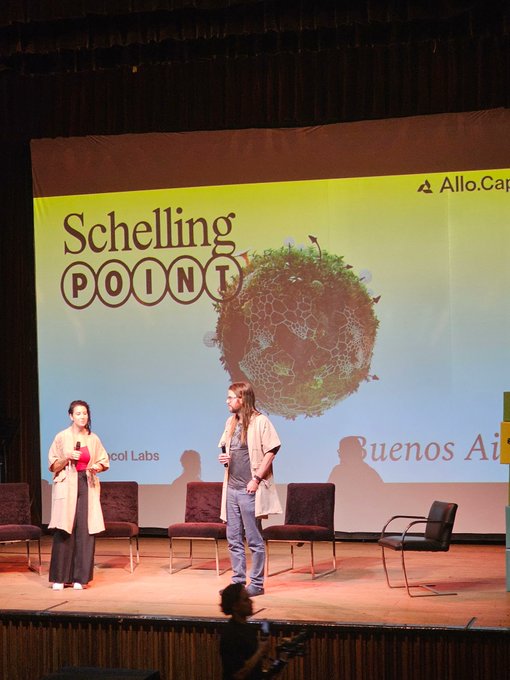
Schelling Point BA has officially launched with opening remarks from @owocki and @mathildawrites, emphasizing the importance of coordination in decentralized systems.
The event kicked off with a focus on:
- Intention and clarity in coordination efforts
- Understanding why coordination matters in practice
- Real-world insights on decentralized organizations
@stellaachenbach will join the stage to share expertise on:
- DAO governance challenges
- The human elements of coordination
- Practical lessons for operators and stewards
The conference appears targeted at practitioners working to make decentralized coordination work effectively in real-world applications.

Schelling Point BA is officially open. @owocki and @mathildawrites just kicked us off with the right tone - intention, clarity, and a reminder of why coordination actually matters. Great start🔥
🔧 Gitcoin GG24 Deep Funding Results
Gitcoin has released the **deep funding update** for GG24's Web3 Tooling and Infrastructure round. **Key Details:** - Projects can now check their qualification status for deep funding - Part of GG24's six-domain structure allocating **$1.8M total** - First round fully designed through structured sensemaking - Focuses on developer tooling and infrastructure projects This represents Gitcoin's approach to directing capital toward critical Web3 development needs. [Check qualification status](https://gov.gitcoin.co/t/deep-funding-gg24-web3-tooling-and-infra-round/25040)
Gitcoin Pivots to Lean Experimentation Model for 2026
Gitcoin has outlined a strategic reset for 2026, moving away from its previous approach to focus on three core principles: **The AAA Framework:** - **Alignment**: Fund projects that advance human thriving - **Alpha**: Identify and attract high-potential builders - **Accelerate**: Operate with small, efficient teams **Coalition-First Funding** The platform will require projects to demonstrate 60-70% funding from external sources before receiving Gitcoin support. This approach aims to surface builders with genuine community backing through the upcoming GG25 round. **Experimental Approach** Rather than committing to large-scale initiatives, Gitcoin will run low-budget, time-limited experiments throughout 2026. The organization will only pursue recapitalization and scaling after these experiments show clear traction and legitimacy. This represents a significant shift from Gitcoin's previous grant-making model, emphasizing validation and external support over direct funding. The strategy suggests a more cautious approach following lessons learned from past rounds. [Read the full strategy](https://gov.gitcoin.co/t/gitcoin-2026-strategy-tl-dr/25049/1)
Gitcoin Unveils 3.0 Vision: Beyond Quadratic Funding to Multi-Mechanism Portfolio
Gitcoin has announced its evolution into version 3.0, marking a significant shift in how public goods funding operates. **The Three Phases:** - **Gitcoin 1.0 (2020)**: Centralized platform focused on Quadratic Funding - **Gitcoin 2.0 (2024)**: Decentralized QF with modular protocols - **Gitcoin 3.0 (2026+)**: Comprehensive portfolio of funding mechanisms **Key Changes:** The new version moves beyond a single funding method to embrace multiple approaches: - Various flavors of Quadratic Funding - Quadratic Voting - Direct Grants - Retroactive public goods funding This transition reflects a broader understanding that different projects and communities need different funding tools. Rather than relying solely on one mechanism, Gitcoin 3.0 aims to provide a complete toolkit for capital allocation. The platform continues its expansion across all EVM-based communities, with tools like Gitcoin Passport extending beyond the original Ethereum ecosystem to protect various blockchain communities from Sybil attacks. This evolution represents a maturation from a single-purpose platform to a diverse ecosystem of funding solutions.
Core Developer Compensation Crisis: Data Reveals Measurable Underfunding Problem
**Core developer undercompensation** has moved beyond anecdotal concerns to become a **measurable crisis** affecting blockchain infrastructure. Trent Van Epps presented compelling data at Schelling Point, highlighting how inadequate funding threatens the sustainability of critical development work across the ecosystem. Key findings reveal: - Systematic underfunding of essential infrastructure work - Growing gap between developer value creation and compensation - Need for coordinated community response The research provides concrete evidence for what many developers have experienced firsthand - that current funding models fail to adequately support the builders maintaining blockchain networks. **This isn't just a developer problem** - it's an ecosystem sustainability issue that affects everyone relying on these networks. Watch the full presentation: [Schelling Point Talk](https://www.youtube.com/watch?v=q5qPYZLGD3U) *Understanding this data is crucial for anyone invested in long-term blockchain infrastructure health.*
Gitcoin Grants Hands Control to Community in GG24 Experiment
**Gitcoin conducted its first community-run grants program** with GG24, marking a significant shift from centralized control. The experiment involved **handing operational keys directly to community members**, allowing them to manage domains independently. This represents a major governance evolution for the platform. **Key insights from the debrief panel:** - Community-run domains delivered clearer focus - Improved signal-to-noise ratio in grant selection - Better capital allocation decisions - Stronger alignment between funders and projects The panel featured prominent community members including MontyMerlin, Paul Glavin, and others sharing **candid lessons learned** from this decentralization experiment. **What's next:** The team discussed how this community-first approach will shape future Gitcoin Grants rounds, potentially making decentralized governance the new standard. Watch the full debrief: [YouTube Panel](https://www.youtube.com/watch?v=xKtTnlDX0HQ)