Rocket Pool Announces Saturn Upgrade with RPL Fee Switch
Rocket Pool Announces Saturn Upgrade with RPL Fee Switch
🚀 RPL Holders Getting Paid


Rocket Pool is preparing to launch its most significant upgrade since inception - Saturn. Key features include:
- Protocol ETH revenue will be directed to staked RPL holders
- DAO-adjustable revenue distribution ratio
- Support for 4 ETH validators
- Introduction of MEGAPOOLS
Development is nearly complete with audits beginning soon. The protocol recently processed over $14M in ETH stakes, clearing the validator minipool queue. Node operators can start with just 8 ETH, with optional RPL staking for increased commission.

Over $14m worth of ETH was staked with Rocket Pool yesterday, fully clearing the validator minipool queue! If you're thinking about becoming a node operator, now could be a good time to start - you just need 8 ETH, with $RPL optional to earn more commission
Get ready for Rocket Pool's biggest upgrade since launch, bringing a range of protocol improvements: + 4 ETH validators + $RPL fee switch + MEGAPOOLS + and more! Development work on Saturn One is nearing completion & audits are starting soon Read more at the link below 👇
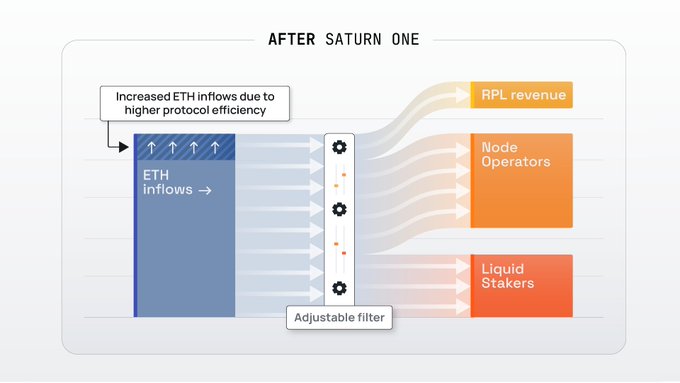
Fee switch coming soon for $RPL! The Saturn upgrade will direct a portion of the protocol’s ETH revenue to staked RPL, in a ratio that can be adjusted by the DAO to be responsive to market conditions Read more about the Saturn upgrade on Medium, link below 👇
Rocket Pool Opens IMC Member Nominations for 2026

Rocket Pool has launched its annual nomination process for the Incentives Management Committee (IMC). The IMC plays a crucial role in the protocol by managing rETH liquidity and overseeing Layer 2 strategy. **Key Details:** - Node operators with voting power can participate in selecting seven committee members - The IMC is responsible for maintaining deep liquidity for rETH - This is part of the protocol's DAO governance structure The nomination and voting process allows community members to shape the protocol's incentive management for the coming year.
Smart Node v1.20.5 Released with Priority Updates for Lighthouse and Nimbus Users
The Rocket Pool development team has released **Smart Node v1.20.5**, marking a new update for the decentralized Ethereum staking protocol. **Priority Levels:** - **High priority** for Lighthouse users - **Medium priority** for Nimbus users - **Low priority** for all other node operators Node operators should assess their client configuration and upgrade accordingly. Full changelog and technical details are available on GitHub.
Rocket Pool's rETH Expands DeFi Utility with New Morpho Lending Market

**New Lending Market Launch** Rocket Pool's rETH token can now be used as collateral on Morpho's lending protocol. Users can supply rETH and borrow ETH through KPK ETH Prime, a low-risk lending vault curated by KPK. **Key Details** - rETH/ETH market now live on Morpho - Enables borrowing ETH against rETH collateral - Deployed via KPK ETH Prime vault - Adds to growing DeFi integrations for Ethereum's decentralized liquid staking token This follows the recent launch of an rETH/USDC market in April, expanding lending options for rETH holders across multiple asset pairs.
Rocket Pool's Saturn 2 Upgrade Surpasses $135M in Staked ETH
Rocket Pool's Saturn 2 upgrade has attracted over $135 million worth of ETH in staked assets, supporting more than 1,500 trustless Ethereum node operators. **Key Highlights:** - Users minting rETH directly contribute to Ethereum's decentralization by supporting independent node operators - The protocol maintains its position as a leader in decentralized liquid staking - This represents significant growth from the $30M deposit pool reported in February 2026 Rocket Pool's approach allows users to stake ETH while maintaining liquidity through rETH tokens, all while supporting Ethereum's core principle of decentralization through a distributed network of node operators.
Rocket Pool Explores Trustless Mechanism to Exit Underperforming Validators
Rocket Pool is researching a trustless onchain mechanism to automatically exit validators that consistently underperform. The initiative aims to protect rETH yield for token holders. **Key Points:** - Mechanism would operate trustlessly onchain without manual intervention - Targets persistently underperforming validators - Designed to safeguard rETH staking rewards The proposal is currently in the research phase, with community discussion open on the DAO governance forum.