💰 Reverse Lending
💰 Reverse Lending
💰 Getting paid to borrow


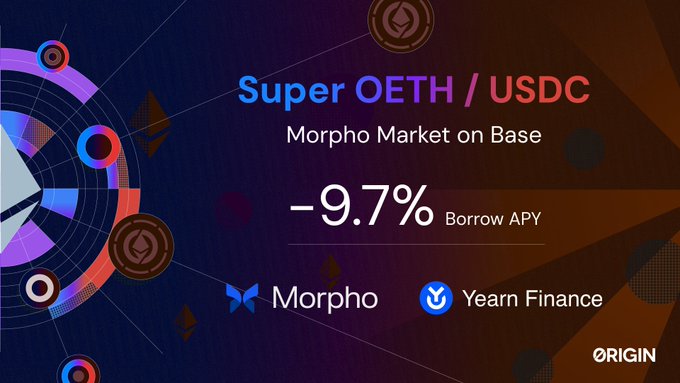
Morpho's Borrow Booster markets are offering negative interest rates on USDC loans across Base and Ethereum networks.
Key Features:
- Borrowers earn ~9.7% APY while taking USDC loans
- Available on both Base (Super OETH market) and Ethereum (OETH market)
- Auto-deleverage feature provides automatic risk management
- Higher LTV loops generate more rewards
How It Works: The markets use yield generated by OETH and Super OETH tokens to subsidize borrowing costs, effectively paying users to borrow rather than charging them.
Risk Management: Auto-deleverage handles risk trims automatically, allowing users to maintain higher loan-to-value ratios while reducing liquidation pressure.
Both markets are accessible through Morpho's platform with competitive LTV ratios - 86% on Ethereum and 77% on Base.

Auto-deleverage is available on @Morpho for Borrow Booster markets. 🛡️ OETH/USDC and superOETHb/USDC both support auto-deleverage, giving you more confidence to size up your loop. Cheaper borrow rates, now paired with automatic risk controls 🧵 (1/2)

Get paid to borrow $USDC on Morpho, available via our Borrow Booster markets on Base and Ethereum Mainnet. Base Super OETH market: app.morpho.org/base/market/0x… Ethereum OETH market: app.morpho.org/ethereum/marke…
Borrow Booster Markets use the yield generated by OETH and Super OETH to subsidize borrow costs. Right now, borrowers are effectively getting paid to take $USDC loans, with higher LTV loops earning more rewards. With auto-deleverage handling risk trims, you can push LTVs while
Origin Pauses eETH ARM After Bug Bounty Report
Origin has temporarily paused its eETH ARM following a bug bounty report that identified an unexpected interaction between the ARM's withdrawal accounting and a recent upgrade to Ether.fi's withdrawal contract. **Key Details:** - No exploitation occurred and no user funds were impacted or lost - The ARM will continue earning lending yield through Morpho during the pause - Arbitrage yield from eETH is temporarily unavailable - Origin added Merkl incentives targeting 3%-3.5% APY to support liquidity providers - Expected pause duration is approximately seven days **What This Means:** - LPs do not need to take any action at this time - The stETH and sUSDe ARMs remain unaffected and operational - Origin plans to migrate users to a new multi-asset WETH ARM - More information about the new ARM will be shared next week Users should wait for official instructions before taking any action. Technical details will be published after remediation is complete.
Origin Sonic and OS ARM Shutting Down After Governance Vote

Origin Sonic (OS) and the OS ARM are officially winding down following a passed governance vote. **Key Details:** - The vault is fully funded and ready to process all withdrawals - Users can claim their S tokens after a protocol-enforced 10-minute delay - Withdrawal support through the Origin Dapp ends on **September 26th, 2026** - OS and OS ARM have stopped earning yield Users should withdraw their funds through [app.originprotocol.com](http://app.originprotocol.com) before the September deadline.
Harvest Finance Launches One-Click Autocompounder for frxUSD/OUSD Curve Pool
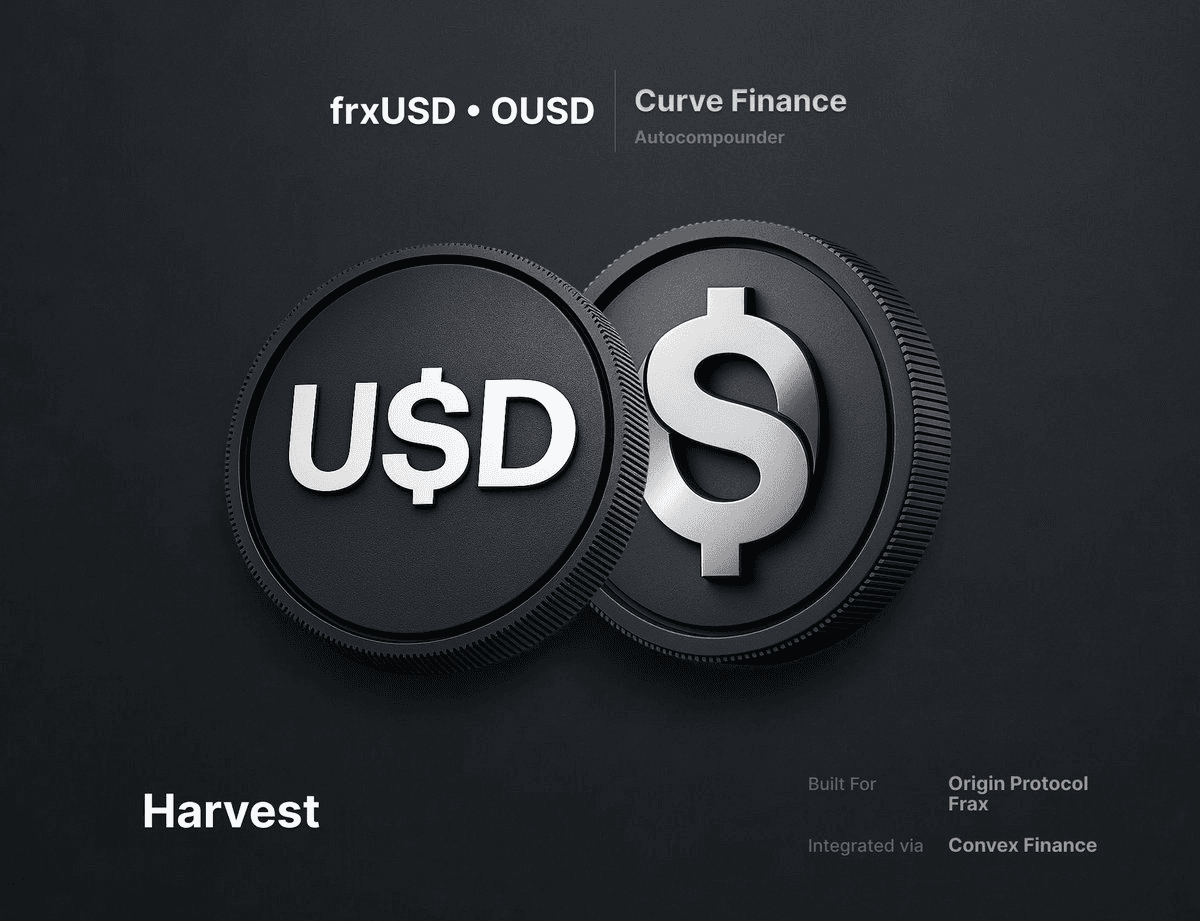
Harvest Finance has introduced a simplified farming solution for the frxUSD/OUSD Curve pool, enabling users to swap directly from assets like USDC and ETH into the pool in a single transaction. **Key Features:** - One-transaction farming from multiple asset types - Automated compounding functionality - Current yield: 7.48% APY **What This Means:** The new autocompounder removes technical barriers for liquidity providers by consolidating multiple steps into one action. Users can now participate in Curve pool farming without manually managing swaps or reinvesting rewards. The frxUSD/OUSD pool pairs two stablecoins, offering a relatively stable farming opportunity compared to volatile asset pairs.
Origin Protocol's eETH ARM Routes Idle Capital to Morpho for Continuous Yield Generation
Origin Protocol's eETH Automated Redemption Manager (ARM) integrates Morpho lending to maintain yield generation during periods without arbitrage opportunities. **Key Performance Metrics:** - 5.7% APY achieved over the past 30 days - Outperforms standard eETH staking (~3% APY) - Built on 2-year proven technology from stETH ARM ($2B+ volume processed) **How It Works:** - Primary strategy: Arbitrages eETH price differences between AMMs and Ether.fi withdrawal queue - When eETH trades below peg, ARM buys discounted eETH and redeems 1:1 for profit - During low arbitrage periods, capital automatically routes to Morpho for lending yields - Provides continuous buy pressure to stabilize eETH peg **Security & Track Record:** - Audited by OpenZeppelin and yAudit - stETH ARM has operated successfully for 2 years - Trusted by Lido Grants, Summer.fi, and Yield - Achieved 30%+ daily APY during peak volatility periods The dual-strategy approach ensures capital remains productive regardless of market conditions. [Explore eETH ARM](http://app.originprotocol.com/#/arm/1:ARM-WETH-eETH)
**Pendle Launches First stETH Volatility Trading Market via ARM Integration**
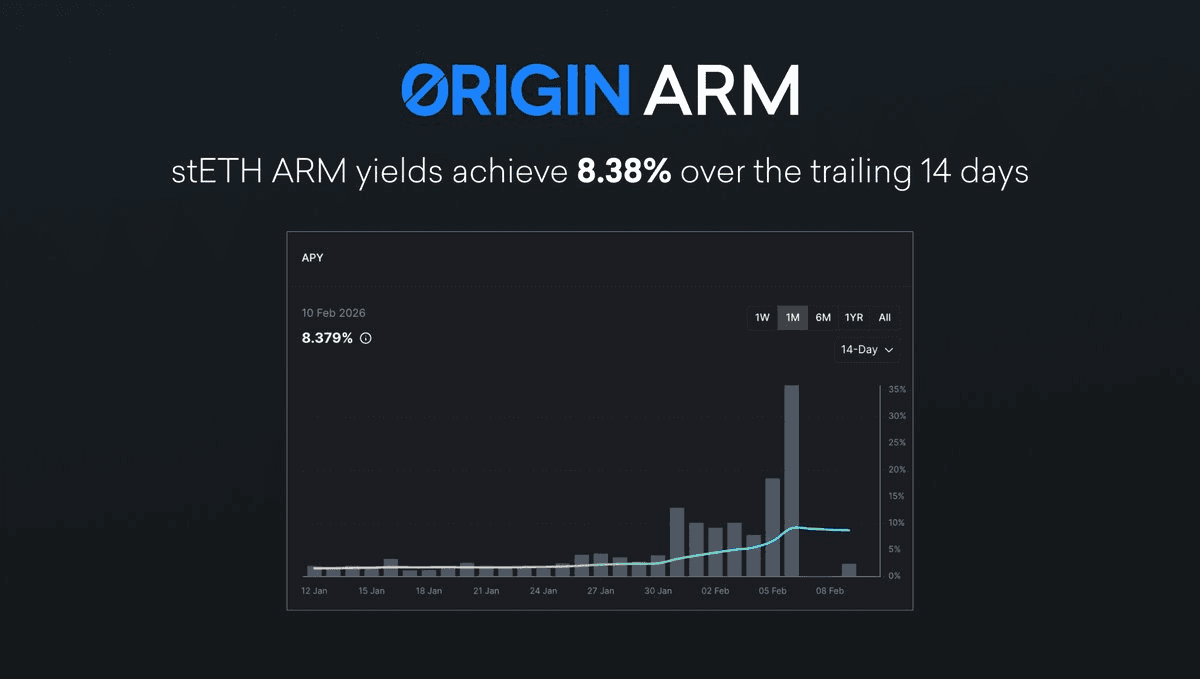
**Pendle introduces liquid yield trading for stETH volatility** through ARM (Automated Risk Management) integration. **How ARM generates yield:** - Buys stETH at discount during volatility - Redeems back to ETH at 1:1 ratio via Lido - Captures spread as profit for depositors **Pendle splits ARM yield into tradeable tokens:** - **PT (Principal Tokens):** Steady ETH exposure + fixed yield - **YT (Yield Tokens):** Leveraged upside to ARM yields This creates the **first direct way to trade stETH volatility** on Pendle. Higher stETH price swings = more arbitrage opportunities = increased yields for ARM depositors. Traders can now: - Speculate on stETH volatility through YT - Lock in fixed yields from ARM via PT - Provide liquidity to earn trading fees The ARM vault combines Lido stETH arbitrage with lending yield on idle ETH via Morpho, creating a unique yield source tied to protocol-driven arbitrage. [Trade the market](https://app.pendle.finance/trade/markets/0x53f940db819400f226466f5ad330c177a4be6b3c/swap?view=pt&chain=ethereum)