Reminder: Last Day to Unstake stSOL using Lido UI
Reminder: Last Day to Unstake stSOL using Lido UI

On February 4th, unstaking stSOL using the Lido UI will no longer be available. Users are advised to unstake any remaining stSOL before then. Staking will only be available via the CLI after that date.

Reminder: February 4th will be the last day to unstake your stSOL using the Lido UI. After that, staking will only be available via the CLI ⚠️ Please unstake any remaining stSOL before then.
Lido DAO Approves Protocol Upgrades, Awaits Dual Governance Review
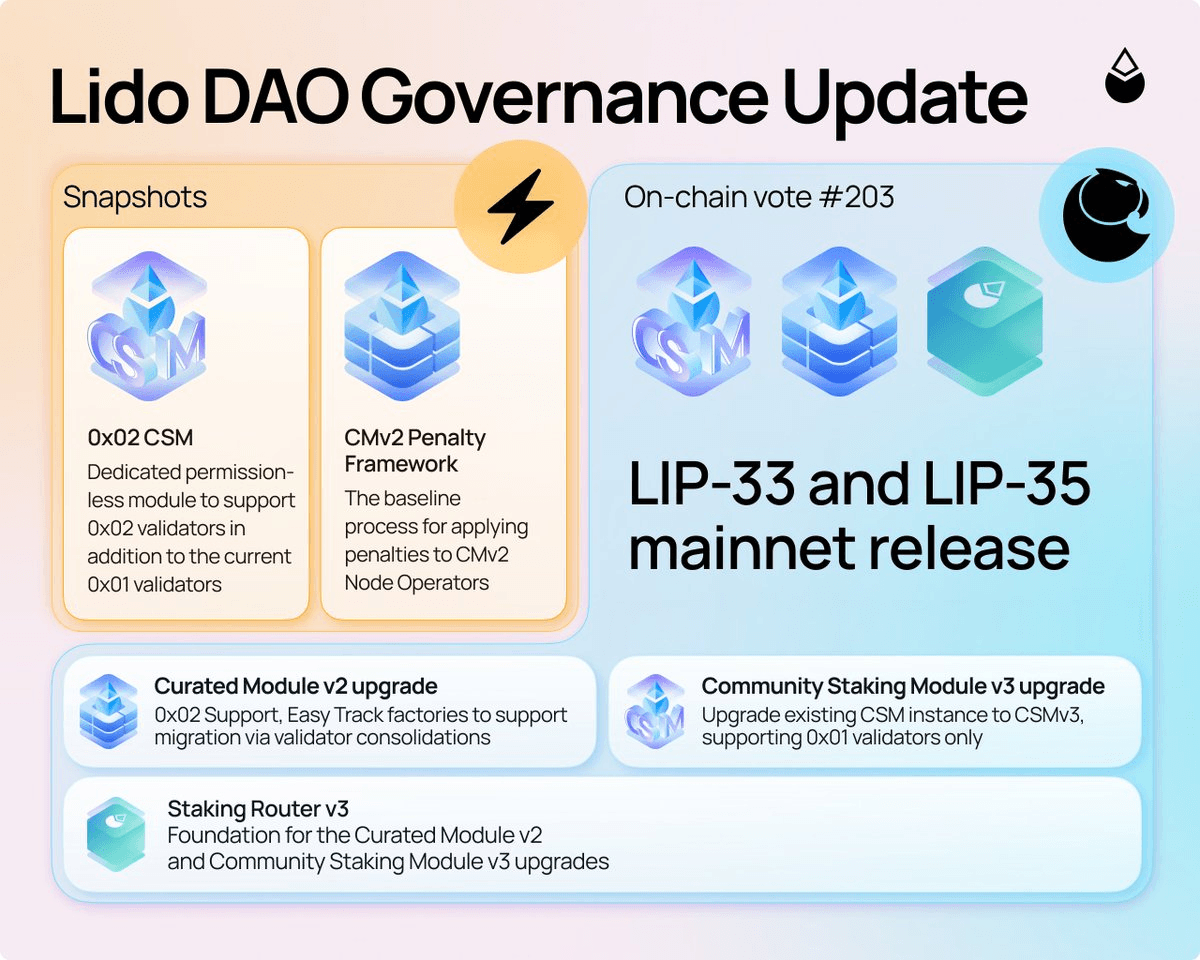
**Lido DAO has approved major protocol upgrades** that will enhance its staking infrastructure. The approved changes include: - Upgrading Community Staking Module (CSM) to v3 - Adding new Curated Module v2 on-chain - Built on Staking Router v3 The proposal is now under **Dual Governance review**. If no veto occurs, the upgrades will be deployed to mainnet. **No action required from stakers** - this is a protocol-level upgrade that will be implemented automatically. The vote passed after a governance window that ran July 15-17. Full details: [dao.lido.fi/vote/203](http://dao.lido.fi/vote/203)
Lido Completes Security Audits for Staking Router v3 and Community Staking Upgrades
Lido has published multiple security audit reports for its upcoming protocol upgrades: **Staking Router v3 & Community Staking V3:** - [Certora audit report](https://github.com/lidofinance/audits/blob/main/Certora%20Staking%20Router%20v3%20Audit%20Report%2007-2026.pdf) - [Statemind audit report](https://github.com/lidofinance/audits/blob/main/Statemind%20Staking%20Router%20v3%20Audit%20Report%2007-2026.pdf) **Easy Track Factories:** - [MixBytes audit report](https://github.com/lidofinance/audits/blob/main/MixBytes%20Lido%20Easy%20Track%20Factories%20(SRv3%20CSMv3%20CMv2)%20Security%20Audit%20Report%2007-2026.pdf) **Off-chain Oracle:** - [Composable Security consultation report](https://github.com/lidofinance/audits/blob/main/Composable%20Security%20Lido%20Oracle%20V8_0_2%20Security%20Consultation%20Report.pdf) Staking Router v3 introduces reallocated stake via consolidations, large validator deposit support, and streamlined validator management for improved protocol efficiency.
Lido Core Upgrade Completes Dual Security Audits
Lido has completed security audits for its Core upgrade, maintaining its standard practice of dual independent reviews. **What was audited:** - Smart contracts - Governance components - Off-chain infrastructure The protocol continues its track record of rigorous security practices, having conducted over 100 audits throughout its history with no user funds lost to date.
Aave Raises Supply Cap to Enable New Strategy
Aave has increased its supply cap to support a new strategy implementation. **Key Changes:** - Higher deposit limits now available for users - Additional allocation space created for new positions - Cap adjustment follows previous capacity increases in April This expansion continues Aave's pattern of gradually scaling supply and borrow limits as demand grows. Users can now deploy larger positions within the protocol's updated parameters.
EarnUSD Launches PT-srUSDe Loop Strategy with Fixed Yields

EarnUSD has introduced a new strategy allocation featuring PT-srUSDe loops. The approach combines: - Fixed-yield principal tokens (PT) on Strata Markets' senior sUSDe tranche (srUSDe) - Looping mechanism on Aave with boosted leverage through Twyne - Powered by Pendle Finance infrastructure The strategy offers a fixed rate return with first-loss capital protection underneath. This builds on previous integrations where PT srUSDe gained support for 1-transaction looping, unwinding, and position optimization on DeFi Saver.