Ready with ion propulsion, rebalancing update on the largest stable farm on dHEDGE
Ready with ion propulsion, rebalancing update on the largest stable farm on dHEDGE
🚀 Ion-powered farms incoming

Stability DAO's April Development Report
- Ion propulsion system ready for implementation
- Rebalancing update for dHEDGE's largest stable farm
- Enhancements to improve user experience on the Stability platform
Key improvements:
- Upgraded stability mechanisms
- Enhanced farm efficiency
- Improved user interface
These updates aim to optimize performance and provide a smoother experience for users of the Stability DAO ecosystem. Stay tuned for more details on how these changes will impact your investments and farming strategies.

Ready with ion propulsion, rebalancing update on the largest stable farm on dHEDGE.

Rebalancing update on $USDy Optimism. 17% of funds are now allocated in sUSD, and 17% in LUSD, both sufficiently stable and decentralized stables earning 14% and 9% respectively in their pair with USDC. The remaining 65% of the vault is in USDC earning.

dHEDGE Products Face Liquidity Constraints Amid rsETH Incident and Aave Freezes
**Ongoing Situation** Several dHEDGE products that utilize Aave are experiencing liquidity constraints due to an rsETH incident. The platform is actively monitoring developments. **Current Status** - rsETH on Ethereum mainnet appears fully backed according to analysis - rsETH remains frozen across Aave V3 and V4 as a precautionary measure - WETH reserves are frozen on multiple networks: Ethereum, Arbitrum, Base, Mantle, and Linea - Exposure to the incident has been capped **Next Steps** Aave is validating information and working on potential resolutions. dHEDGE will provide updates as the situation develops and more information becomes available.
dHEDGE Vault Security: Whitelist Protection Against Front-End Attacks
**dHEDGE vaults implement contract whitelisting to protect against front-end attacks** Following the CoWSwap incident, dHEDGE highlighted its security approach: - Vaults only execute transactions to pre-approved, whitelisted contracts - Protection works regardless of which front-end interface users access - Malicious contracts are automatically rejected at the smart contract level This comes as on-chain attacks continue to exploit vulnerabilities. Recent incidents include: - DRLVaultV3 attack on Ethereum (~$100K USDC) due to missing slippage protection - RWB flash loan exploit on BSC (~$180K) using price manipulation Forta Firewall flagged both exploits in real-time. Security basics remain critical: use slippage protection, verify contracts, and implement pre-execution screening. **Key takeaway:** Contract-level whitelisting adds a crucial security layer that protects users even if a front-end is compromised.
SEC Clears DeFi Front-Ends from Broker-Dealer Registration
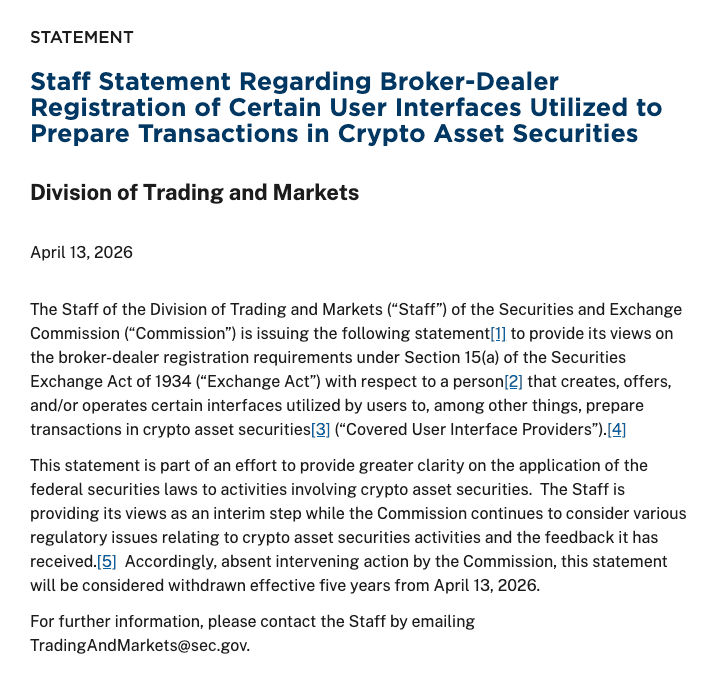
The SEC released a staff statement clarifying that DeFi user interfaces may not need to register as broker-dealers, marking a significant regulatory shift for decentralized finance. **Key Requirements for Exemption:** - No investment advice or recommendations - No order matching or custody of user funds - Fixed fee structures only - Clear disclosure of risks and conflicts of interest **What This Means:** Users can now connect self-custody wallets to DeFi front-ends and execute trades directly on-chain without intermediaries. The guidance applies to DEX interfaces, wallet applications, and browser extensions that maintain a neutral, hands-off approach. This regulatory clarity provides DeFi builders with more certainty and room for growth while maintaining user autonomy and protocol transparency.
Bitcoin 2x and 3x Protected Leverage Tokens Now Available on dHEDGE
dHEDGE now offers Bitcoin 2x and 3x protected leverage tokens through Toros Finance. **What are Protected Leverage Tokens?** - Leverage tokens that include downside protection mechanisms - Available in 2x and 3x Bitcoin exposure variants - Designed to safeguard positions during market downturns **Key Features:** - Accessible through dHEDGE's on-chain investment platform - Built-in protection helps limit losses in volatile conditions - Transparent performance tracking available These tokens provide leveraged Bitcoin exposure while incorporating risk management features that activate during price declines. [Learn more about protected leverage tokens](https://dhedge.org)
dHEDGE Integrates KyberSwap for Enhanced Vault Manager Trading
**dHEDGE has integrated KyberNetwork's KyberSwap** to provide vault managers with optimized swap rates. The integration is **now live**, giving dHEDGE vault managers access to KyberSwap's liquidity aggregation for better trading execution. - Vault managers can now leverage KyberSwap's routing for improved swap rates - Integration enhances the trading capabilities within dHEDGE's on-chain investment platform - This follows dHEDGE's mainnet launch earlier this year The partnership aims to **optimize trading efficiency** for investment strategies managed through dHEDGE's platform.