Polygon Ships Major Upgrades: $1M Gas Subsidy, Agent CLI, and Record Stablecoin Growth
Polygon Ships Major Upgrades: $1M Gas Subsidy, Agent CLI, and Record Stablecoin Growth
🚀 Agents transact free

Lisovo Upgrade Goes Live
Polygon's Lisovo hardfork activated on March 4, introducing:
- $1M in subsidized gas for agent-to-agent payments (PIP-82)
- Enhanced passkey wallet support
- Improved smart contract compatibility
New Developer Tools
The Polygon Agent CLI launched, offering developers a complete toolkit for building onchain agents with wallets, payments, swaps, bridging, and x402 support integrated.
Stablecoin Momentum
- Stablecoin supply reached $3.28B (all-time high)
- Paxos processed $1B+ in volume across 82,000+ transactions
- Brazil's largest FX bank launched BBRL stablecoin on Polygon
- Trust Wallet added cash-to-crypto at 15,000+ U.S. locations via Coinme
Performance Milestone
Polygon achieved a new throughput record, surpassing Base according to growthepie.eth data. Multiple upgrades throughout the year contributed to incremental speed improvements.
The developments demonstrate Polygon's focus on payments infrastructure, with real money movement replacing speculation as businesses migrate from legacy financial rails to onchain settlement.

In practice: one Polygon wallet can fund compliant payroll across 100+ countries. paying thousands of employees in just seconds. Instant. Global. Onchain money movement so businesses can scale without friction. That’s how payroll moves on Polygon.
+36.4% YoY onchain activity. @coca_wallet is making stablecoins spendable anywhere Visa is accepted, powered by Polygon's fast, low-cost settlement. When you’re building for everyday onchain payments, choose Polygon.

A few interesting data points from the last 12 months of COCA user activity on Polygon 👇 📈 +36.4% YoY in on-chain activity (card top-ups, swaps, in-network purchases, and wallet deposits) 💳 Top feature: Card Top-Up 🪙 Top stablecoin for top-ups: $USDT Big shoutout to

Polygon has joined the Enterprise Ethereum Alliance. With the Open Money Stack, we're building the global payment rails for institutions, enabling instant and reliable money movement between traditional systems and onchain rails. Joining @EntEthAlliance, alongside @Nethermind +


🚨 @0xPolygon, @Nethermind, and @ethena just joined the Enterprise Ethereum Alliance 🚨 Here's what they each bring to the ecosystem 🧵

🟪 Enterprise-ready rails 🟪 Predictable, low fees 🟪 Always-on performance 🟪 Deep liquidity 🟪 Built-in distribution And that's why Polygon is the go-to blockchain for global payments.
Polygon is built for agentic payments Low fees and a scalable environment have already made it the leading chain for x402 payments, with autonomous agents moving real money in production. You can see it live today: @OpenClaw agents interacting with Polymarket positions

Free transactions for agents. $1M in rebates on the table. Zero excuses not to build. The future of agentic commerce just got a whole lot cheaper to build.
DeFi gives local stablecoins somewhere to go. JPYC lending markets and a curator-managed JPYC vault are live on @Morpho, launched in collaboration with @SteakhouseFi and @PAOTECHLabs. The integration expands access to risk-managed yen markets and establishing JPYC as a

Paxos has moved over $1.3B in stablecoins on Polygon. Most card networks charge merchants up to 3.5% per transaction. Paxos processed this across 82,000+ transactions for under $700 in gas fees. That's a 99.998% cost reduction. Polygon is a payments chain. Paxos is the proof.

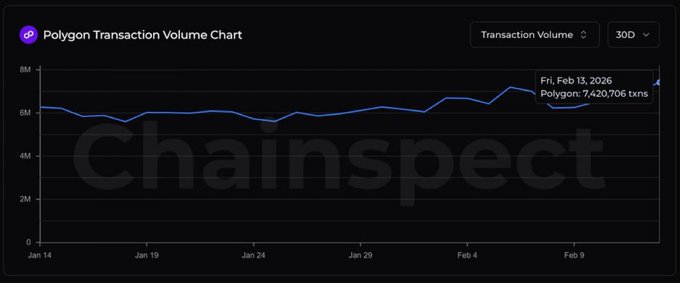
This is what an enterprise-ready chain looks like in motion. Nearly 7.5M transactions processed in a single day. Polygon is proven at scale.
This is what a real payments chain looks like. $3.28B in stablecoins on Polygon. Another all-time high. Actual money, actually moving, on infrastructure built specifically for it. Higher.

With a payments platform designed for real-world use, Paxos is bringing real volume to everyday stablecoin use. More: polygon.technology/blog/stablecoi…

We're fundamentally changing how the world interacts with money. Open. Interoperable. Global. Onchain. Polygon will be the payments solution for all payments solutions.

The Neo Finance Market Map: An ecosystem map of the 100+ projects building the new financial system.

The stablecoin story is usually told in dollars. But Asia doesn't run on dollars. The most interesting activity right now is in local currencies, built on rails that makes domestic settlement cheaper + faster than anything legacy rails offered. Take Japan’s JPYC for example 🇯🇵
JPYC powers merchant payments across Japan. Polygon is built for payments.


デジタル資産 ステーブルコインで代金支払い 都内で実証実験 news.web.nhk/newsweb/na/na-… #nhk_news
We’re building the global financial rails for institutions. More on why Polygon is joining @EntEthAlliance
Zooming out, we've recognized that institutional Ethereum isn’t about “L2s vs L1s” anymore. Simply because institutional Ethereum requires more than scaling blocks, it requires infra that can actually move money. Who's actually building the rails that move money? A deeper look

JPYC is spendable for everyday purchases. @MynaWallet + @DigitalGarage have built payment UIs that let you pay with JPYC on Polygon, in stores, today. The user experience looks like any other payment app, while settlement happens onchain. See it in action at a coffee shop in
Interoperability + openness on the Polygon Open Money Stack
On February 11, Polygon hit a new 6-month daily ATH in APAC stablecoin volume, driven by real-world usage. Largely driven by AUDF $21.9M in a single day.

In Japan, Polygon leads the market in $JPYC activity. Processing more volume than all other chains combined. When it comes to real onchain yen usage, Polygon is the go-to rails.

Stablecoins aren’t theoretical. They’re powering real payments, remittances, fintech flows, and local settlement at scale. Polygon is the proven rails for global money movement.
NEW: Agents can transact for free on Polygon. Rebates are live for Polygon x402 facilitator txns, with up to $1,000,000 in gas fees. Straight to your agent's pocket. Buy, sell, and transact 24/7, without paying a single dollar in fees. Polygon is the home of agentic commerce.
You can also @useTria to spend JPYC on Polygon across Japan > Top up a Tria card in JPYC > Convert tokens to JPYC > Or send JPYC directly to a contact One app. Multiple use cases. The conversion and routing just work because the settlement layer is consistent.
#2 for x402 payments. Agentic payments route to where stablecoin transactions are fast, cheap, and predictable. That's why Polygon is one of the most-used rails for internet-native payments by x402 facilitators and agentic commerce.

Stablecoins in APAC are accelerating. And Polygon is powering the majority of it, accounting for 91% of all stablecoin transfer volume in the region 👇

Traditionally, local-currency stablecoin payments meant stitching together wallets, on/off ramps, compliance tooling, and settlement across multiple vendors. Each one a separate integration. Each one a potential failure point. The Open Money Stack packages that into a single
Tweet not found
The embedded tweet could not be found…
150,000,000 Visa merchants around the world now accept stablecoins as payment on Polygon via @oobit. Connecting the payments chain directly to everyday commerce. In-store and online.

Polygon moves billions daily. Now it moves at checkout too. Today we’re officially live 🎉 Oobit on Polygon network is enabling real-world on-chain spending at over 150 million Visa merchants worldwide. ↓ Pay from the wallet you already use on Polygon ↓ Skip the bridging,

Most payments players are strong in one layer. Infrastructure. Wallets. Fiat rails. Very few are building across all. The Open Money Stack does it all: a vertically integrated stack for end-to-end payments capability. @sandeepnailwal on what it takes to move money at scale.

By integrating stablecoin payroll on Polygon, @useToku plugs directly into existing HR and payroll systems, like ADP, Workday, and Gusto, so companies can move onchain without changing workflows or introducing new risk. > Companies fund payroll in stablecoins on Polygon >
PSA: The Polygon chain will be upgraded on March 4 • accelerating agent-to-agent transactions, subsidizing $1M in gas fees • enabling better wallet support and smart contract compatibility

Lisovo Hardfork The Lisovo hardfork will be released on Polygon mainnet before block number 83756500, at approximately 2pm UTC on Mar 4. This update: subsidizes agent-to-agent gas costs for payments (PIP-82), improves smart contract compatibility for the Count Leading Zeros
JPYC is a yen-denominated stablecoin with a real ecosystem behind it: wallets, merchant payments, lending markets, card top-ups. A growing list of partners building genuinely useful things on top of it. Most of it runs on Polygon, processing more $JPYC volume than every other

Onchain payments scale with regulated access points. Coinme is now powering onramps at 15K+ U.S. locations, directly embedded in @TrustWallet. This is the future of payments. And just a preview of what the Polygon Open Money Stack unlocks.

Meet Cash Deposits 💵 Turn your cash → crypto at 15k+ nearby stores across the U.S*, like CVS, Walmart & Casey’s. Live now in the United States* 🇺🇸 Powered by @Coinme. Try in Trust Wallet ‘Fund’ → short.trustwallet.com/cash-deposits
Most stablecoin payment stacks are stitched together from five different vendors. It works. Until volume grows. Or something breaks. Polygon's Open Money Stack connects everything — fiat, wallets, routing, settlement — in one integration. $2.3T has already moved through the
QuickNode now supports x402 payments on Polygon. Agentic payments need rails that are fast, cheap, and final, with stablecoins that move reliably at scale. That’s Polygon: built for agents to move money.

x402 on Quicknode now supports @0xPolygon Agents can access 80+ chains and pay with USDC on Polygon per request.

Lisovo Upgrade is live with big wins for agents + payments → $1M gas subsidy for agent txns → Stable fee adjustments w/o hardforks → Security + wallet improvements → Latest Ethereum security standards Cheaper agents. Smoother payments. No surprises. polygon.technology/blog/polygon-u…
Global payroll is a $50T market still stuck on fiat rails. It’s one of the largest financial flows in the world and one of the most universal use case for digital money, yet remains constrained by legacy infrastructure. On blockchain rails, payroll is simplified. Employers can
The Polygon Open Money Stack is built for one thing: moving money onchain at global scale. Payments, stablecoins, wallets, on/off ramps, tokenization, and compliance all integrated into one modular stack. Built for real-world finance with fast settlement, low costs, and global

A major catalyst: Aussie stablecoin, $AUDF Demand for regionally native stablecoins is rising, and Polygon’s low, predictable fees + fast finality make it the default settlement layer.
A lot happened in the last 4 weeks. Here's what shipped. 🟪 Lisovo Upgrade on Polygon Mainnet The Lisovo hardfork went live on March 4, bringing $1M in subsidized gas for agent-to-agent payments (PIP-82), better passkey wallet support, and improved smart contract compatibility.
Polygon Launches Comprehensive Developer Kit for Autonomous Agent Economy
Polygon has released the **Agent CLI**, a complete development toolkit designed specifically for autonomous agents operating onchain. **Key Features:** - Session-scoped smart contract wallets with spending caps, contract whitelists, and 24-hour expiry - Token management and transfers across multiple chains - Built-in token swapping via Trails by Polygon with automatic routing - Cross-chain bridging functionality into Polygon - **ERC-8004** standard for onchain identity and reputation - One-command agent registration that issues verifiable identity NFTs - Agent discoverability and reputation tracking from interactions The toolkit integrates with Claude and Openclaw and can be installed via npm. It consolidates wallets, payments, swaps, bridging, and verifiable identity into a single package, eliminating the need for agents to piece together multiple services. This release establishes infrastructure for agent-to-agent commerce on Polygon, providing the foundational layer for autonomous economic activity onchain. Install: `npm install -g @polygonlabs/agent-cli`
Enterprises Choose Polygon for Cross-Border Payments to Cut Costs and Time
Traditional wire transfers to Latin America are expensive and slow, costing $150-500 in fees for a $10,000 transfer and taking up to 4 days to arrive. **Why enterprises are switching to stablecoins:** - Significantly lower transaction costs - Near-instant settlement times - Greater transparency and reliability - Polygon emerging as the preferred infrastructure Most emerging-market stablecoin transfers already run on Polygon's network, which offers faster processing than the 5+ business days typical of traditional banking systems. The shift represents a practical solution to real problems in cross-border payments, particularly for the Latin America corridor where traditional banking infrastructure has been costly and inefficient. [Read the full analysis](https://polygon.technology/blog/latam-corridor-economics-why-enterprises-are-betting-on-stablecoins-for-cross-border-payments)
Polygon Launches Agentic Payments Documentation and CLI Tools

Polygon has released official documentation for its new **Agentic Payments** system, making the tools available for developers to start building immediately. The documentation covers the **Polygon Agent CLI**, a command-line interface designed to facilitate payment services within the Polygon ecosystem. Developers can now access comprehensive guides and technical specifications to integrate these payment capabilities into their applications. This release represents Polygon's continued expansion of its payment infrastructure, providing developers with the resources needed to implement automated payment solutions. [Access the documentation](https://docs.polygon.technology/payment-services/agentic-payments/polygon-agent-cli/)
Default Dry Runs: A Safety Layer for Autonomous Transactions
A new transaction model makes every operation a dry run by default, allowing users to preview outcomes before broadcasting. **Key features:** - Transactions preview their effects before execution - Designed for agentic systems operating at scale - Maintains human oversight in automated decision-making This approach addresses a growing challenge: as autonomous agents execute transactions at machine speed, traditional one-time verification methods fall short. The dry-run-first model creates a continuous accountability layer. **Why it matters:** In distributed control environments where agents make rapid decisions, this safety mechanism ensures humans retain final authority over what gets broadcast to the network.