New Data Services Coming to The Graph
New Data Services Coming to The Graph


The Graph's New Era roadmap introduces novel ways to access data, including upgrading hosted service subgraphs to The Graph Network. High-volume subgraphs that are not upgraded will be auto-upgraded. The Graph Network benefits from global redundancy and a 99.9% query success rate. The Sunrise of Decentralized Data enables developers to upgrade subgraphs, gives Indexers more query demand, and allows Indexers to serve queries for more blockchain networks. The Sunrise also improves query speed and subgraph updates. Upgrading to The Graph Network provides autonomy for developers and eliminates the need for managing indexing infrastructure.

The Graph’s New Era Roadmap empowers devs to build dapps with ease, focusing on improving UX & Developer Experience 🏗️ These improvements include the Sunrise of Decentralized Data, a 3-phase plan to seamlessly upgrade all hosted service subgraphs to The Graph’s robust &
The Sunrise of Decentralized Data is ushering in a new era of possibility for subgraph developers, brimming with new benefits 🌅 The Sunrise will make waiting for queries a thing of the past. Thanks to upgrade Indexers, the moment you publish your subgraph to The Graph, it’s
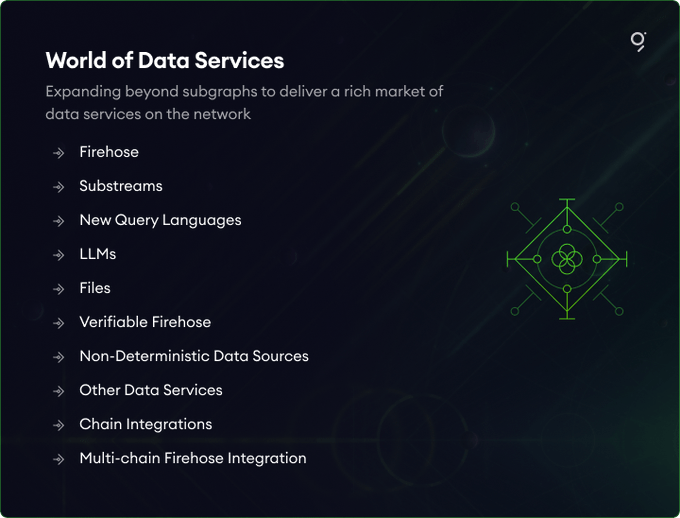
🌐 New data services are coming to The Graph! Reaching beyond subgraphs, the New Era roadmap introduces several novel ways you’ll be able to use The Graph to access the world’s data. What new data service are you most excited to see at The Graph?
As the first light from the Sunrise of Decentralized Data data peeks over the horizon, it ushers in a transformative shift for developers querying subgraphs in The Graph ecosystem 🌅 Hosted service subgraphs are being upgraded to The Graph Network! Developers who query those
🌅 The Sunrise of Decentralized Data is revolutionizing blockchain data. But what does it mean for Indexers? First, the Sunrise enables all hosted service users to upgrade their subgraphs to The Graph Network. As a result, they can begin taking advantage of the superior quality
ICYMI 💡 The upgrade Indexer will empower hosted service users to upgrade their subgraphs to The Graph Network without service interruption ⚡ It’ll serve as a bridge from the hosted service to the network, ensuring that all subgraphs that upgrade to the network can be queried
Stablecoin Compliance Rules Crystallize as MiCA and GENIUS Act Advance
**Regulatory frameworks for stablecoins are now taking concrete shape** as MiCA goes live in Europe and the GENIUS Act progresses in the US. **The emerging compliance standard centers on three requirements:** - Fiat collateralization - Full redeemability - Regular auditing Institutions building data infrastructure to support these compliance requirements are positioning themselves ahead of final rule implementation. Those delaying infrastructure development may face challenges when regulations become enforceable. The regulatory shift follows 2025's GENIUS Act, which brought stablecoins like USDC into the regulated financial system with clear operational guidelines. This has enabled institutions to move beyond pilot programs into production deployments across payments, treasury operations, and capital markets. [Read more about stablecoin compliance infrastructure](https://thegraph.com/blog/stablecoin-compliance-infrastructure-regulatory-readiness/)
🔍 One Query, 40 DeFi Protocols: The Graph's MCP Integration
The Graph Network now enables users to query lending rates across 40+ DeFi protocols simultaneously using natural language through its Graph Lending MCP integration. **How it works:** - Single query like "Where can I find the best stablecoin lending rates?" searches multiple protocols at once - Returns structured, comparable results across dozens of chains - Powered by standardized Subgraph schemas that solve DeFi's data fragmentation problem **The technical breakthrough:** Messari's standardized Subgraphs eliminated the need for 40 different schemas and custom adapters. When combined with MCP (Model Context Protocol), this standardization connects blockchain data directly to AI tools like Claude. Users can now access real-time DeFi lending data without manually checking each protocol or building custom integrations.
🔗 Three Key Web3 Standards Now Live Together on Base
**Three foundational web3 standards are now working together in production on Base:** - **ERC-8004** for identity management - **x402** for micropayments (pay-per-query in USDC) - **Subgraphs** for blockchain data access This marks a significant milestone as these protocols integrate seamlessly. The x402 payment standard, recently added to The Graph's Subgraph Gateways, enables users to pay for individual data queries across dozens of supported networks without requiring traditional API keys. [Learn more about x402 payments](https://thegraph.com/docs/en/subgraphs/guides/x402-payments/)
AI Agents Need Structured Blockchain Data to Function at Scale
**AI agents operate at machine speed**, making thousands of decisions per minute in the crypto economy. Unlike humans who browse block explorers, these agents require **structured, normalized, and queryable blockchain data** to function effectively. - Agents assessing DeFi risk cannot work with raw transaction logs - They need data formatted for rapid querying and decision-making - The infrastructure enabling this agent economy operates behind the scenes This represents a fundamental shift in how blockchain data must be organized and accessed. As AI agents become more prevalent in web3, the demand for **properly structured data infrastructure** will intensify dramatically. The agent economy isn't about human-readable interfaces—it's about machine-optimized data pipelines that can support thousands of automated decisions every minute.
Agent0 Subgraphs Now Live Across Five Mainnets with Unified GraphQL Schema
**Agent0 Subgraphs are now operational across five major blockchain networks** - Base, BNB Chain, Ethereum, Monad, and Polygon - using a single GraphQL schema. **Key features:** - Real-time indexing of every ERC-8004 agent across all chains - No code rewrites needed when switching between networks - Already processed over 1 million queries - Accessible via [Graph Explorer](https://thegraph.com/explorer?search=agent0) **What this enables:** - Developers can query agent data with a single GraphQL request instead of scanning thousands of blocks - AI agents can discover, hire, and interact with each other using structured blockchain data - Machine-scale data access for agents that operate continuously The infrastructure indexes agent identities, capabilities, reputation, and validation data in milliseconds. Developers building ERC-8004 agents can now access comprehensive onchain data without building custom indexers.