mStable Launches mPT-sUSDe: Multi-Protocol Yield Strategy Combining Ethena, Pendle, and Aave
mStable Launches mPT-sUSDe: Multi-Protocol Yield Strategy Combining Ethena, Pendle, and Aave
🔗 Multi-Protocol Yield Stack

mStable has launched mPT-sUSDe, a new yield product that combines multiple DeFi protocols to create leveraged fixed APY returns.
The strategy works in three layers:
- Foundation: Uses Ethena's sUSDe (staked USDe) as the base yield-bearing asset
- Fixed APY: Leverages Pendle's principal tokens to convert variable yields into fixed returns
- Amplification: Utilizes Aave's money markets to add leverage and multiply the fixed APY
How it works:
- USDe is backed by crypto assets and hedged with derivatives
- sUSDe provides the staked version with native yield
- Pendle splits sUSDe into yield tokens (YT) and principal tokens (PT)
- PT tokens start at a discount and mature to $1, creating fixed APY
- Aave's deep Ethereum liquidity enables mStable to manage leverage efficiently
The product is now live and available for deposits at mstable.com, targeting users seeking predictable, amplified yields through this multi-protocol approach.

1/ The wait is over. Efficient APY available now. Leveraging the liquidity of @Ethereum, starting with the APY foundation of @ethena, made powerful with @Pendle_fi’s fixed APY, and multiplied with @Aave. mPT-sUSDe now live on mStable Learn more 👇
🏦 mStable Stacked Yield Diversifies with $1M mAPOLLO Allocation

**mStable Stacked Yield** is allocating **$1 million** to [mAPOLLO](https://twitter.com/ApolloCryptoFM), marking its second major yield source. **Key Details:** - Apollo runs market-neutral stablecoin strategies across multiple chains and venues - [Midas RWA](https://twitter.com/MidasRWA) packages these strategies into a vault-compatible token - The allocation will complement the existing Ethena loop strategy **What This Means:** The vault is diversifying its yield generation beyond a single source, potentially reducing risk while maintaining stable returns. Market-neutral strategies aim to profit regardless of market direction by balancing long and short positions. This follows mStable's previous integration with Apyx Finance, continuing the protocol's strategy of offering users simplified access to multiple yield opportunities through a single token.
🏃 mStable Stacked Yield Delivers 27% Returns While Traditional Dollars Sit Idle
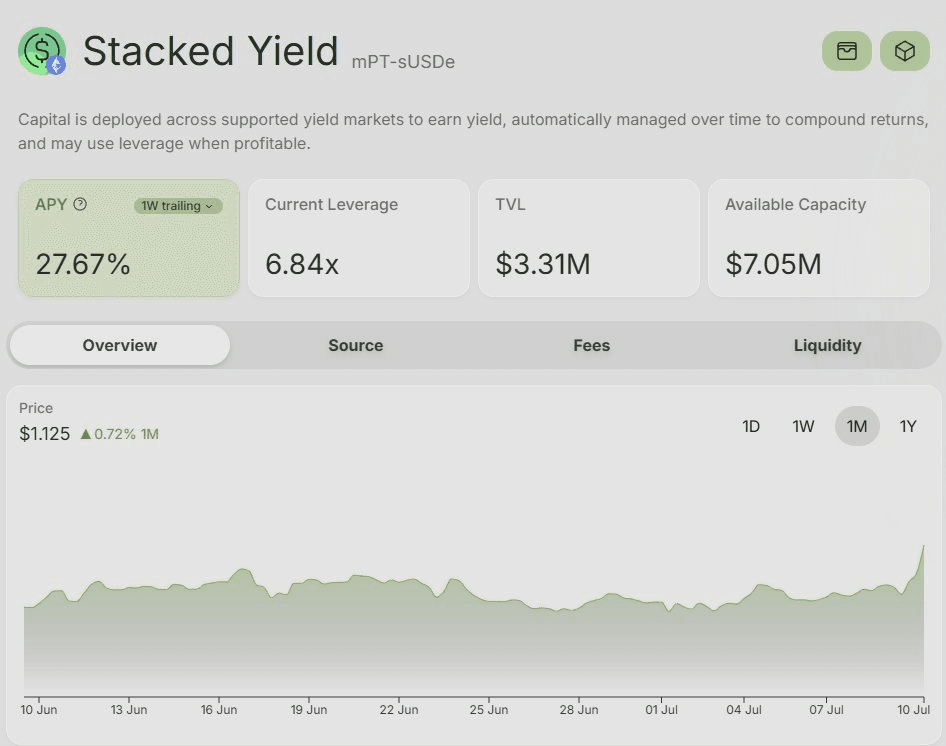
**mStable's Stacked Yield vault generated 27% returns this week** while traditional dollars remained stagnant. **The mechanism:** - Powered by Ethena's USDe - Looped through Aave lending protocol - Capacity currently available for new deposits **Market context:** - $316B in stablecoins exist across the market - Most stablecoins earn zero yield - mStable offers 0% entry fee this week The vault leverages Ethena's synthetic dollar (USDe) through Aave's lending markets to generate yield. This approach allows dollar-pegged assets to earn returns rather than sitting idle in wallets. [Learn more about mStable](https://mstable.org)
Apyx Brings Preferred-Share Yields Onchain via Strategy and Strive Assets
**Apyx** is bringing yield from preferred-share assets onchain, offering a new return mechanism distinct from perpetual funding rates, lending yields, or staking rewards. **Key Assets:** - Strategy's **STRC** (linked to MicroStrategy's Bitcoin holdings) - Strive's **SATAA** **Market Integration:** - 63.5% of Apyx's TVL flows through Pendle - 42.7% of Saturn's TVL also routes via Pendle - Significant portion of onchain STRC held indirectly through these pools Pendle's yield infrastructure has become a primary venue for STRC's onchain growth, with fixed yield strategies emerging as compelling approaches as real-world asset (RWA) yield tokens scale.
🏦 mStable Stacked Yield Vault Adds Apyx as Second Yield Source
**mStable's Stacked Yield vault is expanding beyond a single yield source.** The vault previously relied solely on Ethena's Liquid Leverage for returns. Now it's integrating [Apyx](https://apyx.fi) as a second yield engine, accessed through apxUSD principal tokens on [Pendle](https://pendle.fi). **Key changes:** - One vault, one token interface remains unchanged - Multiple yield sources now operate under the hood - Apyx brings dividend-backed yields alongside Ethena's leverage strategy - Users maintain simple exposure while the vault manages complexity The vault currently loops USDe through Aave with Merkl rewards, and plans to add a PT position targeting 12%+ returns from a different yield mechanism. **The approach:** Keep the product simple for users while diversifying yield sources behind the scenes.