Monthly Community AMA
Monthly Community AMA


DIA is hosting a monthly Telegram AMA session, happening on the first Tuesday of every month. The next AMA will be held on Tuesday, December 5th in the DIA #Telegram chat. Participants can submit their questions.

💬 Monthly Community AMA $DIA is hosting a monthly Telegram AMA session, happening the first Tuesday of every month. The next AMA will be held on Tuesday, December 5th in the DIA #Telegram chat. ✍️ Submit your questions: bit.ly/3TzWDPb
DIA Oracle Integrates with Teqoin Layer
DIA has announced a new oracle integration with Teqoin, expanding its network of blockchain data feeds. This integration allows Teqoin to access DIA's decentralized oracle services for reliable price data and other blockchain metrics. **Key Points:** - DIA oracle layer now supports Teqoin network - Integration provides decentralized data feeds for the Teqoin ecosystem - Follows similar integration pattern as previous LitVM oracle deployment The partnership strengthens DIA's position as a cross-chain oracle provider while giving Teqoin developers access to verified, transparent data sources for their applications. [Read the full technical details](https://www.diadata.org/blog/post/dia-oracle-layer-teqoin/)
DIA Deploys Full Oracle Infrastructure on TeQoin L2
DIA has launched its complete pricing infrastructure on TeQoin, a zero-fee Layer 2 network focused on DeFi and real-world assets (RWAs). **Key Deployments:** - Price feeds for standard crypto assets - DIA Value for RWA pricing - Proof of Reserve verification - Verifiable randomness functionality This deployment addresses a critical infrastructure gap: TeQoin couldn't list lending markets without reliable collateral pricing. DIA's oracle suite now provides the necessary pricing layer to enable these markets. The infrastructure builds on DIA's existing RWA capabilities, which already support the growing $28B tokenized RWA market with trustless, verifiable pricing solutions.
DIA Value: Intrinsic Valuation Oracle for Institutional DeFi Assets
Market-based oracles were built to bring external price data onchain, but they rely on continuous trading in liquid markets. This model breaks down for institutional DeFi assets like tokenized treasuries, fund NAVs, and yield-bearing tokens. **The core problem:** These assets don't trade frequently enough to generate reliable market prices. Their value exists in smart contracts and reserves, not order books. **DIA's solution:** DIA Value computes intrinsic value from verifiable inputs rather than market prices. This approach provides accurate valuations for assets that don't fit traditional oracle assumptions. The shift represents a fundamental rethinking of how oracles work for institutional DeFi infrastructure.
Upshift Founder Calls Out Crypto Vault Providers for Self-Reported NAV Practices
**Aya Kantor, founder of Upshift, criticized the crypto industry's approach to Net Asset Value (NAV) reporting.** - Most vault providers currently self-report their NAV, which Kantor describes as "pretty insane" - In traditional finance, fund administrators and trading desks must be separate entities - NAV calculation requires independence to maintain integrity **The core issue:** Upshift, which has grown to over $300M, was built on the principle that self-reported NAV is insufficient as traditional finance moves into crypto vaults. **Key takeaway:** As institutional capital enters crypto, the industry must adopt TradFi standards for verification infrastructure. The separation of fund administration from trading operations is non-negotiable for maintaining trust and meeting institutional requirements. This highlights a critical infrastructure gap in DeFi that needs addressing as the space matures.
Particula's PDARP Automates Lending Protocol Risk Management
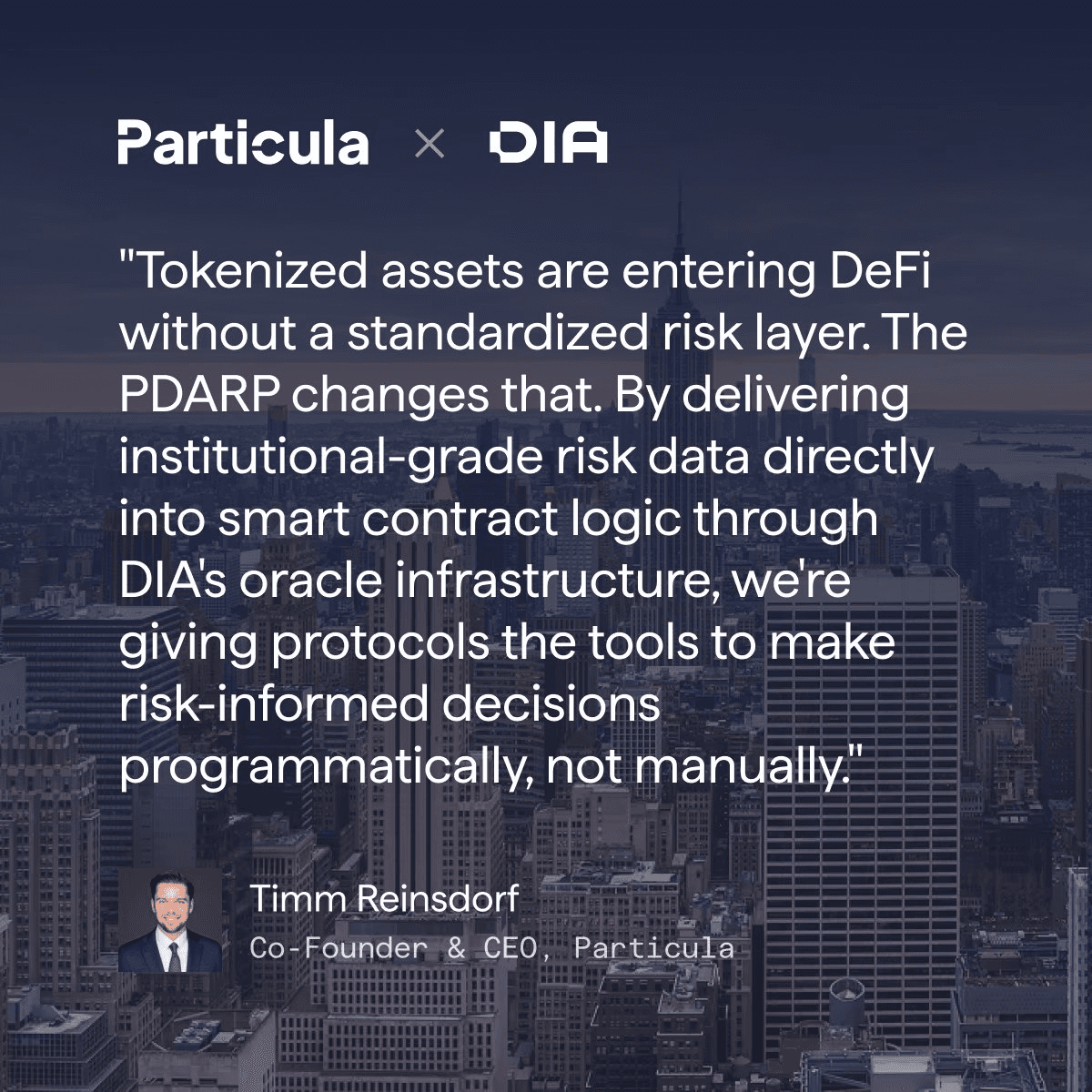
**Automated Risk Management for DeFi Lending** Lending protocols traditionally rely on manual governance votes to set collateral ratios - a slow, reactive process. [Particula's](https://particula.io) PDARP system changes this by making risk decisions continuous and automated. **How PDARP Works:** - Risk scores update in real-time - Reserve verification runs continuously - Pricing signals feed directly into smart contracts - Contracts execute parameter changes automatically without governance delays This shift from manual governance to reactive automation means lending protocols can respond to market conditions instantly. Collateral ratios, vault rebalancing, and asset eligibility now adjust based on live risk data rather than periodic votes. The integration with DIA's oracle infrastructure provides the data layer that makes autonomous risk management possible.