Linea Documentation Update Released
Linea Documentation Update Released
📚 Linea docs refreshed


Linea has published an update to its documentation page. The zkEVM rollup's technical documentation is available at docs.linea.build for developers building on the network.
Key Points:
- Documentation refresh for Linea's developer resources
- Updates available on the official Linea Docs page
- Follows previous documentation updates from earlier this month
Linea continues to maintain its technical documentation for developers working with the zkEVM scaling solution.

Check out the update on the Linea Docs page! docs.linea.build

Just gave Linea Docs a fresh coat of paint. Cleaner design, more readable documentation, same high quality content crafted by our team. You can now view and copy any page as full Markdown. Feeding your favorite agent just got easier. Vibe code on Linea, backed by real

Phylax Security Integration Prevents $1.5M+ in Exploit Attempts
A misconfigured integration created standing approvals that could have drained user funds. Phylax Systems' Credible Layer security integration successfully intercepted the threat. **Key Prevention Metrics:** - $44,653 in confirmed user losses prevented - 4,000 drain attempts blocked - $1.5M+ in cumulative drain volume neutralized **How It Works:** Drain transactions are evaluated and rejected during the block building process, preventing them from ever reaching inclusion on-chain. All protected smart contracts remain untouched and secure. The integration demonstrates how proactive security measures at the sequencer level can identify and stop exploits before execution, rather than responding after damage occurs.
Phylax Systems CEO Discusses Proactive DeFi Security
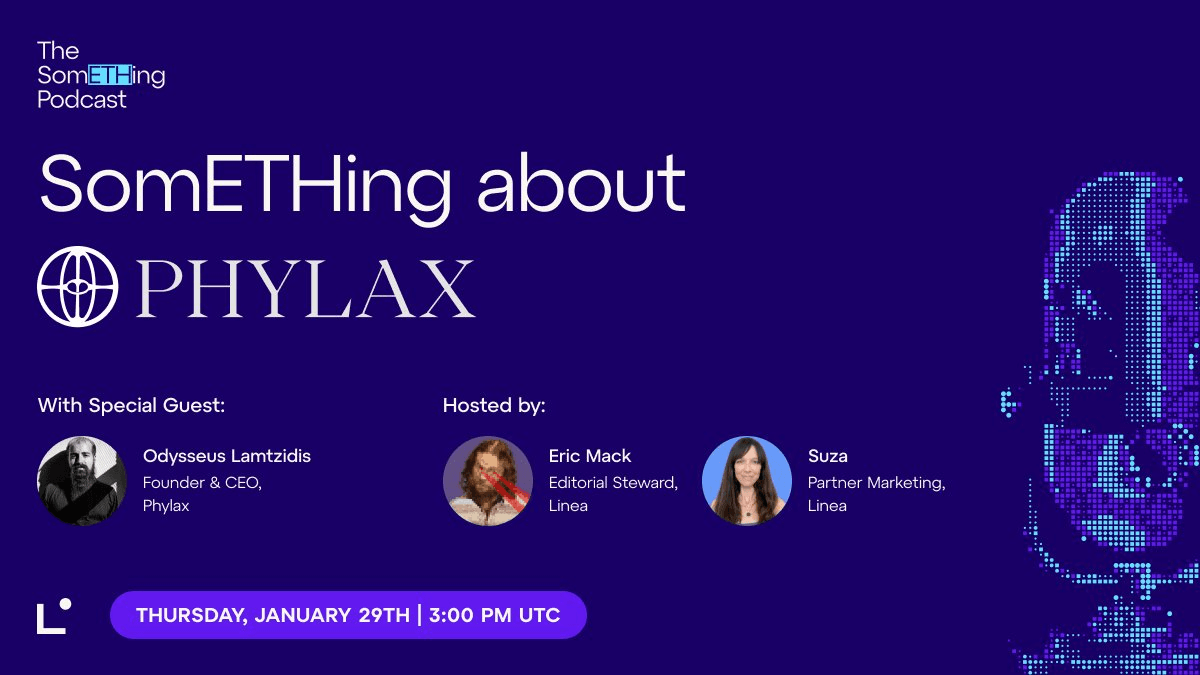
Phylax Systems CEO Odysseas will discuss the evolution from reactive to proactive security approaches in DeFi during an upcoming conversation. **Key Details:** - **Topic:** The Credible Layer and its implications for builders and DeFi security - **Date:** Thursday, January 29th - **Time:** 3:00 PM UTC - **Platform:** X and YouTube - **Hosts:** suzapolooza_eth and EricCMack Several protocols including Euler Finance, Malda, Turtle, and Denaria Finance have already integrated the Credible Layer for protocol protection. Public assertions are available at [app.phylax.systems](http://app.phylax.systems).
🛡️ DeFi protocols adopt Phylax Credible Layer security
**Four DeFi protocols now live with Credible Layer protection** Euler Finance, Malda, Turtle, and Denaria Finance have deployed Phylax's Credible Layer to protect their protocols, with more deployments coming soon. **How it works:** - Protocols define "bad outcomes" through assertions - security rules validated by the sequencer - Invalid transactions are dropped before execution - Valid transactions proceed normally - All assertions are publicly viewable at [app.phylax.systems](http://app.phylax.systems) **The shift from bug hunting to outcome prevention** Traditional security focuses on finding bugs, but some always slip through. The Credible Layer takes a different approach by preventing harmful outcomes rather than searching for vulnerabilities. Linea has integrated this technology into its sequencer, stopping exploits before they execute. This risk reduction enables institutions like SharpLink to deploy more capital into DeFi. The technology aims to make DeFi less risky for mainstream adoption. [Learn more](https://docs.phylax.systems/credible/credible-introduction?utm_source=twitter&utm_medium=social&utm_campaign=cmp-100328643-afbf08)
Linea Introduces Onchain Assertions for Transaction-Level Rule Enforcement
Linea has introduced a new feature allowing developers to write and deploy assertions directly onchain in Solidity. The sequencer enforces these rules against every transaction without requiring third parties or additional trust assumptions. **Key features:** - Assertions written in Solidity and deployed onchain - Sequencer-level enforcement on all transactions - No external dependencies or new trust models - Rules can be modified without touching production contracts This builds on Linea's recent collaboration with [Boundless](https://boundless.xyz) to support The Signal, an open-source ZK consensus client that enables trustless Ethereum state access across rollups.