Lido Becomes Largest Permissionless Ethereum Staking Protocol
Lido Becomes Largest Permissionless Ethereum Staking Protocol
🏆 Lido claims permissionless crown

Lido has achieved a major milestone, becoming the largest permissionless staking protocol on Ethereum with over 565,000 ETH staked through its Community Staking Module (CSM).
Key developments:
- The CSM allows anyone to run validators with less ETH than traditional solo staking
- Share limit increased from 5% to 7.5% of total Lido stake
- Over 500 operators now secure Ethereum through CSM
Lido V3 Launch:
The protocol recently launched V3, introducing modular staking infrastructure and stVaults. Notable features include:
- 0% infrastructure fee until March 31, 2026 for vaults over 250 ETH
- Obol's Ethereum Client Team Vault for multi-operator DVT staking
- Enhanced decentralization and client diversity options
This milestone reinforces Lido's position as a leader in making Ethereum staking more accessible while maintaining security and decentralization.
With Lido V3, Obol leverages tested infrastructure without introducing complex deposit flows, smart contracts or standalone frontends. This lets Lido provide trusted staking infrastructure, while Obol and client teams focus on running decentralized, client-diverse DV clusters.
CSM Share Limit: 7.5% The CSM permissionless share limit has been increased from 5% to 7.5% of total Lido stake, further enhancing the decentralisation of the Lido protocol. Enhanced access, enhanced decentralization.

Obol is launching the Ethereum Client Team Vault - a multi-operator, DVT-powered Vault built on Lido V3 - prioritizing security, Ethereum alignment and risk minimization. ↓

Additionally, existing pooled staking setups do not offer a way to create a curated, operator-specific vault with rewards and responsibilities tied to a defined set of operators. The Ethereum Client Team Vault is the first offering to provide a solution to these limitations.
Lido V3 Mainnet Launch Community Call x.com/i/broadcasts/1…
Obol offers a curated, multi-operator DVT vault that is credibly decentralized by design. Users can stake via the Ethereum Client Team Vault and signal support for the core teams that maintain Ethereum, benefiting from their expertise and alignment with Ethereum.
Operated by @sigp_io, @ChainSafeth, @develpgmbh & @Nethermind, the Ethereum Client Team Vault is designed for ETH-aligned stakers, DAO treasuries, and capital allocators who want to stake in a way that is secure, Ethereum-aligned, and low risk.
Curious how teams are building on Lido V3? Stop by tomorrow to cover all things Lido V3 and to see how early builders are making use of stVaults across their staking operations. 📆 February 3rd, 2pm UTC More info here: luma.com/aimtqioq

The vault launches with a conservative configuration: no leverage, looping or complex DeFi strategies. The result is a secure staking option prioritizing validator performance, operator quality, client diversity and decentralization.
With more than 565,000 ETH staked via the Lido Community Staking Module, Lido is now the largest permissionless staking protocol on Ethereum.

As Ethereum evolves, so does Lido, and upgrades like this are imperative to preserving the long-term security and decentralization of both Lido and Ethereum.
For more information, check out the complete case study here: blog.lido.fi/lido-v3-obol-m…
An upgrade like this, for a protocol of Lido's size, require extensive technical and operational scoping, followed by multi-stage internal and external testing and coordination with Node Operators, researchers, auditors and more. These efforts are, in essence, a
T-1 hour⏱️ Stop by the Lido V3 Mainnet Launch Community Call in 60 min to talk stVaults and to hear how the leading projects in the space are using stVaults to usher in a new paradigm for Ethereum staking. youtube.com/live/RG_N4sT2N… Livestreamed on Twitter & Youtube and more.

Lido V3 is coming. Join Lido contributors and V3 builders on Tuesday, February 3rd, at 2pm UTC to celebrate the launch of Lido V3 and stVaults. Featuring guests from @P2PValidator, @LineaBuild, @Northstake_DK, @PierTwo_com & more. Welcome to the future of Ethereum staking.

Lido V3, initializing… Don’t miss the upcoming stVaults Builders Fireside Chat where we'll cover the most novel staking products built with Lido V3 and stVaults. Featuring @Northstake_dk, @PierTwo_com & @rocksolidHQ. 📆 2pm UTC, February 3rd.

Lido V3: Modular infrastructure for a new paradigm of Ethereum staking. blog.lido.fi/lido-v3-is-liv…
The Community Staking Module (CSM) is a Lido staking module built around permissionless entry, allowing anyone to run validators with less ETH and improved capital efficiency compared to solo staking. To get started, check out lido.fi/csm.

Lido V3 is coming. Join Lido contributors and V3 builders on Tuesday, February 3rd, at 2pm UTC to celebrate the launch of Lido V3 and stVaults. Featuring guests from @P2PValidator, @LineaBuild, @Northstake_DK, @PierTwo_com & more. Welcome to the future of Ethereum staking.
The Ethereum Client Team Vault addresses limitations in pooled staking architectures. Existing setups do not allow users to express client diversity or multi-operator security model preferences.
Due to the length of the Ethereum entry queue, contributors are offering an early adopter campaign. Until March 31st 2026, the stVaults Lido Infrastructure fee will be reduced from 1% to 0%. This promotion applies to identified vaults with a Total Value exceeding 250 ETH.

Ethereum Staking Reaches Historic Milestone at 30% of Total Supply
Ethereum has achieved a significant milestone in network security and decentralization, with **30% of all ETH now staked** - marking an all-time high for the network. This represents continued growth from the 29% staking rate observed in mid-2025, demonstrating sustained confidence in Ethereum's proof-of-stake consensus mechanism. **Key implications:** - Increased network security through greater validator participation - Reduced circulating supply potentially affecting market dynamics - Growing institutional and retail confidence in long-term staking commitments The milestone reflects Ethereum's maturation as a proof-of-stake network since The Merge in 2022, with validators continuing to lock up their ETH to secure the network and earn rewards.
🔐 Obol Launches Ethereum Client Team Vault on Lido V3
Obol has launched the **Ethereum Client Team Vault**, a multi-operator staking solution built on Lido V3 using Distributed Validator Technology (DVT). **Key Features:** - Operated by four Ethereum client teams: Sigma Prime, ChainSafe, Develp, and Nethermind - Conservative configuration with no leverage or complex DeFi strategies - Focuses on validator performance, operator quality, client diversity, and decentralization **What Makes It Different:** - First curated, operator-specific vault with rewards tied to a defined set of operators - Allows users to express preferences for client diversity and multi-operator security - Leverages Lido's trusted infrastructure without complex deposit flows or new smart contracts The vault targets ETH-aligned stakers, DAO treasuries, and capital allocators seeking secure, low-risk staking that supports Ethereum's core development teams. [Read the complete case study](https://blog.lido.fi/lido-v3-obol-multi-operator-distributed-validators-on-lido-stvaults)
Lido V3 Builders Showcase stVaults Innovation
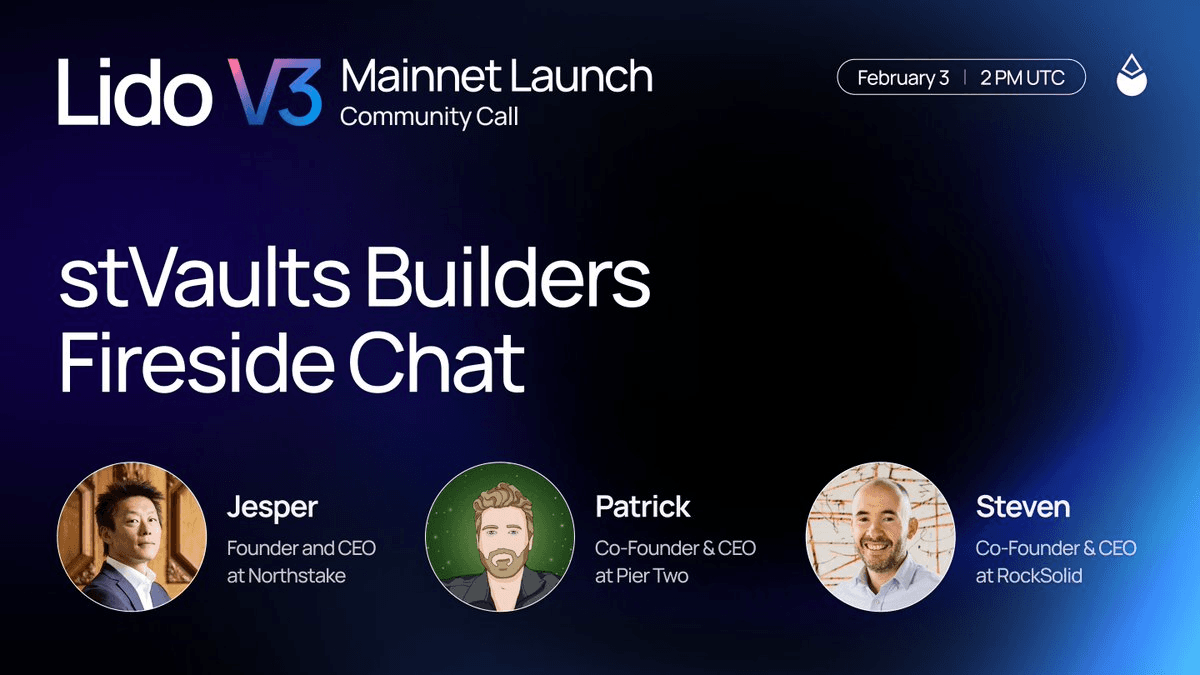
Lido is hosting a **stVaults Builders Fireside Chat** on February 3rd at 2pm UTC to highlight new staking products built with Lido V3. **Featured builders:** - Northstake - PierTwo - RockSolid The session will explore novel staking solutions enabled by the V3 upgrade and stVaults infrastructure. This follows the broader Lido V3 launch celebration scheduled for the same day, which includes additional participants like P2P Validator and Linea. [Join the conversation](https://lido.fi) to learn how builders are leveraging the new staking architecture.
Lido Protocol Undergoes Major Upgrade to Maintain Ethereum Alignment
Lido is implementing a significant protocol upgrade to preserve long-term security and decentralization for both itself and Ethereum. **Key Points:** - The upgrade requires extensive technical scoping and multi-stage testing - Coordination involves Node Operators, researchers, and auditors - These efforts represent a **decentralization premium** - the cost of maintaining a distributed validator set - The upgrade ensures Lido remains adaptive to Ethereum's evolving roadmap The protocol's size demands careful operational planning to maintain its increasingly permissionless validator network while staying aligned with Ethereum's development direction.