Ledger Connect Issue Fixed
Ledger Connect Issue Fixed

The Ledger Connect issue reported yesterday has been fixed. Balancer was not affected and the frontend is safe to use. Users are advised to stay vigilant and exercise caution with their transactions.

UPDATE: The Ledger Connect issue communicated yesterday has now been reported as fixed. Balancer was not affected and the frontend is safe to use. We continue to advise all users to stay vigilant and exercise caution with their transactions. x.com/ledger/status/…

UPDATE: The genuine Ledger Connect Kit 1.1.8 is now fully propagated. Ledger and WalletConnect can confirm that the malicious code was deactivated. You are now safe to use your Ledger Connect Kit. Reminder that that we always encourage clear signing.
WARNING: A potential vulnerability has been detected with Ledger Connect. We advise all users to exercise heightened caution and avoid using the Balancer frontend until further information is available. x.com/bantg/status/1…

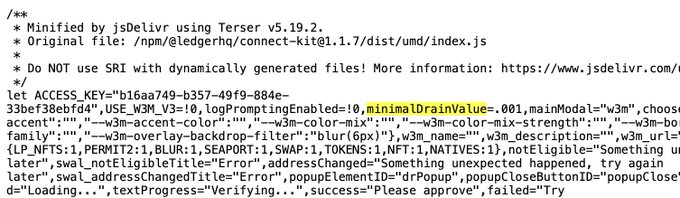
🚨 ledger library confirmed compromised and replaced with a drainer. wait out interacting with any dapps till things become clearer. cdn.jsdelivr.net/npm/@ledgerhq/…
Balancer Votes to Reallocate Unclaimed Rewards and Extend Claim Window
Two governance proposals closed on Balancer: **BIP-922: Unclaimed Rewards Reallocation** - Moves ~364k BAL and ~350k LDO from old liquidity mining contracts - Tokens sat unclaimed in merkle contracts since first program - Funds transferred to BizDev Safe for future use **BIP-923: Extended Claim Window** - Extends deadline for funds rescued from November 3rd V2 incident - Original deadline: August 10th - If passed: Six-month extension granted Both votes were open to BAL holders across all chains and closed August 4th at 6PM UTC. Affected users can check eligibility at [balancer.fi/portfolio](http://balancer.fi/portfolio). [Vote on BIP-922](https://snapshot.org/#/s:balancer.eth/proposal/0xd56aaecd79ed7d00fdb8f25216e73494b2bfe635480d22c1556af422311a1965) | [Vote on BIP-923](https://snapshot.org/#/s:balancer.eth/proposal/0x1486a57ebdc0de5ab6482bf2e7aca9f82d75eff77d97cd8bbfce4bde4f55906a)
Covenant Finance Launches First DEX Position Tranching on Balancer's Monad Pool
Covenant Finance has introduced a novel tranching mechanism for Balancer's AUSD/USDC/USDT0 liquidity pool on Monad, marking the first time they've applied this technology to a DEX position. **Key Innovation:** - The LP position is split into two separate tokens: one representing yield and another for price exposure - Liquidity remains boosted through Neverland Money integration - This builds on Balancer's existing $8M TVL stable pool that already combines swap fees with lending yields **Technical Details:** - The tranching allows investors to choose between yield-focused or exposure-focused strategies - Original pool maintains its triple-yield structure: swap fees + lending returns + liquidity incentives - [View the pool on Balancer](https://balancer.fi/pools/monad/v3/0x2daa146dfb7eaef0038f9f15b2ec1e4de003f72b) This development represents a new primitive in DeFi composability, enabling more granular risk management for liquidity providers.
Balancer Clarifies Outstanding BAL Supply Calculation for Upcoming Buyback Program
Balancer has clarified the calculation for outstanding BAL shares ahead of its planned buyback program. **Key Details:** - Outstanding shares exclude BAL tokens that cannot be bought back - Total supply of 72,697,103 BAL reduced to 64,616,812 outstanding shares - Full calculation methodology available in [forum discussion](https://forum.balancer.fi/t/bip-919-bal-tokenomics-revamp/7001/23) **Buyback Program Context:** The buyback stems from BIP-919, the tokenomics revamp approved in April 2026: - Fixed price: $0.1487 (NAV per share at proposal time) - Funded from DAO treasury, capped at 35% of net assets - Total cap: $3,362,868.55 (~22,615,121 BAL) - Opens April 2027, runs for 12 weeks - All bought-back BAL will be burned This clarification ensures transparency in how the buyback program will calculate eligible tokens when it launches next year.
Balancer DAO Sets BAL Buyback Price at $0.1487 Per Token
The Balancer DAO has finalized its BAL token buyback parameters following the approval of BIP-919 in April. **Key Details:** - **Buyback price:** $0.1487 per BAL token (based on treasury NAV per share at proposal time) - **Funding source:** DAO treasury, capped at 35% of net assets - **Total allocation:** $3,362,868.55 (~22,615,121 BAL maximum) - **Timeline:** Opens April 2027, runs for 12 weeks - **Token treatment:** All purchased BAL will be burned The buyback is part of a broader tokenomics revamp approved earlier this year. The price was determined using the treasury's net asset value per share calculation at the time the original proposal was submitted. This represents a significant treasury deployment aimed at reducing BAL supply through systematic token burns over the three-month window.
Balancer V3 Launches AutoRange Pools for Self-Managing Concentrated Liquidity
Balancer V3 has launched **AutoRange Pools**, a concentrated liquidity solution that automatically adjusts price ranges without manual intervention. **Key features:** - Liquidity providers deposit once; the pool manages range adjustments automatically - No oracle dependency or third-party managers required - Positions are standard ERC-20 tokens (not NFTs), enabling use as collateral and in governance - Range shifts based on the pool's own trading activity when price crosses a threshold - Designed for established pairs with real volume **Target users:** - DAOs and treasuries seeking autonomous liquidity management - Passive LPs wanting concentrated liquidity efficiency without maintenance overhead - Protocols needing oracle-free, composable liquidity primitives The system addresses three core problems with traditional concentrated liquidity: constant range management, NFT fragmentation, and JIT bot attacks. Two audits (Cantina and Certora) were completed before launch. Balancer offers simulations for token pairs before deployment to assess fit. [Learn more]( https://docs.balancer.fi/concepts/explore-available-balancer-pools/autorange-pool/reclamm-pool.html) | [View pools](https://balancer.fi/pools?poolTypes=AUTORANGE)