KUSD Rewards Explained: Real Payment Flows, Not Promises
KUSD Rewards Explained: Real Payment Flows, Not Promises
💰 Where KUSD Rewards Actually Come From


KUSD has clarified how its reward system operates, distinguishing itself from typical crypto yield mechanisms.
How KUSD Generates Rewards:
- Rewards come from actual payment settlement flows, not speculation or token emissions
- Capital backing KUSD is deployed as short-term credit to verified institutions
- Credit is used to settle real transactions, then repaid as cash flows clear and recycled
Key Design Principles:
- Built for resilience across different market cycles
- Backed by verification, rules, and automated defenses rather than speculative promises
- Self-liquidating credit model ensures capital efficiency
The approach represents a shift toward utility-driven stablecoin mechanics grounded in traditional finance settlement processes.
3/ Capital backing KUSD is deployed as short-term, self-liquidating credit to verified institutions. Used to settle transactions → repaid as cash flows clear → recycled again.

How KUSD manages risk: Designed for real-world credit KUSD isn't backed by promises or hope; verification, rules, and automated defenses secure it. Here's how: 🧵

✧ KUSD developments ⍛ KUSD rewards were detailed as being generated from real payment settlement flows, using short-term credit extended to verified institutions - designed to remain resilient across market cycles.

How KUSD generates rewards. Most on-chain rewards depend on markets or incentives. KUSD is different. Rewards are generated when payments settle, not when prices move. Full breakdown in the blog ↓ blogs.kerneldao.com/blog/how-kusd-…
2/ KUSD rewards come from somewhere else entirely: real payment and settlement activity.

January Recap: rsETH Capital Efficiency, Gain Vault Upgrades & KUSD Mechanics
**Key January Developments:** - **rsETH capital efficiency unlocked** - Enhanced liquidity and utility for restaked ETH positions - **Gain vault performance strengthened** - Improved reward mechanisms and optimization strategies - **KUSD mechanics explored** - Groundwork laid for stablecoin integration within the ecosystem These updates focus on building **scalable infrastructure** designed to perform across different market cycles, moving beyond short-term gains toward sustainable growth. More announcements coming soon.
Risk Management Framework Integrates Chainlink Proof of Reserve for Onchain Finance
A comprehensive risk management framework has been introduced featuring several key components for secure onchain operations: - **KYB-verified counterparties** for institutional-grade compliance - **Real-time LTV monitoring** to track collateralization ratios - **Chainlink Proof of Reserve** integration for transparent asset verification - **Automated liquidations** to manage risk exposure - **Insurance-backed vault structures** for additional security layers The framework addresses the growing need for risk infrastructure as financial institutions increasingly tokenize assets like stablecoins, bank deposits, and carbon credits on blockchains.
Kelp Hosts AMA on High Gain DeFi Vault with Embedded Insurance Coverage
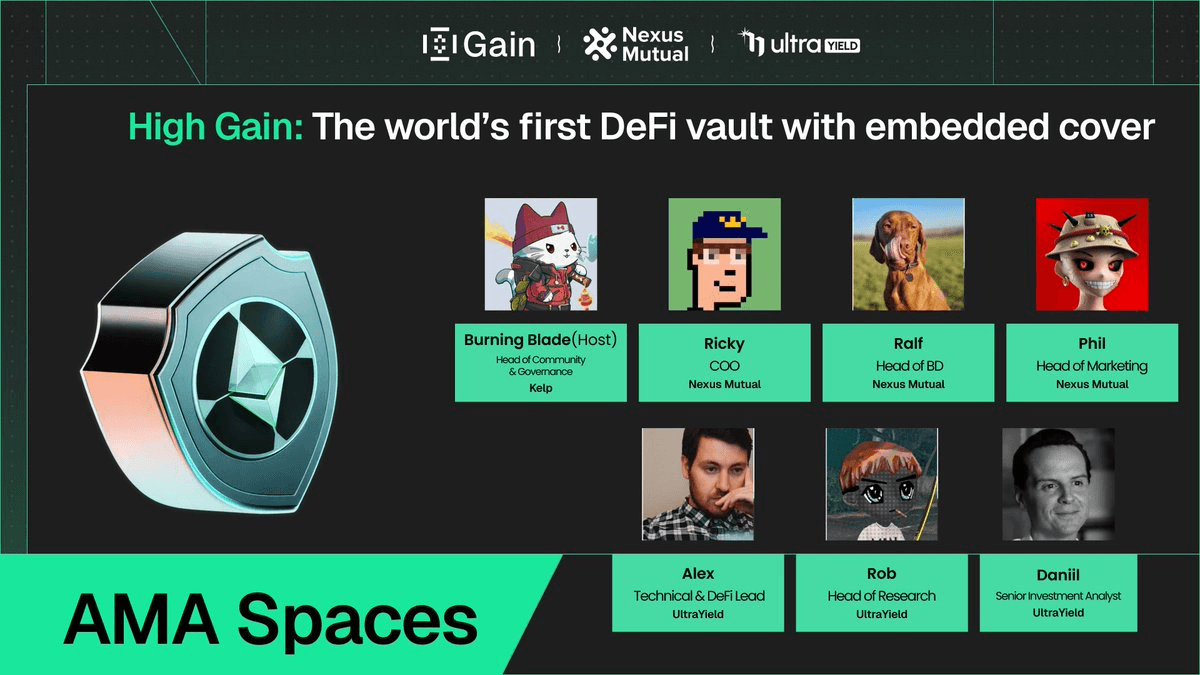
**Kelp DAO showcased 2025 ecosystem milestones** through their annual wrapped retrospective, followed by community engagement sessions. The team hosted an AMA focused on **High Gain - the first DeFi vault with built-in insurance coverage**. The session featured: - Nexus Mutual and UltraYield representatives - Discussion of insurance design architecture - Vault-level risk management strategies - Pathways for institutional participation High Gain represents an evolution of Kelp's design philosophy: **making sophisticated DeFi strategies accessible and secure** without operational overhead. The embedded cover feature eliminates the need for separate insurance arrangements, streamlining the user experience while maintaining institutional-grade security standards.
rsETH Hits $1B on Aave, Unlocks 14x Leverage Through E-Mode
**rsETH achieved several integration milestones across DeFi platforms:** - **E-Mode launch on Aave v3 Core market** enables up to 93% LTV for rsETH-ETH loops, allowing ~14x leverage and ~9% rewards - **Contango integration** introduced one-click E-Mode looping with up to 14x leverage, removing manual looping requirements - **rsETH supply on Aave v3 Core crossed $1B**, making it the 8th-largest asset on the platform with supply caps near maximum utilization - **Total rsETH TVL reached 500,000+ ETH restaked** - **Cross-chain expansion** shows $65M+ supply on [Aave v3 Avalanche](https://app.aave.com) and [Base markets](https://app.aave.com) The E-Mode feature improves capital efficiency by reducing idle capital in loops while maintaining the same risk profile for correlated assets. Users can now access deeper liquidity through Aave's Core market, which holds ~$1B ETH available for borrowing. [Start looping on Aave](https://app.aave.com/reserve-overview/?underlyingAsset=0xa1290d69c65a6fe4df752f95823fae25cb99e5a7&marketName=proto_mainnet_v3)