Join API3 at L2 Days Istanbul Event
Join API3 at L2 Days Istanbul Event


API3 invites people to join them at L2 Days Istanbul, a two-day event dedicated to Ethereum scaling solutions. API3's Product Lead will participate in a panel discussion and they will also have a booth where they will share free merch. The event is organized by l2beat and Scroll_ZKP. The event details and registration information are provided in previous news updates.

Builders, are you headed to Istanbul for @EFDevconnect? We have 3 FREE tickets to giveaway for @L2DAYSxyz, happening on November 14-15. Register Now for a chance to win a free ticket to L2 Days. Drawing on November 10 at 4pm UTC. api3dao.typeform.com/to/xhTlQ2te

Join API3 in Istanbul for @ETHGlobal, November 17-19. Hackers from around the world are coming together to experience an incredible hackathon weekend. We will be hosting a Builder Mixer, sponsor workshop, & opportunities to build with dAPIs and QRNG. Apply now:
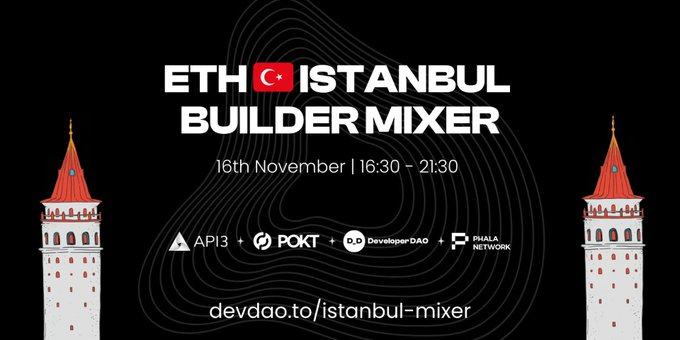
We’re excited to co-host the @ETHGlobal Builder Mixer with @POKTnetwork @developer_dao & @PhalaNetwork! We’re bringing together the builders shaping the future of the Ethereum ecosystem. Network with builders, get to know our teams, and enjoy the good vibes before some serious
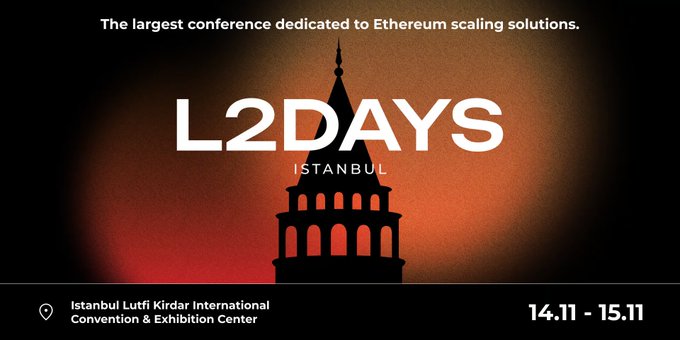
Join us tomorrow at @L2DAYSxyz Istanbul, a two-day event organized by @l2beat & @Scroll_ZKP, dedicated to Ethereum scaling solutions. ▲ Attend the “L2s from the Perspective of Application Builders” panel featuring API3 Product Lead @UgurMersin61 ▲ Visit the API3 booth, where
API3 DAO Ships New Integrations and Vaults Amid Market Volatility
API3 DAO continued development despite market conditions, delivering several key updates: - **New chain integration**: Robinhood Crypto support added - **Vault launch**: Purinta USDC Vault now live - **Morpho market**: CASHCAT/USDG market deployed - **Purinta features**: Additional functionality delivered The team emphasized their commitment to consistent building regardless of market direction, maintaining focus on infrastructure development and ecosystem expansion.
API3 Oracles Recapture Liquidation Value for Markets
API3 has developed an oracle system that changes how liquidation profits are distributed in DeFi markets. **How it works:** - When price movements trigger position liquidations, those updates generate value - Traditionally, this value goes to MEV searchers and block builders - API3's oracles capture this value and return it to the market itself **Current deployment:** - Over 200 data feeds available on the API3 Market - Integrated with OEV Network across 40+ chains - Provides real-time data access with value recapture built in This approach redirects profits that would normally leak out of protocols back to the platforms and their users, rather than being extracted by third parties.
Zero-Percent Borrow Campaign Runs Without Token Emissions
A new 0% borrowing campaign is operating without token emissions, breaking from the typical DeFi playbook. **How it differs:** - Traditional campaigns print tokens as rewards - Farmers typically dump those tokens immediately - Rates rise again once emissions end **This approach:** - No new tokens are minted - The market sustains itself organically - Eliminates the boom-bust cycle of emission-based incentives This model addresses a recurring problem in DeFi where artificial incentives create temporary activity that evaporates when rewards stop flowing.
Zero-Cost USDC Borrowing Against wstETH on Morpho Labs
**Free borrowing opportunity on Morpho Labs** Traders can currently borrow USDC against wstETH at 0% net cost on Morpho Labs. While the base rate is 2.8% APR, live incentives fully cover the borrowing cost. **Key details:** - Market: wstETH/USDC on Morpho Labs - Base rate: 2.8% APR - Net rate after incentives: 0% - Campaign details: [Merkl opportunities](https://app.merkl.xyz/opportunities/ethereum/MORPHOBORROW/0x6d2FbA32B8649d92432D036c16aA80779034b746) - Market link: [Morpho market](https://app.morpho.org/ethereum/market/0x6d2fba32b8649d92432d036c16aa80779034b7469b63abc259b17678857f31c2/wsteth-usdc) The opportunity is OEV-boosted and powered by API3 DAO. The incentive program has a limited duration, so rates may change when the campaign ends.
Api3 Activates Security Monitoring for Morpho Vaults with Hypernative Partnership
Api3 has launched enhanced security monitoring for its Morpho vaults through a partnership with Hypernative Labs. **Key Features:** - Continuous monitoring layer added to existing security infrastructure - Protection against malicious actors through specialized watchguard system - Three vaults now live with enhanced security: - [Api3 dCOMP USDC](https://app.morpho.org/ethereum/vault/0x36cfe1568461E499391ef0A555300F1ae2da2439/api3-dcomp-usdc) - [Api3 Core USDC](https://app.morpho.org/ethereum/vault/0xe2221Aa07ec3266DA87763E2b1e28d07A8a4e53b/api3-core-usdc) - [Kabu USDC](https://app.morpho.org/ethereum/vault/0x54210d3f1A066413891AF9E17210E787d5C6e3f4/kabu-usdc) The vaults combine OEV-boosted yields with first-party oracle data and now include always-on security monitoring as an additional protective layer beyond Api3's existing curation and oracle security measures.