🔐 Integritas Partners with RelAI to Bring Verifiable AI Data Integrity
🔐 Integritas Partners with RelAI to Bring Verifiable AI Data Integrity
🔐 AI Trust Problem


Integritas has partnered with RelAI to join their Solana-based AI marketplace, bringing blockchain-backed data verification to AI workflows.
Key Features:
- Hashes data at the edge and anchors it on-chain in real time
- Provides immutable, timestamped proof of AI data provenance
- Enables auditable workflows from dataset ingestion through training to inference
- Delivered via standard API for easy integration
The partnership leverages Minima's fully decentralized blockchain, ensuring proofs remain immutable, censorship-resistant, and lightweight enough for edge computing. This makes verifiable AI data integrity accessible without relying on cloud vendors or centralized databases.

Great to be partnering with @relayaisolana and bringing Integritas to the RelAI Marketplace. RelAI’s focus on trusted, verifiable AI marketplaces makes it a natural home for Integritas. By hashing data at the edge and anchoring it on-chain in real time, Integritas provides

We’re excited to partner with @Minima_Global and bring their data integrity tooling to the RelAI Marketplace. As part of this partnership, Integritas, Minima’s real-time data verification middleware, will be listed on RelAI as a consumable API. Integritas enables real-time

Minima Raises Over $1M in Challenging Market, Sets Multiple Records on Republic Europe
Minima has successfully raised over $1 million through Republic Europe, achieving several platform records despite difficult fundraising conditions. **Key Achievements:** - Largest Swiss-based company raise on Republic Europe - #6 campaign by funds raised on the platform in the last two years - Largest convertible round on the platform in the last two years - Largest Programming & Security campaign - Attracted investors from 30 countries - Top 10 average investment ticket The fundraise represents confidence in decentralized technology that operates at the edge on billions of devices, moving beyond centralized infrastructure. Minima focuses on lightweight, embedded blockchain infrastructure designed for constrained systems and IoT devices, where verifiable, tamper-proof data at the source becomes essential as autonomy and IoT scale. The campaign surpassed its initial target by over 120k, signaling clear belief in the project's direction rather than hype.
Minima's Maximize Program Concludes After Distributing 50M Tokens
Minima's **Maximize rewards program has officially ended** after distributing over 50 million $MINIMA tokens to network participants. **Key Details:** - The program was always designed as a finite initiative with a dedicated token allocation - All existing contracts will continue to maturity and pay out normally - No new Maximize contracts are available as the allocation has been exhausted - The conclusion represents the program operating as originally intended Maximize became one of the most successful MiniDapps in the Minima ecosystem, rewarding users who participated in the network over its multi-year run.
Minima Reaches 2 Million Blocks With Full Decentralization
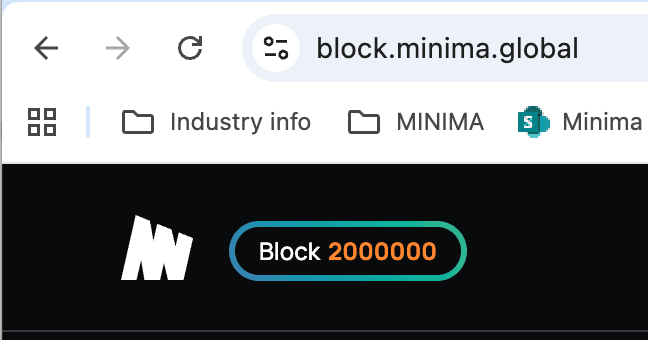
The Minima blockchain network has achieved a significant milestone, surpassing 2,000,000 blocks while maintaining complete decentralization. **Key achievements:** - Zero downtime throughout operation - No centralized validators required - Every user operates a full node This approach contrasts with most blockchain scaling solutions, which typically sacrifice decentralization for performance. Minima's architecture enables billions of devices to run decentralized nodes, moving away from the traditional reliance on large data centers. The network's design represents a fundamentally different approach to blockchain infrastructure, prioritizing true decentralization while achieving scalability at the edge of the network.
🗑️ Crypto's Hidden Waste Problem
While crypto debates energy consumption, **e-waste remains the elephant in the room**. Blockchain networks generate massive hardware graveyards: - ASIC mining equipment becomes obsolete quickly - GPU farms burn out from constant operation - Validator hardware gets replaced under the guise of "upgrades" **Minima takes a different approach** - zero hardware pressure. The network runs on: - Existing smartphones and devices - Hardware with multi-year lifespans - Zero crypto-specific manufacturing footprint While other chains push users to buy specialized equipment, **Minima uses what you already own**. The greenest hardware is the hardware not manufactured for you.