Infrastructure as Revenue: Controlling Value Flow in Your Chain
Infrastructure as Revenue: Controlling Value Flow in Your Chain
💰 Your chain, your money

Blockchain infrastructure is evolving from a cost center to a revenue-generating asset. By owning your chain, you gain control over:
- Transaction sequencing - Determine the order and priority of transactions
- Fee structures - Set and adjust gas fees according to your economic model
- Native integrations - Build custom connections with other protocols and services
- Value flow - Direct how economic value moves through your ecosystem
This shift represents a fundamental change in how blockchain projects approach infrastructure. Rather than relying on shared networks, projects can now monetize their own infrastructure while maintaining full control over the user experience and economic incentives.
The model transforms infrastructure from an operational expense into a strategic asset that generates ongoing revenue.

Own your chain, own your revenue. Your infrastructure becomes a revenue-generating asset. You control transaction sequencing, fee structures, native integrations, and how value flows through your ecosystem.
Optimism Launches OP Enterprise for Business Blockchain Adoption
Optimism has introduced **OP Enterprise**, a new initiative aimed at bringing blockchain technology to business applications. Key features include: - Enterprise-grade infrastructure built on Optimism's Layer 2 technology - Designed to help businesses deploy scalable blockchain solutions - Maintains Ethereum compatibility while offering improved performance - Targets organizations seeking fast, stable, and cost-effective blockchain infrastructure The launch represents Optimism's expansion beyond consumer applications into the enterprise sector, providing companies with tools to build on proven Layer 2 technology. [Read the full announcement](https://www.optimism.io/blog/introducing-op-enterprise)
Unichain and Celo Launch on Shared Infrastructure Platform
Two major blockchain projects have launched on the same infrastructure provider, marking a significant milestone in Ethereum scaling. **Key Developments:** - **Unichain** deployed its Ethereum layer-2 network on the platform - **Celo** migrated its mobile payment infrastructure to the same system - Both projects receive mission-critical support despite serving different use cases Unichain, previously announced in October 2024, aims to reduce transaction fees and improve liquidity for the Uniswap protocol. Celo focuses on scaling mobile payments in emerging markets. The shared infrastructure approach demonstrates how a single platform can support diverse blockchain applications—from DeFi protocols to mobile payment systems—while maintaining performance and reliability standards.
Ethereum L2 Network Captures 58% of All Layer-2 Transactions
A major Ethereum Layer-2 scaling solution has reached significant adoption milestones: - **50+ chains** now running in production - **58% market share** of all L2 transactions - **$6.1B in Total Value Locked (TVL)** - **8-12 weeks** average time to production deployment The network was developed by the team that contributed to Ethereum's core scaling standards. This infrastructure enables faster and more cost-effective transactions while maintaining Ethereum's security guarantees.
Optimism Launches Three-Tier Chain Deployment System
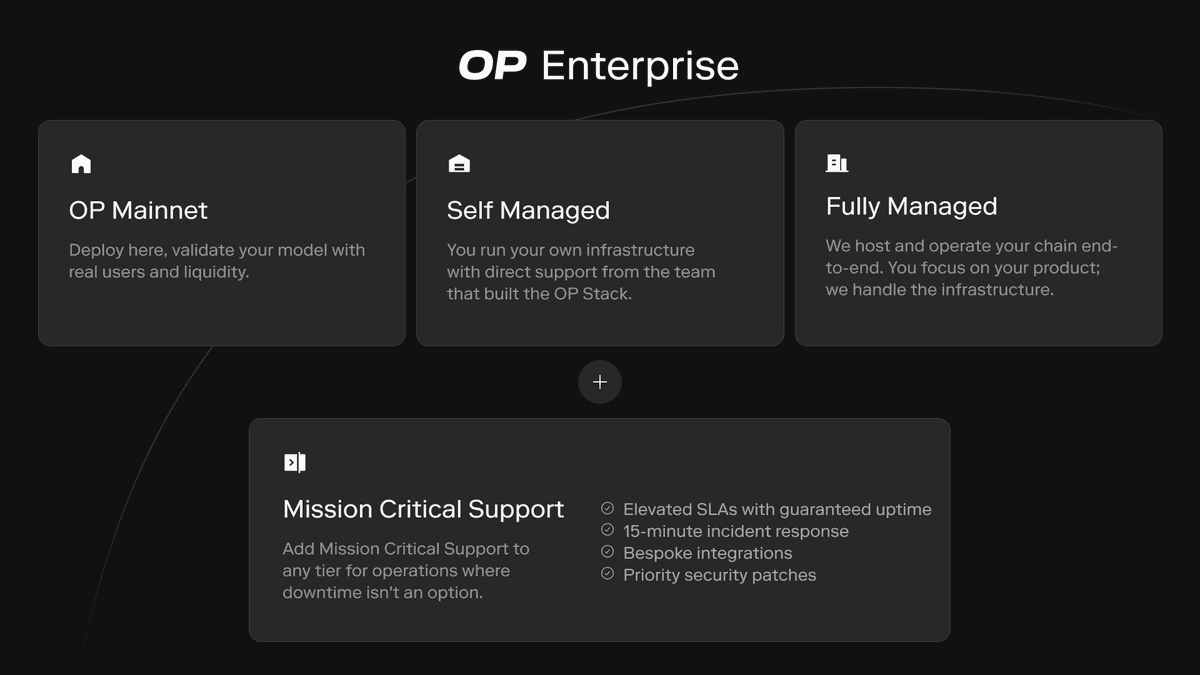
Optimism has introduced a new three-tier system for deploying chains within the Superchain ecosystem, available in 8-12 weeks. **The three tiers include:** - **OP Mainnet**: Start on the established network and graduate when ready - **Self Managed**: Teams operate their own chain with Optimism's support - **Fully Managed**: Optimism runs the entire chain infrastructure This tiered approach provides flexibility for projects at different stages, from those wanting to test on proven infrastructure to teams seeking full operational control or complete hands-off management. The announcement follows Optimism's recent rebranding clarification, distinguishing OP Mainnet as one chain within the broader Superchain network.
OP Enterprise Streamlines Vendor Management Across 50+ Chains
**OP Enterprise** has standardized vendor management across more than 50 blockchain networks, addressing two key pain points for enterprises. **What's been solved:** - Standardized terms and negotiated costs across 50+ chains - Reduced partnership timelines from 6-12 months to rapid deployment - Eliminated millions in potential costs - Gave enterprises control over their economics **The problem it addresses:** Enterprises consistently report two challenges: lack of control over their economics and lengthy vendor onboarding processes. The solution provides tier-one integrations that are ready to deploy immediately, removing the traditional barriers to multi-chain operations.