🔐 Hinkal's Privacy Protocol: Reshaping Enterprise On-Chain Finance
🔐 Hinkal's Privacy Protocol: Reshaping Enterprise On-Chain Finance
🔐 Privacy becomes default


Hinkal is building privacy infrastructure for institutional blockchain adoption. CEO Jason Li of MPCVault discusses how the protocol's embedded privacy features are transforming enterprise finance.
Key architectural principles:
- Separated protocol into distinct layers with isolated responsibilities
- Each layer (verification, records, actions, rules) can be independently audited and upgraded
- Externally verifiable and deployed across Ethereum, Solana, and TRON
Recent integrations demonstrate institutional demand:
- Polygon integrated Hinkal for private stablecoin payments in their wallet
- TRON deployment enables confidential settlements without exposing balances or payment history
- Adopted by enterprise solutions including MPCVault ($8B monthly volumes), Rubic, and Request Network
Compliance features:
- Chainalysis KYT screening prevents high-risk addresses
- Selective disclosure via viewing keys maintains auditability
The protocol aims to make privacy default across blockchain ecosystems, addressing the primary blocker for institutional clients moving treasury operations on-chain.

Hinkal Pay is live on @trondao Confidential settlements and payouts for institutional on-chain finance. TRON powers one of the largest stablecoin ecosystems globally - but like all public blockchains, transaction data remains fully visible. For businesses, this creates a

Read more: hinkal.io/blog/hinkal-pa…
For serious capital to move on-chain at scale, privacy can't be a single feature or a niche workaround - it has to be the default. That conviction shaped hinkal from day one. Today opens: How We Built The Best Privacy Protocol On The Market Signature series, Episode 01: Smart

Hinkal is now powering privacy for stablecoin payments on @0xPolygon. Polygon has integrated Hinkal directly into its Open Money Stack, bringing confidential stablecoin transfers to embedded wallet flows, pay-ins, and payouts. Sender, amount, and relationships (wallets) can now

Every stablecoin transfer on a public chain broadcasts who sent it, who received it, and how much moved. For a business moving money, privacy is paramount. We just launched private payments on Polygon. Here's how it works.

This is the foundational architecture we designed with one goal in mind: to make privacy default across the blockchain ecosystem, driving institutional adoption at scale. Every episode that follows opens another layer of that system: the cryptography, the multi-chain

For privacy infrastructure to operate in real financial environments, reliability matters as much as confidentiality. For this, the giant block of code that does everything didn't really seem a proper match. So we separated the protocol into distinct layers with isolated

Building the industry’s favorite privacy protocol. Jason Li, CEO of MPCVault, talks about hinkal and how its embedded privacy infrastructure is reshaping enterprise on-chain finance.

@0xPolygon partnerships with Meta, Visa, and Modern Treasury were followed by one key integration: Hinkal for private stablecoin payments Inside the Polygon wallet. For Polygon’s institutional clients, privacy remains the primary blocker. Hinkal is the protocol solving this

Good analysis from @lucianlamp on where stablecoin infrastructure is heading. The important signal here is not just private payments - it’s that @0xPolygon clearly recognizes institutional stablecoin adoption needs TradFi-grade confidentiality to scale. After partnerships with

x.com/i/article/2052…
Read our blog: hinkal.pro/blog/powering-…
Building the industry's favorite privacy protocol. Tim Draper, founder of Draper Associates, talks about Hinkal and why it’s foundational to the next phase of blockchain adoption.

Building the industry's favorite privacy protocol. Vitalik Buterin, founder of Ethereum, talks about Hinkal and how it sets the standard for privacy at the protocol level.

But we also understood something early: Institutional adoption does not come from promises. It comes from infrastructure that behaves predictably under pressure. Privacy systems cannot depend on whether an operator behaves correctly, whether internal permissions are configured

Building the industry's favorite privacy protocol. Marc Boiron, CEO of Polygon Labs, talks about Hinkal and why it's essential infrastructure for institutional on-chain finance.

🔐 UTXO Model Explained: Commitments and Nullifiers
Hinkal breaks down the technical architecture behind private blockchain transactions in their latest blog post. **Key concepts covered:** - **UTXO Model**: How unspent transaction outputs structure private state - **Commitments**: Cryptographic representations that hide transaction details - **Nullifiers**: Mechanisms that prevent double-spending without revealing transaction history This episode builds on previous cryptographic foundations, explaining how mathematical proofs translate into actual private money movement on-chain. [Read the full technical breakdown](https://www.hinkal.io/blog/episode-03-utxo-model-commitments-nullifiers)
Privacy-First Blockchain Replaces Account Balances with Single-Use Notes
A new blockchain architecture abandons traditional account balances in favor of discrete value records called "notes." **How it works:** - Each note represents a specific amount of an asset with an owner and timestamp - Notes are created once, used once, then retired—never modified - Only cryptographic fingerprints (commitments) are published on-chain - Actual amounts, assets, and owners remain completely private - Anyone can verify a note's authenticity without seeing its contents **Why it matters:** Traditional account models create public transaction histories that can reveal financial relationships and patterns. This note-based system breaks that chain by eliminating running balances entirely. When you pay someone, your notes are retired and new ones are created for the recipient—both sides remain private with no public trail connecting the transactions.
Hinkal Enables Two-Way Private Bridging Across Solana, Tron, and Near
Hinkal has launched **bidirectional private bridging** between Solana, Tron, and Near networks, expanding its cross-chain privacy infrastructure. **Key Features:** - Users can now bridge assets privately in both directions across all three chains - Builds on Hinkal's existing privacy-focused payment solutions - Maintains transaction confidentiality while enabling seamless cross-chain transfers This development strengthens Hinkal's position in providing privacy tools for multi-chain operations, allowing users to move assets between major blockchain ecosystems without exposing transaction details. Full details: [Hinkal Blog Announcement](https://www.hinkal.io/blog/blog-both-way-bridging-solana-tron-near)
Institutions Need Privacy and Compliance to Bring Flow On-Chain

Stablecoin adoption and regulatory frameworks are advancing together, both dependent on institutional capital flow. Institutions require two critical elements to move on-chain: - **Privacy** - Trading positions, treasury operations, and counterparty relationships must remain confidential and cannot exist on public ledgers - **Compliance** - Regulated institutions need sanctions screening, audit trails, and reporting capabilities These requirements are not mutually exclusive. Regulators demand selective disclosure to appropriate parties at the right time, achieved through viewing keys and Know Your Transaction (KYT) monitoring. **Compliant privacy** means confidentiality and compliance can coexist simultaneously. A panel discussion in Palo Alto on June 2 will explore this framework, featuring representatives from [Merkle Science](https://merkle.science), Crossmint, Centrifuge, Arca, Wave Digital, and Mento Labs.
Hinkal Pay Launches Private Crypto Payments with Compliance Controls
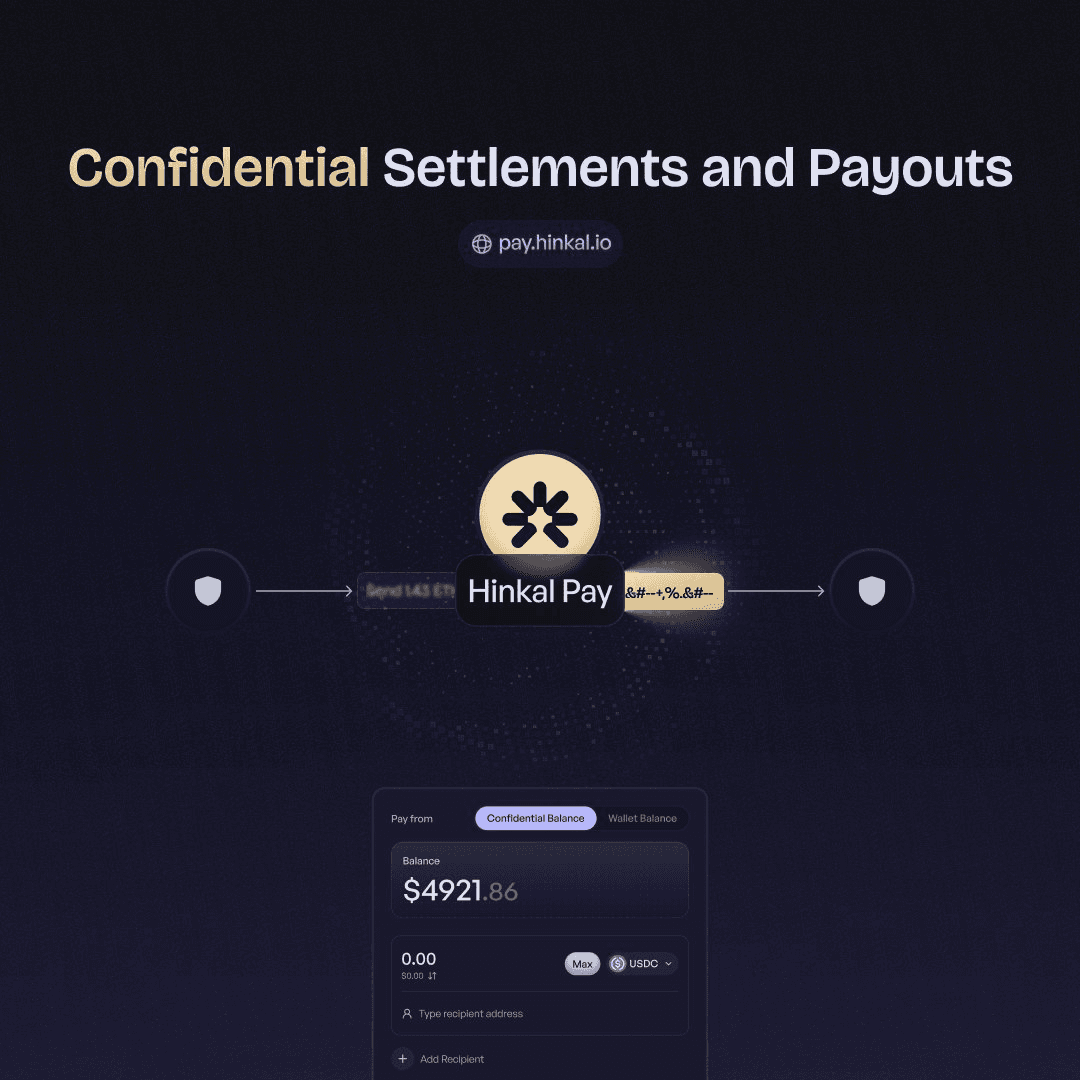
**Hinkal Pay** has launched, enabling businesses and consumers to settle transactions with full confidentiality. **Key Features:** - Sender, recipient, and amounts remain private on-chain - Works with existing wallets, chains, and stablecoins - Supports confidential sending, receiving, and payouts - Maintains compliance through Chainalysis screening **How It Works:** Funds move to a confidential balance within Hinkal's smart contract, controlled by the recipient's existing wallet. Recipients can execute private payouts to vendors, employees, or partners, or send to public wallets while keeping the sender private. **Availability:** - Live on Ethereum, Base, Arbitrum, Polygon, Arc, and Optimism - Supports USDT, USDC, DAI, and ETH - All transactions screened before execution; high-risk addresses blocked The service builds on Hinkal's earlier Private Send feature, which enabled private top-ups for non-custodial crypto cards through Ether.fi integration.