Hashlock Launches Free AI Security Audit Tool for Web3 Developers
Hashlock Launches Free AI Security Audit Tool for Web3 Developers
🔍 Free AI Finds Your Bugs

Security firm Hashlock, known for auditing Klima Protocol's Autocompounder, has released a free AI-powered security audit tool in beta. The tool performs rapid scans of smart contracts to identify:
- Security vulnerabilities
- Optimization opportunities
- Best practices compliance
- Gas efficiency issues
The tool has been tested with several projects including TokenRacer's 1-min options and Ithaca Protocol's AI Agent infrastructure. Developers can access the beta version at aiaudit.hashlock.com

Earlier this year, our security partners @Hashlock_ audited Klima Protocol’s Autocompounder. Now they’re giving Web3 builders a free, powerful way to secure their code. If you’re building, try their new tool in Beta: aiaudit.hashlock.com
Agentic Carbon Transactions Approaching Reality
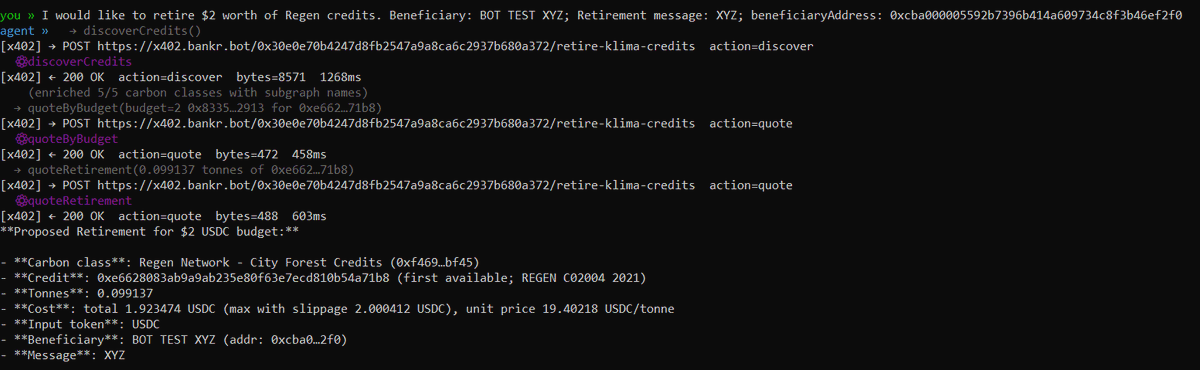
The era of autonomous agent-driven carbon transactions is approaching, marking a significant shift in how carbon markets operate. **Key Development:** - Automated systems will soon handle carbon credit trading without human intervention - This follows 2025's institutional adoption breakthrough in tokenization **What This Means:** Agentic commerce - where AI agents autonomously execute transactions - is becoming the next frontier for carbon markets. This evolution builds on recent progress in tokenizing carbon assets, making them more accessible and tradeable. The shift could streamline carbon credit markets, reducing friction and enabling more efficient climate action through automated trading systems.
Klima 2.0 Defines Five User Groups for Carbon Market Infrastructure
Klima 2.0 outlines five distinct participant categories for its carbon market infrastructure: **Carbon suppliers** (project developers and traders) receive a predictable, rules-based route to market with clear execution terms and no opaque spreads. **Carbon buyers** access verified retirements with transparent pricing. Credits cannot be resold—retirement is permanent, ensuring environmental claims remain auditable. **Coordinators** (kVCM and K2 participants) signal preferences that shape execution conditions within fixed bounds, enabling distributed decision-making without centralized control. **Liquidity providers** maintain continuous protocol access through open markets, ensuring reliable entry and exit without embedding carbon in automated market makers. **Builders and integrators** can develop against open-source smart contracts and APIs to embed carbon functionality into workflows. All groups operate under identical rules. The system aims to coordinate different interests without collapsing them into a single financial abstraction.
Klima Foundation Partners with Regen Network to Launch New Carbon Credit Class
**Klima Foundation announces strategic partnership with Regen Network** through the Klima Partnership Program to advance digital carbon market infrastructure. **Key developments:** - New carbon class launching on Klima platform featuring City Forest Credits - Regen Network brings blockchain-based ecological verification expertise - Partnership focuses on digital MRV, registry interoperability, and carbon asset innovation **Technical integration includes:** - Seamless data integrations for cross-chain retirement and tracking - Advanced standards for on-chain issuance and transfers - Enhanced access to high-quality urban forest credits The collaboration combines Regen's technical capabilities with City Forest Credits' high-impact credits to create **scalable, transparent climate finance tools**. This partnership represents a significant step toward building trusted digital infrastructure for carbon markets.
Urban Forest Carbon Credits Hit $1M+ in Major Transaction
A landmark transaction saw **over 31,000 metric tons of City Forest Credits (CFC) sold for more than $1 million**, with prices ranging from **$34-45 per ton**. This pricing significantly exceeds average voluntary carbon market rates, demonstrating strong demand for urban nature-based climate solutions. **Key highlights:** - City Forest Credits focuses on urban tree planting and preservation - Credits deliver verifiable carbon removals plus co-benefits - Additional benefits include improved air quality, reduced stormwater runoff, and energy savings - Solutions directly impact 80% of Americans living in urban areas The transaction showcases the **immense potential of urban forestry** for both climate impact and community benefits, setting new benchmarks for nature-based carbon credit pricing.
City Forest Credits Sets National Standards for Urban Tree Carbon Removal
**City Forest Credits** launches as a nonprofit carbon registry establishing national standards for greenhouse gas reductions through urban tree planting and preservation across U.S. metropolitan areas. **Key Features:** - ICROA-endorsed registry based on rigorous urban forestry science - Delivers verifiable carbon removals with measurable co-benefits - Targets 80% of Americans living in urban settings **Additional Benefits:** - Enhanced air quality in cities - Reduced stormwater runoff - Energy savings for residents - Greater social equity outcomes The initiative addresses climate change while improving urban living conditions through scientifically-backed tree preservation and planting programs.