Golem Project Contributes 1,000 ETH to rsETH Relief Effort
Golem Project Contributes 1,000 ETH to rsETH Relief Effort
🤝 DeFi rallies together


Golem Project and Golem Foundation have donated 1,000 ETH to support the ongoing rsETH relief initiative.
- The contribution follows similar efforts from other DeFi protocols, including EtherFi, which recently submitted a proposal to their DAO
- The relief effort aims to restore rsETH's backing
- Multiple protocols are collaborating to assist affected users
The coordinated response demonstrates growing solidarity within the DeFi ecosystem during crisis situations.

Another one. @golemproject and @golemfoundation have made a 1,000 ETH contribution to the ongoing rsETH relief effort. We appreciate their willingness to participate and help users. DeFi United.

Golem Foundation and Golem Factory are contributing a combined 1000 ETH from our treasuries to @aave's coordinated DeFi relief effort following the rsETH incident. We've been working closely with the Aave team this week in a supporting capacity. Our contribution will go toward

Ethena Joins Multi-Protocol Effort to Restore rsETH Backing After Bridge Exploit
**Recovery Effort Expands** Ethena has joined the collaborative effort to restore backing for rsETH following the April 18 Kelp DAO bridge exploit. The protocol now has multiple commitments from ecosystem partners including: - Lido Finance (proposal submitted to DAO) - EtherFi (proposal submitted to DAO) - Ethena (latest contributor) **Current Status** - rsETH reserves paused across Ethereum Core, Arbitrum, Base, Mantle, and Linea - WETH reserves on Ethereum Core V3 unfrozen; users can supply again - WETH LTV remains at 0 - rsETH on Ethereum mainnet confirmed fully backed **Background** The incident stemmed from an exploit of Kelp DAO's rsETH bridge. Aave service providers immediately froze affected markets to prevent new deposits and borrowing. Analysis shows potential bad debt scenarios, with recovery plans now in progress. Aave emphasizes that its contracts were not exploited - the issue originated with rsETH's bridge infrastructure. Full incident report: [governance.aave.com](https://governance.aave.com/t/rseth-incident-report-april-20-2026/24580)
Aave V4 Raises Asset Caps Again as Demand Fills Capacity
**Aave V4 continues rapid growth trajectory** Multiple assets on Aave V4 have reached full capacity, prompting risk managers to raise supply, borrow, and credit line caps. @LlamaRisk proposed the increases to accommodate surging demand. **Key milestones:** - V4 crossed $20M in deposits - Multiple rounds of cap increases since launch - Security-first approach: caps start conservative and scale gradually - Runs on Chainlink oracle infrastructure securing tens of billions on V3 The protocol follows a deliberate growth strategy - deposit caps begin conservatively, then risk managers evaluate and propose increases as capacity fills. This measured approach balances user demand with protocol security during the maturation phase. Aave Pro interface available at [pro.aave.com](https://pro.aave.com)
Aave Pro Gets Enhanced Reserve Pages with Interest Rate Data and Supply Caps
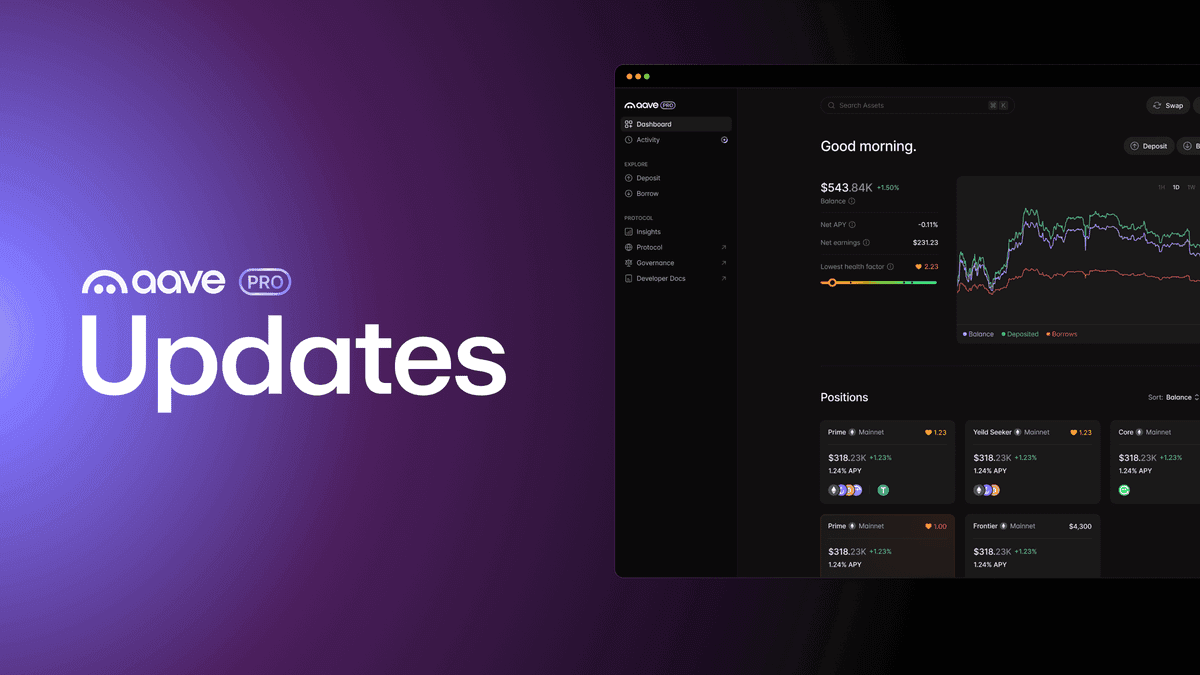
Aave has rolled out UI and UX improvements to Aave Pro on both mobile and web platforms. The update introduces **new reserve pages** that display: - Per-asset interest rate data - Supply and borrow caps - Top addresses These enhancements build on Aave Pro, the interface for Aave V4 that allows users to earn, borrow, swap, and monitor positions.
Aave Pro Interface Launches for V4 Protocol
Aave has launched **Aave Pro**, a new interface for interacting with Aave V4 Protocol. **Key features include:** - Earning and borrowing capabilities - Token swapping functionality - Position monitoring tools The interface is now available at [pro.aave.com](https://pro.aave.com/) This follows the V4 testnet launch in November 2025, which included a developer preview of the Pro interface. The full announcement details are available on the [Aave blog](https://aave.com/blog/aave-v4-live-ethereum). Aave Pro provides users with a streamlined way to access V4's liquidity protocol features through a web-based interface.