Global Stablecoin Market Cap Crosses $300B Milestone in 2025
Global Stablecoin Market Cap Crosses $300B Milestone in 2025
🚀 Stablecoins Hit $300B


The global stablecoin market has reached a significant milestone, surpassing $300 billion in market capitalization for the first time in 2025.
Key Market Metrics:
- Monthly growth: +2%
- Year-to-date growth: +6.5%
Market Leaders:
- USDT: $176.3B (commanding 58% market share)
- USDC: $74B (holding second position)
This milestone reflects the continued expansion of stablecoins' role in the crypto ecosystem, building on steady growth throughout the year. The market has grown substantially from approximately $233 billion earlier in 2025.
USDT maintains its dominant position with over half the market, while USDC continues as the clear second choice for users seeking dollar-pegged digital assets.

🚨 Stablecoin Milestone! 🚨 Global #stablecoin market cap has surpassed $300B for the first time in 2025 📈 (+2% MoM, +6.5% YTD). • $USDT: $176.3B (58% share) 🏆 • $USDC: $74B 🥈

BRIDGERS Expands Cross-Chain Token Support with New Solana Asset
BRIDGERS has added support for a new Solana-based token (DiRshqNDE68bWbGdLHm1GwQ76MvWQG3af6w1NdQondo), enabling users to route it across multiple blockchains. **Key Features:** - Non-custodial execution through smart contracts - Aggregated liquidity for efficient routing - User-authorized transactions This addition continues BRIDGERS' pattern of expanding token support, following similar integrations for various Solana and Ethereum-based assets throughout June 2026. Users can access the bridging functionality at [dapp.bridgers.xyz](http://dapp.bridgers.xyz).
Ethereum Foundation Cuts Budget 40%, Shifts Focus to Core Development
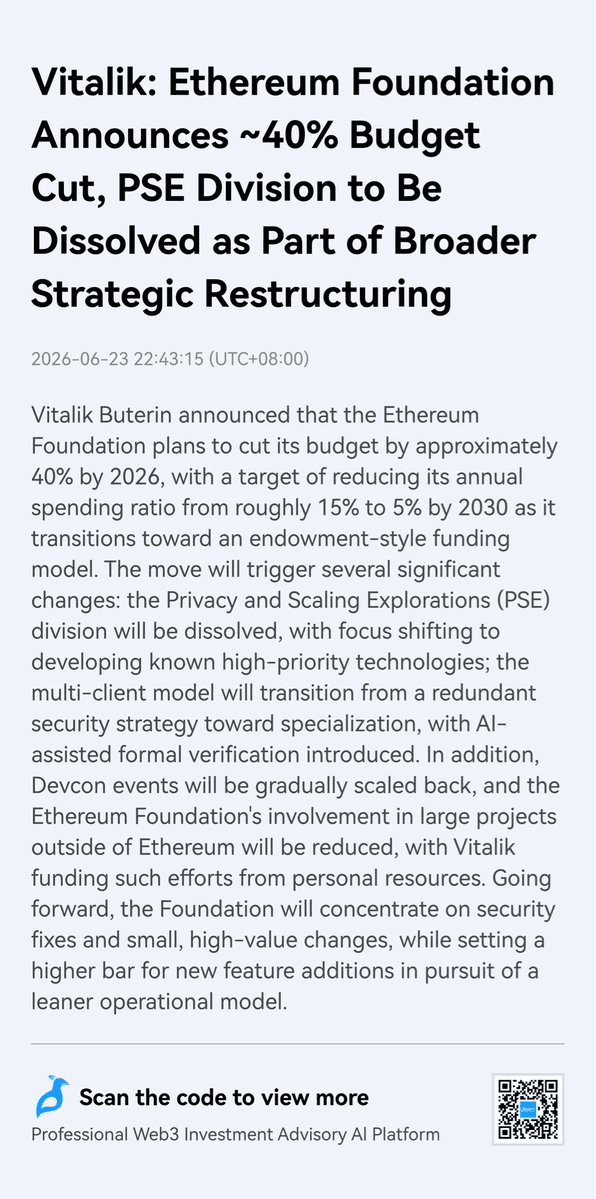
The Ethereum Foundation is implementing significant organizational changes: **Budget Restructuring** - Budget reduced by approximately 40% by 2026 - Annual spending ratio targeted to drop from 15% to 5% by 2030 - Vitalik Buterin previously deployed $44M in ETH toward security and infrastructure **Operational Changes** - PSE (Privacy and Scaling Explorations) division to be dissolved - Devcon events will be scaled back - Reduced involvement in non-Ethereum projects **Security Focus** - AI-assisted formal verification being implemented to strengthen protocol security The foundation is entering what Buterin describes as a "lean" phase, concentrating resources on core Ethereum development while reducing peripheral activities. This marks a shift toward fiscal discipline and focused execution on the protocol's fundamental infrastructure.
OPENAI Token Now Available for Cross-Chain Routing on Bridgers
Bridgers has added support for $OPENAI token, enabling users to route it across multiple blockchain networks. **Key Features:** - Non-custodial execution through smart contracts - Aggregated liquidity across chains - User-authorized transactions This addition follows recent listings of $ANTHROPIC, $gasDAI, and $XDAI on the platform. Bridgers continues expanding its cross-chain routing capabilities, now supporting over 40 blockchains and 600+ assets. The platform recently upgraded its user interface to provide clearer rate visibility and a more streamlined authorization and routing process. [Access the dApp](http://dapp.bridgers.xyz)
RCON Token Now Available for Cross-Chain Routing on BRIDGERS Platform
**RCON token is now live on BRIDGERS**, enabling users to move the token across different blockchain networks. **Key features of the integration:** - Non-custodial execution means users maintain control of their assets - Smart contract-based routing handles the technical process - Aggregated liquidity pools facilitate transfers - Users authorize transactions directly from their own wallets The listing was announced earlier this month and is now accessible through the BRIDGERS platform at [dapp.bridgers.xyz](http://dapp.bridgers.xyz).
Bridgers Increases Bitcoin Transaction Capacity to Nearly 2 BTC Per Swap

Bridgers has expanded its cross-chain routing capacity, now supporting transactions of nearly 2 BTC per swap. **Key Features:** - Non-custodial execution with smart contract-powered routing - Aggregated liquidity across multiple blockchain ecosystems - Support for over 400 cryptocurrencies including BTC, XMR, and various tokens - Users maintain control by authorizing transactions from their own wallets The platform continues to add new token support, recently integrating BPRM (BASE), XMR, and various chain-specific assets. Bridgers focuses on optimizing execution paths by aggregating liquidity across different ecosystems. Access the platform at [dapp.bridgers.xyz](http://dapp.bridgers.xyz)