Fiet Bridges Institutional Capital to Arbitrum Without Full Onchain Migration
Fiet Bridges Institutional Capital to Arbitrum Without Full Onchain Migration
💰 Institutions go programmable

Fiet has launched on Arbitrum, enabling institutions to make their existing capital programmable without moving it fully onchain.
How it works:
- Institutions prove reserves offchain (banks, custodians, exchanges)
- Liquidity commits onchain only when needed
- Capital stays in existing custody and treasury systems
Key benefits:
- Reserve-backed liquidity without idle capital
- Onchain policy enforcement at execution
- Lower-cost, scalable infrastructure
This approach addresses a major friction point for institutional adoption by meeting capital where it already exists rather than requiring full migration.
Read the technical breakdown: How Fiet Made Reserve-Backed Liquidity Practical Onchain

The global economy is becoming programmable. Capital is moving onchain, markets are converging, and new financial systems are emerging. From commodities to payments to new market structures, growth accelerated across the Arbitrum Platform in March.
Fiet’s model enables: ✓ Reserve-backed liquidity without idle capital ✓ Reserves held in existing custody + treasury systems ✓ Onchain policy enforcement at execution ✓ Lower-cost, scalable market infrastructure Learn more: blog.arbitrum.io/how-fiet-made-…

Get a closer look at how offchain capital becomes programmable: blog.arbitrum.io/how-fiet-made-…
New financial primitives are what expand the programmable economy. .@boros_fi by @pendle_fi launched funding rate markets on Arbitrum, where deep capital and reliable execution already exist. They quickly reached product-market fit, hitting $338.5M in daily notional volume.

We hit a new ATH of $338.5m Daily Notional Trading Volume this week! Full send

Capital efficiency is crucial for institutions moving onchain. .@usher_web3 built Fiet on the Arbitrum Platform so DeFi can integrate with existing capital systems and offer a more practical path for institutions building on the programmable economy.

Fiet is unlocking institutional liquidity for the programmable economy on Arbitrum. Instead of forcing capital fully onchain, institutions can prove reserves offchain (banks, custodians, exchanges) and commit liquidity onchain when needed. By meeting institutions where their

The programmable economy is being built with real capital And institutions are choosing Arbitrum to power it

The world's largest financial institutions are increasingly tokenizing assets, and they're choosing Arbitrum to do it. Money market funds: • Franklin Templeton • WisdomTree • BlackRock • Spiko • Centrifuge Tokenized equities: • Robinhood • Dinari Real estate: Estate

Early-Stage Web3 Teams Gain Access to $100K+ in Prizes and Top-Tier VC Connections

A new program is connecting early-stage blockchain teams with capital and investors through a structured approach. **Key Features:** - Direct investor exposure via curated introductions and Demo Day presentations - Over $100,000 in prizes available to participating teams - Access to leading venture capital firms **Participating Investors:** - Pantera Capital - Tandem by Offchain - Electric Capital - Lightspeed Venture Partners - IOSG Ventures - Arca The initiative focuses on bootstrapping teams in their earliest stages, providing both funding opportunities and networking pathways to established venture partners in the web3 space.
Robinhood Chain Opens Developer Program for Tokenized Markets and DeFi Applications
Robinhood is actively recruiting developers to build financial products on Robinhood Chain, an Arbitrum-based Layer 2 network. **Focus Areas:** - Tokenized markets - Retail-friendly DeFi protocols - Seamless trading infrastructure - Consumer investing applications The chain aims to modernize global financial markets through programmability, enabling self-custodial stocks and ETFs with 24/7 trading capabilities. By leveraging the Arbitrum Platform, Robinhood maintains operational independence while accessing shared liquidity and security.
Gains Network Cuts Trading Fees in Half Following Arbitrum Upgrade
**Gains Network has slashed minimum trade fees by 50%** following the latest ArbOS upgrade on Arbitrum. The infrastructure improvement demonstrates how Layer 2 scaling solutions can directly impact user experience. Lower, more predictable transaction costs enable trading platforms to operate more efficiently, particularly during periods of market volatility. **Key benefits:** - 50% reduction in minimum trading fees - More predictable costs during volatile markets - Improved scalability for onchain businesses The upgrade shows how technical improvements at the infrastructure level translate into tangible benefits for end users and applications built on top of the network.
PayPal's PYUSD Reaches $331M TVL on Arbitrum as Programmable Payments Gain Traction
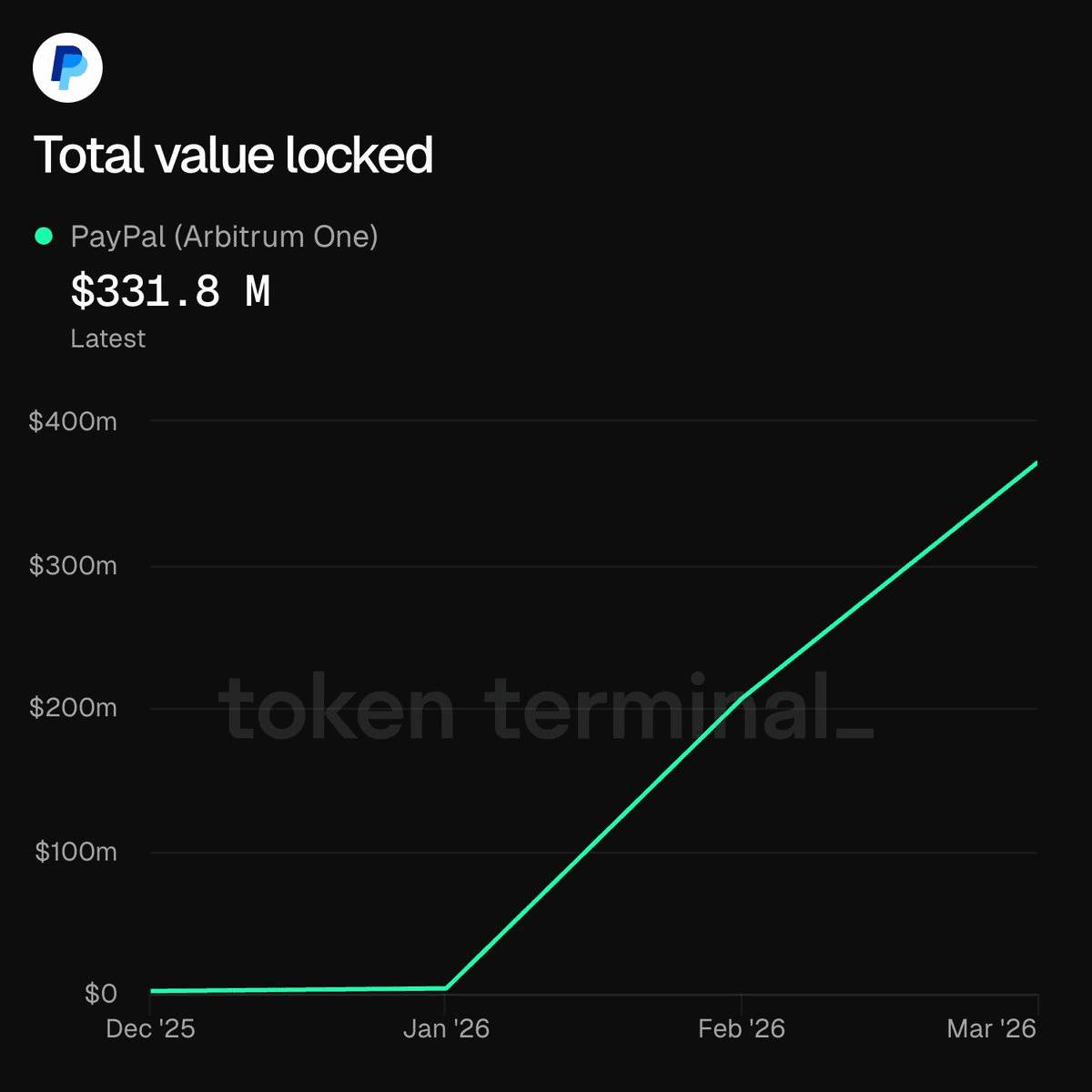
PayPal's stablecoin PYUSD has reached **$331M in total value locked (TVL)** on Arbitrum, marking significant growth in programmable payment adoption. **Key developments:** - PYUSD experiencing rapid vertical growth on the Arbitrum network - Major payment providers selecting blockchain rails offering instant settlement and low transaction costs - Payment adoption accelerating where liquidity depth and settlement predictability are strong The milestone demonstrates how **global payment companies are increasingly choosing Layer 2 solutions** for their infrastructure needs, prioritizing networks that can handle payments at scale with reliable execution.