Factors Hindering Institutional Adoption of Tokenized Assets and Chainlink's Solution
Factors Hindering Institutional Adoption of Tokenized Assets and Chainlink's Solution
🔑 Unlocking Tokenized Assets' Potential

Three key factors are currently holding back the mass institutional adoption of tokenized assets: 1) Blockchains are not integrated with enterprise systems, 2) Blockchains cannot communicate with each other, and 3) The ecosystem is fragmented. Chainlink's Cross-Chain Interoperability Protocol (CCIP) is proposed as a complete solution to address these challenges. CCIP aims to provide a universal integration gateway that allows banks to leverage their existing expertise and services, securely transfer tokens across chains while meeting institutional security standards, and connect to any blockchain, future-proofing new tokenization platforms.

Three factors holding back the mass institutional adoption of tokenized assets: 1. Blockchains aren’t connected to the enterprise stack 2. Blockchains can’t talk to other blockchains 3. The ecosystem is fragmented One complete solution: #Chainlink CCIP.
3 key problems #CCIP’s universal integration gateway solves for banks: 1. Integration with offchain systems—banks can leverage their existing expertise and services 2. Transferring tokens cross-chain securely—CCIP meets & exceeds institutional security standards 3. Connecting to
Chainlink Expands Reach with 8 New Integrations Across Multiple Chains
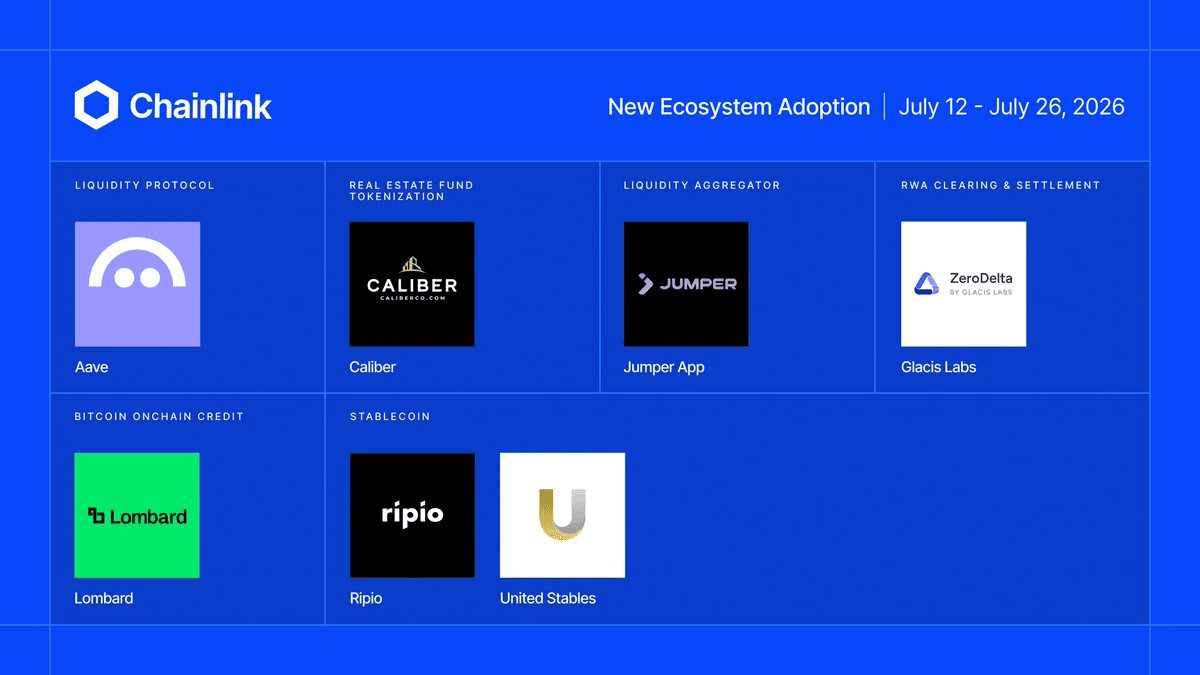
Chainlink continues its steady expansion with **8 new integrations** across 4 services and 3 different chains. **Key adopters include:** - @aave - @CaliberCo - @glacislabs - @jumperapp - @Lombard_Finance - @RipioApp - @UTechStables This follows recent momentum from Robinhood Chain's adoption of Chainlink as its official oracle provider, powering stock tokens and cross-chain connectivity for millions of users. The integrations span Chainlink's core services including CCIP for cross-chain transfers, Data Feeds for pricing, and ACE for compliance solutions. Notable recent use cases include enabling asset transfers between Solana and EVM chains, and powering compliant real estate fund tokenization. Chainlink maintains consistent adoption rates, with similar integration numbers reported throughout July 2026.
Chainlink Expands Capital Markets Network with Nine Major Financial Institutions
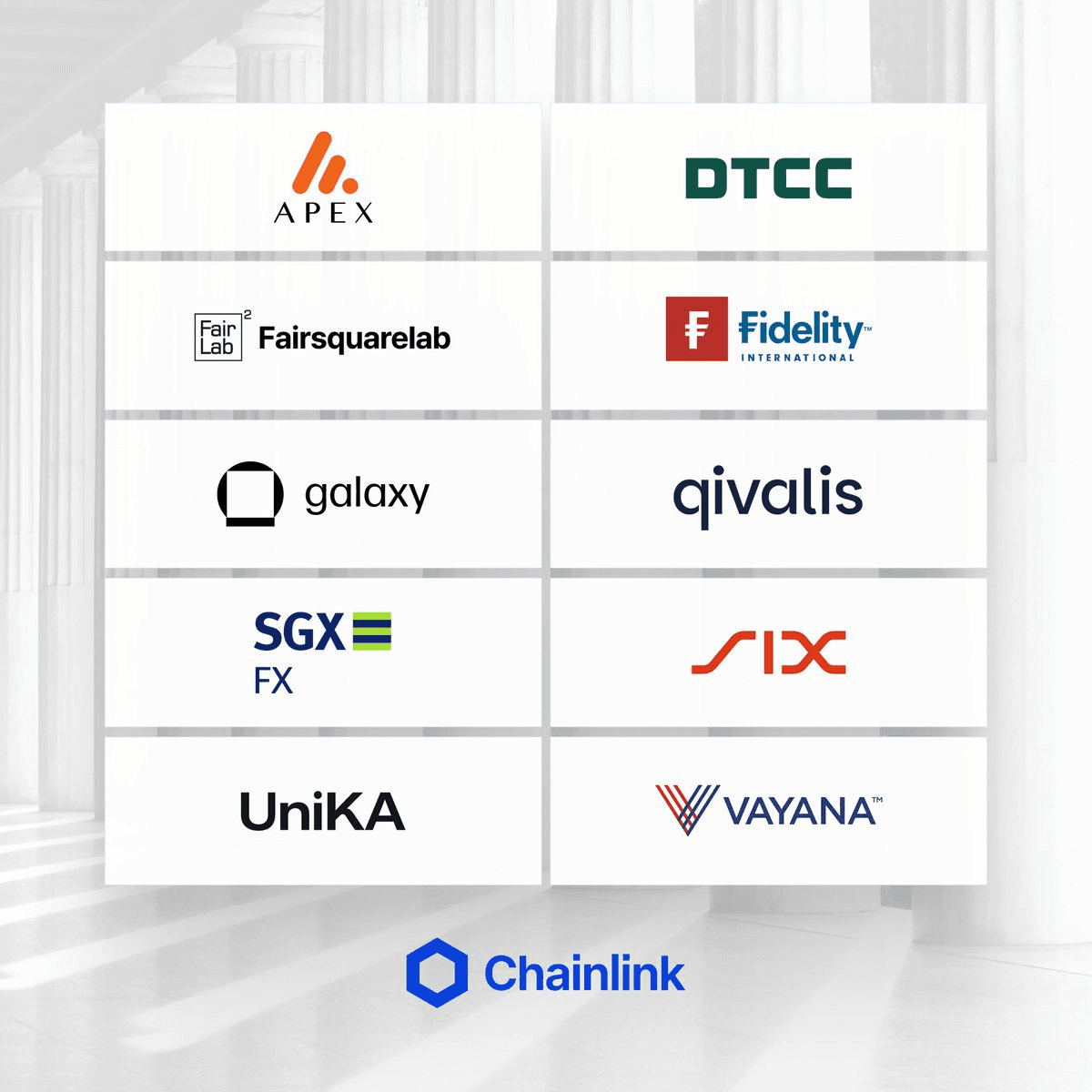
Chainlink continues building momentum in traditional finance integration, adding nine institutions to its capital markets network: **New Partners Include:** - **Apex Group** - Global financial services provider - **DTCC** - Securities clearing and settlement infrastructure - **Fidelity International** - Asset management firm - **Galaxy** - Digital asset financial services - **SGX** - Singapore Exchange - **SIX** - Swiss financial infrastructure operator This expansion follows December's major announcement featuring Swift, Euroclear, UBS, and dozens of other financial institutions exploring Chainlink's infrastructure for connecting traditional finance systems with blockchain networks. The growing list of participants signals continued institutional interest in blockchain-based capital markets infrastructure, focusing on interoperability between legacy financial systems and distributed ledger technology. [Original Chainlink announcement](https://blog.chain.link/chainlink-banking-capital-markets-announcements/)
Chainlink Q2 2026: Major Adoption Across Prediction Markets, RWAs, and Derivatives
Chainlink released its Q2 2026 quarterly review, highlighting continued momentum in enterprise adoption and product expansion. **Key Developments:** - Major institutional users including Amundi, Polymarket, Coinbase, and Aave deepened integration - Significant growth in prediction markets, tokenized real-world assets (RWAs), and derivatives sectors - New product launches: 24/5 U.S. Equities data feeds and 24/7 foreign exchange (FX) data - LINK Reserve expanded by over 1.4 million tokens The quarter builds on Q1's foundation, demonstrating Chainlink's role in connecting traditional finance infrastructure with blockchain systems. The expansion of always-on market data feeds addresses a key need for DeFi protocols requiring continuous price information beyond traditional market hours. Full details available in the [Q2 2026 quarterly review](https://chain.link/blog/quarterly-review-q2-2026).
Chainlink Q2 2026: $7B Migrates to CCIP, 50+ Banks Join Project Pangea
Chainlink reported significant Q2 2026 growth metrics: **Key Developments:** - **$7B+ in assets** migrated to Cross-Chain Interoperability Protocol (CCIP) - **Project Pangea launched** with participation from 50+ banks - **10 prediction markets** integrated Chainlink services - **Chainlink Reserve** reached 4.5M+ LINK tokens - **$110B in total value** now secured by the network **Traditional Finance Adoption:** Major institutions including DTCC and SIX are leveraging Chainlink infrastructure, signaling continued institutional interest in blockchain connectivity solutions. The quarter demonstrates Chainlink's expanding role as infrastructure connecting traditional finance with blockchain systems.
Lombard Finance Enables Cross-Chain Bitcoin Deposits via Chainlink Integration
**Lombard Finance has integrated Chainlink** to enable cross-chain distribution for its Bitcoin Onchain Credit Strategy, developed in partnership with Flow Traders. **Key developments:** - Chainlink powers secure cross-chain deposits of BTC.b and LBTC into the credit strategy - The integration expands institutional access to Bitcoin-based credit products - This builds on Lombard's October 2024 partnership with Chainlink, which included CCIP, Price Feeds, and Proof of Reserve The integration allows Bitcoin holders to participate in institutional credit strategies across multiple blockchain networks, removing previous barriers to cross-chain Bitcoin movement.