🔍 Ethereum's Next Wave
🔍 Ethereum's Next Wave
🔍 Ethereum's biggest problem


Ethereum builders face critical barriers to creating the next generation of great applications.
Key discussion topics include:
- User experience challenges that prevent mainstream adoption
- Sustainable monetization models for long-term viability
- Other technical and business obstacles
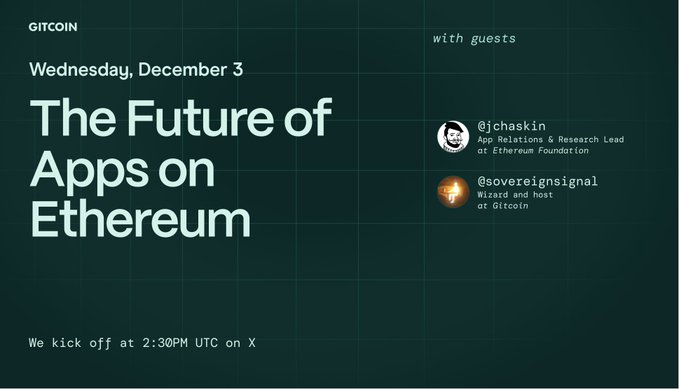
Expert insights from @jchaskin22 will explore solutions for developers and founders building on Ethereum.
The conversation addresses fundamental questions about scaling Web3 applications and improving accessibility for both builders and users.

What’s the biggest barrier for the next wave of great apps on Ethereum? Is it UX? Sustainable monetization? Something else? We're going deep on this with @jchaskin22. A conversation for every builder and founder in the ecosystem. 🗓️ Wednesday, Dec 3rd ⏰ 2:30 PM UTC Set your
🔧 Gitcoin GG24 Deep Funding Results
Gitcoin has released the **deep funding update** for GG24's Web3 Tooling and Infrastructure round. **Key Details:** - Projects can now check their qualification status for deep funding - Part of GG24's six-domain structure allocating **$1.8M total** - First round fully designed through structured sensemaking - Focuses on developer tooling and infrastructure projects This represents Gitcoin's approach to directing capital toward critical Web3 development needs. [Check qualification status](https://gov.gitcoin.co/t/deep-funding-gg24-web3-tooling-and-infra-round/25040)
Gitcoin Pivots to Lean Experimentation Model for 2026
Gitcoin has outlined a strategic reset for 2026, moving away from its previous approach to focus on three core principles: **The AAA Framework:** - **Alignment**: Fund projects that advance human thriving - **Alpha**: Identify and attract high-potential builders - **Accelerate**: Operate with small, efficient teams **Coalition-First Funding** The platform will require projects to demonstrate 60-70% funding from external sources before receiving Gitcoin support. This approach aims to surface builders with genuine community backing through the upcoming GG25 round. **Experimental Approach** Rather than committing to large-scale initiatives, Gitcoin will run low-budget, time-limited experiments throughout 2026. The organization will only pursue recapitalization and scaling after these experiments show clear traction and legitimacy. This represents a significant shift from Gitcoin's previous grant-making model, emphasizing validation and external support over direct funding. The strategy suggests a more cautious approach following lessons learned from past rounds. [Read the full strategy](https://gov.gitcoin.co/t/gitcoin-2026-strategy-tl-dr/25049/1)
Gitcoin Unveils 3.0 Vision: Beyond Quadratic Funding to Multi-Mechanism Portfolio
Gitcoin has announced its evolution into version 3.0, marking a significant shift in how public goods funding operates. **The Three Phases:** - **Gitcoin 1.0 (2020)**: Centralized platform focused on Quadratic Funding - **Gitcoin 2.0 (2024)**: Decentralized QF with modular protocols - **Gitcoin 3.0 (2026+)**: Comprehensive portfolio of funding mechanisms **Key Changes:** The new version moves beyond a single funding method to embrace multiple approaches: - Various flavors of Quadratic Funding - Quadratic Voting - Direct Grants - Retroactive public goods funding This transition reflects a broader understanding that different projects and communities need different funding tools. Rather than relying solely on one mechanism, Gitcoin 3.0 aims to provide a complete toolkit for capital allocation. The platform continues its expansion across all EVM-based communities, with tools like Gitcoin Passport extending beyond the original Ethereum ecosystem to protect various blockchain communities from Sybil attacks. This evolution represents a maturation from a single-purpose platform to a diverse ecosystem of funding solutions.
Core Developer Compensation Crisis: Data Reveals Measurable Underfunding Problem
**Core developer undercompensation** has moved beyond anecdotal concerns to become a **measurable crisis** affecting blockchain infrastructure. Trent Van Epps presented compelling data at Schelling Point, highlighting how inadequate funding threatens the sustainability of critical development work across the ecosystem. Key findings reveal: - Systematic underfunding of essential infrastructure work - Growing gap between developer value creation and compensation - Need for coordinated community response The research provides concrete evidence for what many developers have experienced firsthand - that current funding models fail to adequately support the builders maintaining blockchain networks. **This isn't just a developer problem** - it's an ecosystem sustainability issue that affects everyone relying on these networks. Watch the full presentation: [Schelling Point Talk](https://www.youtube.com/watch?v=q5qPYZLGD3U) *Understanding this data is crucial for anyone invested in long-term blockchain infrastructure health.*
Gitcoin Grants Hands Control to Community in GG24 Experiment
**Gitcoin conducted its first community-run grants program** with GG24, marking a significant shift from centralized control. The experiment involved **handing operational keys directly to community members**, allowing them to manage domains independently. This represents a major governance evolution for the platform. **Key insights from the debrief panel:** - Community-run domains delivered clearer focus - Improved signal-to-noise ratio in grant selection - Better capital allocation decisions - Stronger alignment between funders and projects The panel featured prominent community members including MontyMerlin, Paul Glavin, and others sharing **candid lessons learned** from this decentralization experiment. **What's next:** The team discussed how this community-first approach will shape future Gitcoin Grants rounds, potentially making decentralized governance the new standard. Watch the full debrief: [YouTube Panel](https://www.youtube.com/watch?v=xKtTnlDX0HQ)