Ethereum's Fusaka Upgrade Goes Live with 13 EIPs on Mainnet
Ethereum's Fusaka Upgrade Goes Live with 13 EIPs on Mainnet
🚀 Fusaka drops 13 EIPs

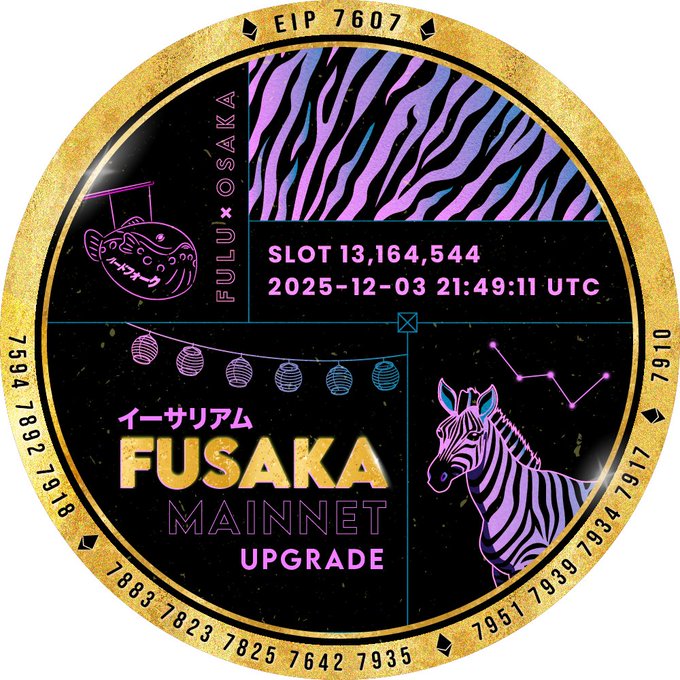
Ethereum's Fusaka upgrade is now live on mainnet after activating at epoch 411392 on December 3rd at 21:49 UTC.
The upgrade implements 13 Ethereum Improvement Proposals (EIPs) that bring significant scaling and user experience improvements:
- PeerDAS unlocks 8x data throughput for rollups, enabling cheaper blob fees and faster confirmations
- R1 curve support enables mobile-native passkeys and simpler signatures for better wallet UX
- Based pre-confirmations reduce transaction latency from minutes to milliseconds
- Gas limit increase from 45M to 60M expands network capacity
- New per-transaction gas cap of 2^24 requires developer attention
Key upcoming dates:
- BPO1: December 9th
- BPO2: January 7th
Community members continue monitoring the network for any issues over the next 24 hours following the successful activation.

Join the @ethStaker community to watch the Fusaka Mainnet upgrade go live. Discuss secure scaling, PeerDAS, and the next era of onchain growth with core researchers before the fork hits at ~21:49 UTC. Today at 21:20 UTC.

Today Ethereum forks to Fusaka! 🦓 Join the Community Watch Party at 21:20 UTC (4:20pm ET) to - hear about what's new in Fusaka - watch the fork (21:49 UTC) - get ready for what's coming in Glamsterdam - and collect POAPs for being part of history! livestream link below ↓

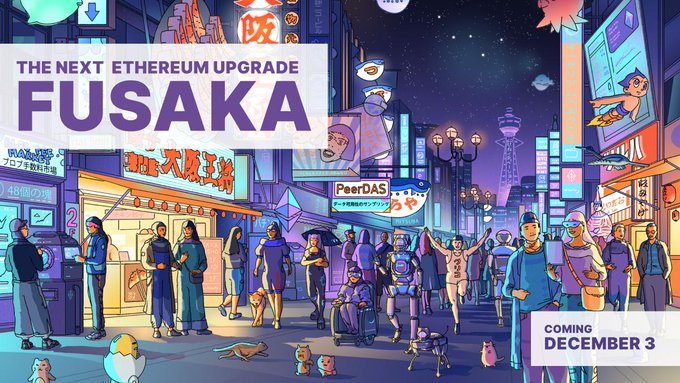
1/ Fusaka is coming December 3rd. Ethereum’s next major upgrade shows that the network can grow to meet global demand, without compromising on decentralization or permissionlessness. Whether you’re a user, builder, institution, or operator, here’s how Fusaka will impact you.
upgrade in progress . . . activating Fusaka @ epoch 411392 // 21:49:11 UTC
Missed the Fusaka network upgrade? 13 Ethereum Improvement Proposals (EIPs) are now live on Mainnet. Here’s Fusaka in 35 seconds.
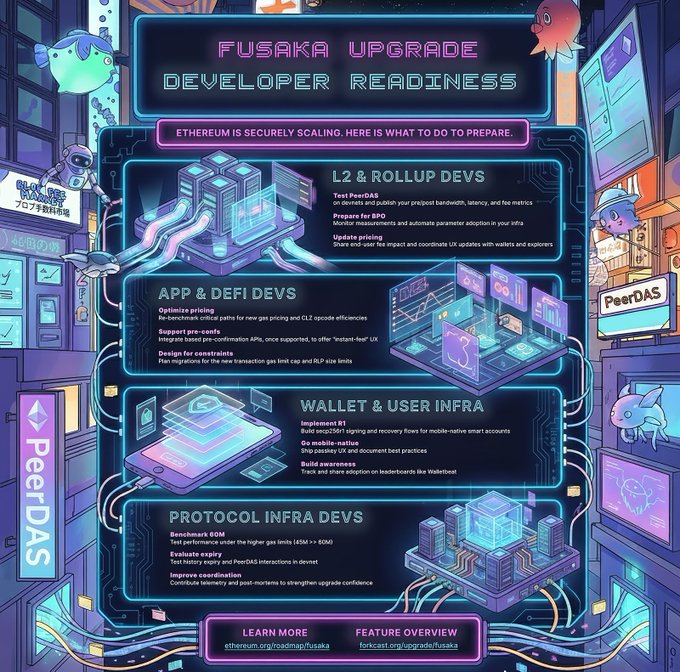
1/ The Fusaka upgrade is coming December 3rd. Ethereum is securely scaling. Are you ready to support the changes? Here’s what developers across the ecosystem need to do to prepare 🧵
Devcon 8 Tickets Now Available for Mumbai Event This November
**Devcon 8 tickets are now on sale** for the Ethereum community's annual gathering in Mumbai this November. The event will bring together: - Builders and researchers - Protocol maintainers - Community organizers - Anyone interested in Ethereum's development This year's conference emphasizes a **more focused and intimate format** compared to previous editions. The gathering centers on core Ethereum values including open source development, privacy, security, and censorship resistance. **Availability is limited**, so interested attendees should secure their spots early. [Get tickets](https://devcon.org)
Devcon 8 Tickets Now Available for Mumbai Event This November
**Devcon 8** is scheduled for November 3-6, 2026 at the JIO World Center in Mumbai, India. The annual Ethereum community conference will focus on core principles: - Open source development - Privacy - Security - Censorship resistance **Tickets are now available** but spots are limited for this global gathering of Ethereum builders and developers. The event serves as the primary annual meeting point for the Ethereum community to discuss technical developments and the future direction of the ecosystem.
🛡️ ETH Rangers Program Launches to Fund Ethereum Security Work
The Ethereum Foundation has partnered with Secureum, The Red Guild, and Security Alliance (SEAL) to launch the **ETH Rangers Program** in late 2024. The initiative provides **financial stipends** to individuals conducting public goods security work within the Ethereum ecosystem. **Key details:** - Program aims to incentivize security research and protection efforts - Supported by the Protocol Security Research Team and Ecosystem Funding Initiative - Focuses on strengthening Ethereum's overall security infrastructure The program represents a collaborative effort to reward those contributing to the network's safety and resilience.
Ethereum Ecosystem Ships 22 Updates: Privacy Tools, AI Agents, and Institutional Infrastructure
The Ethereum ecosystem delivered significant updates across privacy, AI integration, and institutional infrastructure. **Privacy Advances** - Aztec Network Alpha launched with native privacy features - Scroll enabled private transfers onchain - Hinkal Pay introduced end-to-end confidential payments - Peer Verify allows privacy-preserving identity proofs via ZK **AI Integration** - Morpho Agents (beta) enables natural language lending integration - Venice shipped verifiable encrypted AI systems - Coinbase's x402 protocol moves to Linux Foundation for AI payment standards **Infrastructure Updates** - Ethereum Economic Zone framework aims to unify L1 and L2s - Aave V4 released with hub-and-spoke architecture supporting 20+ assets - Fast Confirmation Rule reduces L1 to L2 deposit times to 13 seconds - Post-quantum wallets launched on Starknet **Institutional Progress** - Stablecoins on Ethereum surpassed $180B supply (60% global market share) - ZKsync's Cari Network brings tokenized deposits onchain with five regional banks - ENS integrated with PayPal for cross-border payments **Security & Recovery** - Privacy Ethereum released Social Recovery SDK for wallet restoration - Safe launched Safenet (beta) pre-execution security layer - Silo V3 introduced safer lending market architecture The Ethereum Foundation published its mandate and launched [pq.ethereum.org](https://pq.ethereum.org) for post-quantum cryptography research.
Ethereum Foundation Publishes Official Mandate Document
The Ethereum Foundation has released its **EF Mandate**, a comprehensive document that functions as a constitution, manifesto, and operational guide for the organization. The mandate is primarily intended as an internal framework to clarify the Foundation's purpose and direction. It outlines the EF's core mission and responsibilities within the Ethereum ecosystem. The full document is available at ethereum.foundation/ef-mandate.pdf for those interested in understanding the Foundation's formal structure and objectives.