Ethereum's Fusaka Upgrade Cuts L2 Fees by 40-60%
Ethereum's Fusaka Upgrade Cuts L2 Fees by 40-60%
⚡ Ethereum just got cheaper

Ethereum's Fusaka upgrade has launched, targeting affordability and scalability for tokenization projects.
Key improvements:
- PeerDAS technology reduces L2 reporting costs to Ethereum mainnet
- Transaction fees on Layer 2s like Arbitrum and Base drop 40-60%
- Gas limit increases from 45M to 60M, boosting throughput
- Passkey support enables Face ID wallet security instead of seed phrases
Impact on tokenization:
- Makes real-world asset tokenization economically viable
- Enables high-volume transactions at lower costs
- Opens door for mainstream adoption of on-chain assets
The upgrade positions Ethereum to handle billions of users while maintaining low costs and high security. Next major update "Glamsterdam" planned for H1 2026.

What does the Fusaka upgrade mean for tokenization? Ethereum's Fusaka upgrade is here. This upgrade is not just technical. It's the massive scaling event that finally unlocks tokenization. Especially for RWAs. Here is what you need to know 👇 The main goal of the upgrade is
Bitbond Launches No-Code Platform for Compliant Token Offerings
Bitbond has introduced **Offering Manager**, a platform that enables token offerings without requiring developer expertise. **Key features:** - Configure offering parameters including pricing and caps - Built-in KYC/AML investor onboarding through branded portals - Multiple payment options: bank transfer, credit card, and stablecoins - Automated token distribution upon offering completion - Support for Ethereum, Solana, and Stellar networks The platform targets enterprises looking to tokenize assets like equity, real estate, and digital bonds while maintaining regulatory compliance. A free version is available at [om.bitbond.com](https://om.bitbond.com).
Bitbond Selects Lava Network for Enterprise-Grade RPC Infrastructure

Bitbond has chosen Lava Network as its RPC provider to support institutional-scale tokenization operations. **Key Points:** - Lava Network has processed over 150 billion RPC calls across 30+ blockchain networks - The infrastructure powers major global trading platforms - Lava routes traffic to the fastest and most reliable providers on each supported chain - The selection emphasizes the need for zero-downtime blockchain access at enterprise scale Bitbond's Token Tool enables users to create and manage ERC20, ERC1400 tokens, and NFTs across EVM chains using CertiK-audited smart contract templates. The platform serves banks, corporations, and content creators for tokenization projects.
Bitbond Launches Self-Serve Platform for Regulated Token Offerings
Bitbond has opened its Offering Manager platform to the public, allowing companies to launch regulated token offerings without extensive technical overhead. The platform supports three core functions: - **Configure**: Set pricing, investment caps, and custom branding - **Onboard**: Integrated KYC/AML compliance through white-label investor portals - **Collect**: Accept payments via credit cards, stablecoins, and wire transfers The system supports multiple asset types including equity tokens, real estate, and digital bonds. It operates across Ethereum, Solana, and Stellar networks. Bitbond reports the infrastructure has already powered over 300 token offerings. The platform is now available as a self-service tool, with a free tier for getting started. [Learn more](https://om.bitbond.com)
AI Agents Can Now Tokenize Real-World Assets Like Wineries Without Code
**New MCP Server Enables AI-Driven Asset Tokenization** Bitbond Token Tool has launched an MCP (Model Context Protocol) server that allows AI agents to tokenize real-world assets directly onchain without requiring any coding knowledge. **Key Features:** - AI agents can issue and manage tokens for physical assets like wineries - Token deployment takes approximately 30 seconds - Native integration with OpenClaw for seamless agentic workflows - Built on Token Tool's CertiK-audited smart contract templates The new server extends Token Tool's existing capabilities for creating and managing ERC20, ERC1400 tokens, and NFTs across EVM chains. This development makes tokenization accessible to AI agents, potentially streamlining how businesses digitize real-world assets. [Try Token Tool's MCP server](https://tokentool.bitbond.com)
Token Tool Launches 60-Second MCP Install for Claude Desktop and IDEs
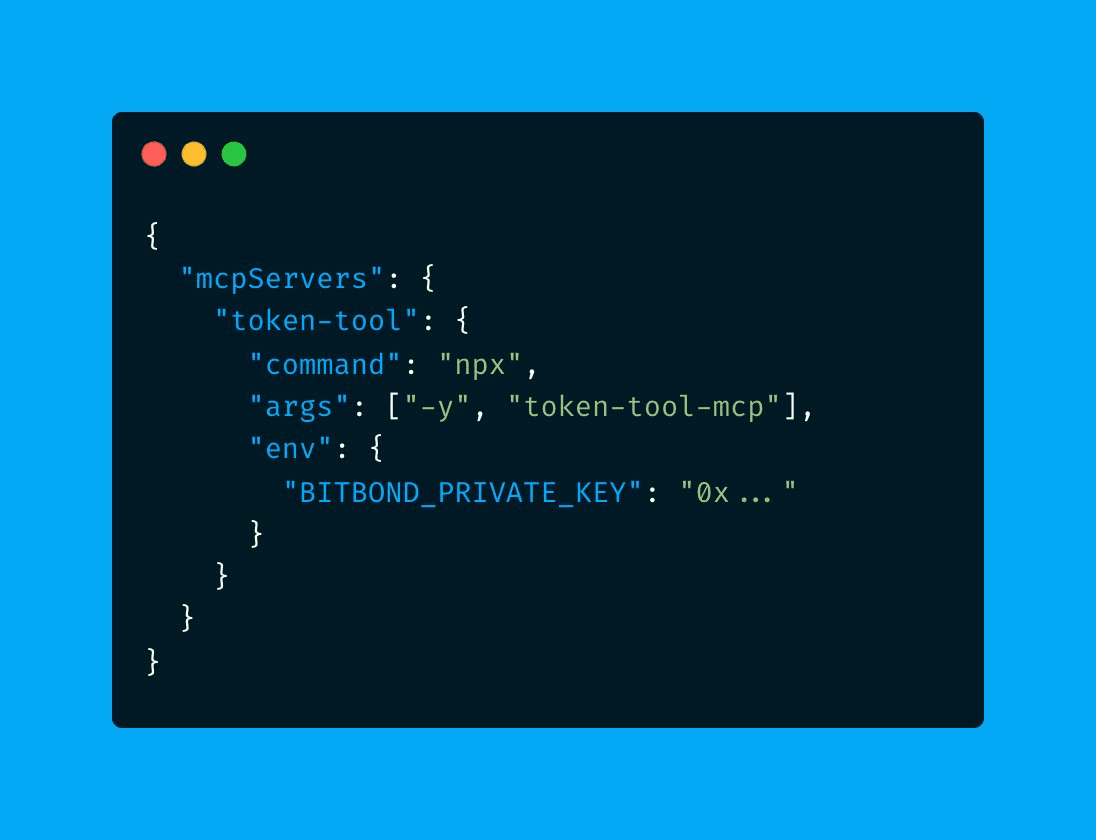
**Quick Setup Process** Token Tool now offers a streamlined installation through Model Context Protocol (MCP) that takes just 60 seconds. Users can install via a single command: `npx -y token-tool-mcp` **Platform Compatibility** - Works with Claude Desktop - Integrates with Cursor - Compatible with VS Code The tool maintains its $299/token pricing for mainnet deployments, matching the existing web UI cost. One-click installation links are available in the project's README documentation. **What This Means** Developers can now access Token Tool's ERC20, ERC1400, and NFT deployment capabilities directly within their development environments, streamlining the token creation workflow without switching between applications.