Enzyme Joins Canton Foundation, Plans Q3 Integration
Enzyme Joins Canton Foundation, Plans Q3 Integration
🏛️ Enzyme Goes Institutional


Enzyme has officially joined the Canton Foundation, marking a significant step in expanding its infrastructure to regulated finance networks.
Key developments:
- Enzyme becomes a member of the Canton Foundation
- Plans to bring Onyx and Myso natively to Canton Network in Q3 2026
- Aims to provide vault infrastructure for Canton's privacy-first, regulated finance rails
Canton Network focuses on institutional-grade blockchain infrastructure with privacy features designed for regulated financial institutions. Enzyme's integration will bring its decentralized asset management capabilities to this environment.
The move represents Enzyme's strategic expansion beyond Ethereum into networks serving traditional finance institutions seeking blockchain solutions.

Enzyme is now a member of the @CantonFdn 🎉 We're looking forward to actively contributing to the ecosystem as we get ready to bring Onyx and Myso natively to @CantonNetwork in Q3. See you there 👋 @digitalasset

Tokenized Assets Hit $60B But Half Remain Illiquid

The tokenized asset market has reached **$60 billion**, but approximately half of these assets are currently illiquid. Forbes describes this situation as "a waiting room" - assets exist on-chain but lack active trading or movement. **Key Points:** - $30B worth of tokenized assets are essentially dormant - This liquidity gap represents a significant infrastructure challenge - Early movers in tokenized fund operations are positioning themselves for future growth Enzyme Finance is developing [Onyx](http://enzyme.finance/products/onyx), a solution aimed at addressing this liquidity problem in the tokenized asset space. The platform targets fund managers and issuers looking to build operational infrastructure for tokenized assets. The situation highlights a common pattern in emerging markets: rapid asset growth outpacing the development of supporting infrastructure and liquidity mechanisms.
Onyx Simplifies Cross-Chain Fund Management with Chainlink CCIP Integration
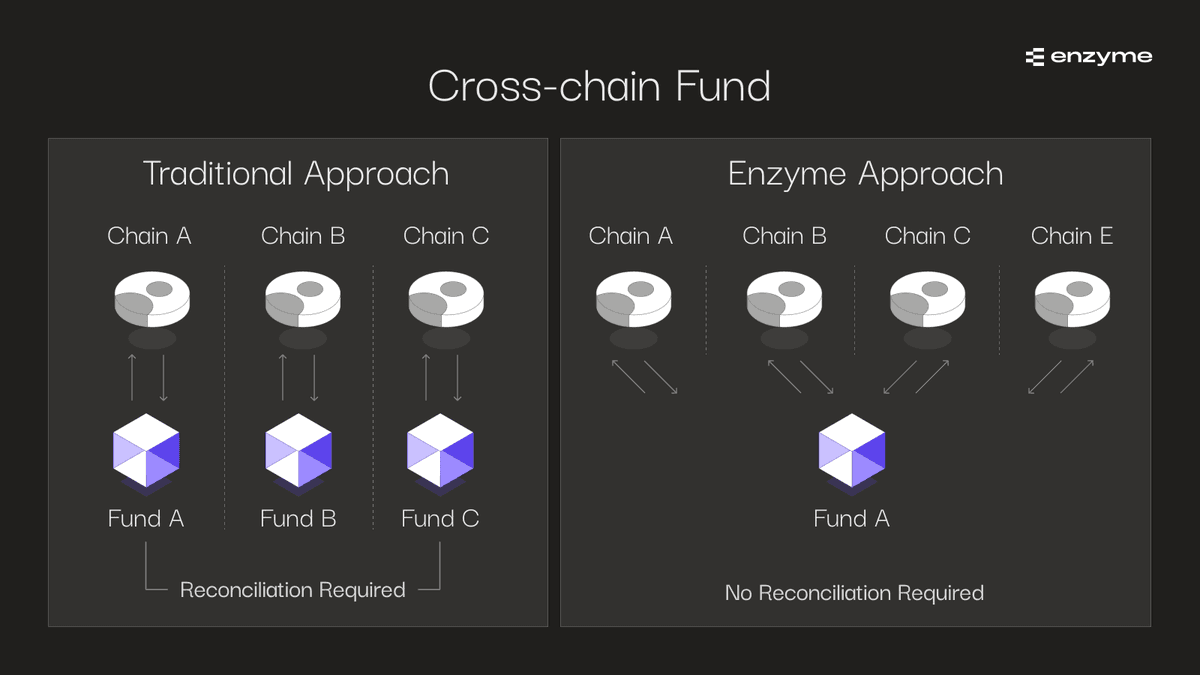
Onyx has introduced a cross-chain deposit feature that addresses a common pain point in vault infrastructure. The solution allows investors to deposit from any EVM chain into a single fund automatically. **Key features:** - Powered by [Chainlink CCIP](https://chain.link/cross-chain) - Managers can accept deposits and redemptions from any EVM chain - Maintains a single fund without requiring extra deployments - Eliminates reconciliation complexity Traditionally, vault infrastructures push cross-chain complexity onto fund managers. Onyx's approach centralizes this process, making multi-chain fund management more accessible. The feature is now live for managers looking to streamline their cross-chain operations.
Credilabs and Turtle Launch Tokenized Credit Card Receivables on Enzyme via Visa Program
**Credilabs** and **Turtle** have successfully implemented a **tokenized credit card receivables financing structure** on the Enzyme protocol as part of a Visa program. **Key Details:** - The implementation represents a real-world application of tokenized finance infrastructure - Built on Enzyme's asset management protocol on Ethereum - Part of Visa's broader blockchain and tokenization initiatives This deployment demonstrates how traditional financial instruments like credit card receivables can be brought on-chain through tokenization, enabling more efficient and transparent financing structures. Learn more at [enzyme.finance](http://enzyme.finance)
Private Credit On-Chain: From Theory to Practice
**The Reality of On-Chain Private Credit** Private credit represents a massive $6 trillion market that remains largely trapped in traditional spreadsheet-based systems. While many discuss the potential of bringing private credit on-chain, the practical implementation reveals specific challenges and opportunities. **Key Points:** - The infrastructure for on-chain private credit is moving from concept to actual deployment - Traditional private credit workflows rely heavily on manual processes and legacy systems - Blockchain rails offer potential improvements in transparency, settlement speed, and accessibility - Real-world implementation requires addressing regulatory frameworks and institutional adoption barriers The gap between theoretical discussions and practical applications of on-chain private credit highlights the ongoing evolution of decentralized finance infrastructure. As the market matures, understanding the actual mechanics becomes crucial for participants looking to navigate this emerging space.