El Salvador Students Build Bitcoin Payment System, Farmers Settle in Sats
El Salvador Students Build Bitcoin Payment System, Farmers Settle in Sats
🌱 Students code payments

Four years after Bitcoin became legal tender in El Salvador, grassroots adoption continues to expand beyond initial implementation.
Key Development at Cherito Cafe:
- Local students independently built a Bitcoin payment system from the ground up
- Farmers now settling harvest payments in satoshis
- Featured in Episode 4 of the Financial Freedom Tour
Broader Context: This follows documented Bitcoin adoption across El Salvador, including:
- Berlin's shops accepting sats and teaching self-custody in classrooms
- El Zonte's circular Bitcoin economy built on education and trust
- Academic institutions like Universidad Tecnológica integrating Bitcoin into curriculum
The student-built payment infrastructure at Cherito Cafe represents organic, bottom-up Bitcoin integration rather than top-down mandate implementation.

Some places talk about Bitcoin. The town of Berlin in El Salvador uses it. ⚡🇸🇻 In Episode 3 of the Financial Freedom Tour El Salvador, shops accept sats, classrooms teach self-custody, and a town quietly grows into a circular Bitcoin economy.
It has been four years since $BTC became legal tender in El Salvador. At @CheritoCafe, local students built a Bitcoin payment system from scratch, and now local farmers are settling harvests in sats. Episode 4 of the Financial Freedom Tour is out now. ☕
Episode one of the Bitfinex Financial Freedom Tour in El Salvador is now live 📽 With @criptobastardo and @bitdriver_sv, we step inside the Universidad Tecnológica de El Salvador to see how Bitcoin is being taught, discussed, and questioned in an academic setting.
We're already counting down to next year. 🇸🇻 A month back at Plan B Forum El Salvador reminded us why Bitcoin Country matters. The vision of financial freedom shared in a place that turned conviction into action. Watch the full recap! 🟧
Bitcoin did what banks never could. 🇸🇻 Today in the Financial Freedom Tour, @criptobastardo, and @bitdriver_sv visit El Zonte, a small coastal town in El Salvador that built one of the world’s first circular Bitcoin economies through education, trust, and everyday payments. ⚡
Fed Cuts Rate Outlook to One 2026 Cut as Bitcoin Drops 7%
**Bitcoin fell over 7%** from its local high following the Federal Reserve's hawkish pivot. The FOMC revised its 2026 outlook to just **one rate cut, likely in Q4**, down from previous expectations. **Key developments:** - Significant disagreement among Fed participants on future policy path - Internal Fed uncertainty has historically supported bitcoin prices - Bitcoin had climbed from $71k to $75k in 72 hours before the announcement - Institutions absorbed nearly 5x daily miner supply leading into the decision **Market context:** - Bitfinex analysts had predicted the $74,000-$76,000 region would cap BTC in the near term - Over $700M in spot ETF inflows across five consecutive March sessions - Bitcoin showed decoupling from equities, rising while S&P 500 hit four-month lows The Fed's hawkish stance strengthened the dollar and weighed on risk assets, though historical patterns suggest Fed policy uncertainty could eventually benefit bitcoin.
🚗 From Banking to Bitcoin: El Salvador's Transport Revolution
**Former Bank Executive Pivots to Bitcoin Transport** Napoleon Osorio spent 15 years as a banking executive before the pandemic disrupted his career. Rather than returning to traditional finance, he founded **BitDriver**, El Salvador's first private transport company operating entirely on Bitcoin. The story is featured in Episode 5 of *The Bitcoin Dream in El Salvador*, showcasing how the country's Bitcoin adoption is enabling new business models. BitDriver represents a practical application of cryptocurrency in everyday services, moving beyond speculation into real-world utility. This follows El Salvador's broader Bitcoin integration, including companies like Ditobanx launching Bitcoin financial services across Latin America.
Bitcoin Short-Term Holder SOPR Tests Critical 1.0 Level at $70,600
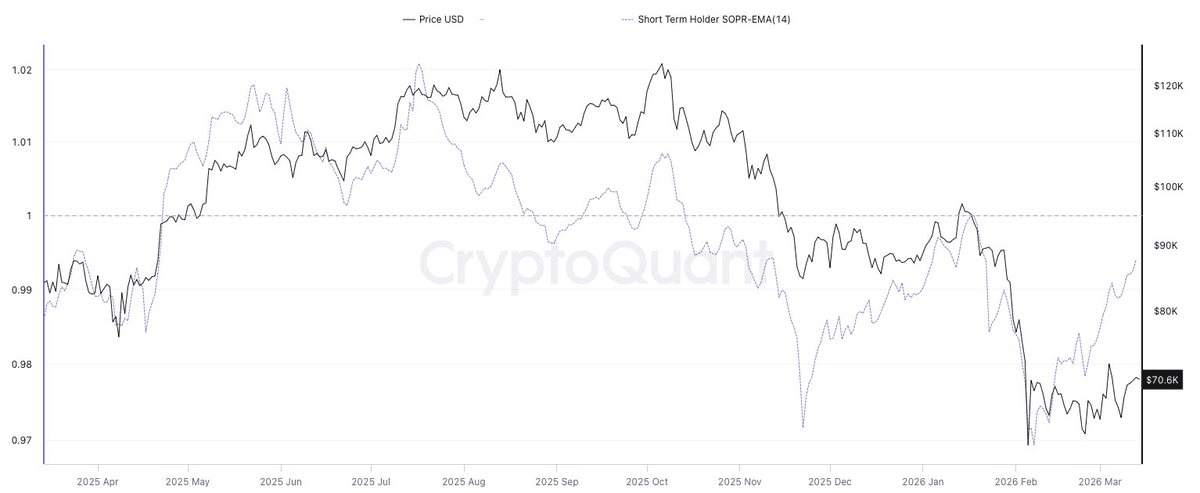
Bitcoin's Short-Term Holder Spent Output Profit Ratio (SOPR) is nearing the 1.0 threshold at $70,600, a key on-chain metric that tracks whether recent buyers are selling at a profit or loss. **Key Points:** - SOPR approaching 1.0 from below, matching mid-January pattern - Previous test at this level capped the rally - On-chain traders monitoring whether it acts as resistance or breaks higher **What This Means:** When SOPR is at 1.0, short-term holders are breaking even on average. This level has historically acted as a psychological barrier. The mid-January test resulted in price resistance, and traders are now watching to see if history repeats or if Bitcoin can push through to establish new momentum. The outcome at this level could signal the next directional move for Bitcoin's price action.
Bitfinex Offers Zero-Fee Trading on All ETH Pairs

Bitfinex has announced zero-fee trading across all ETH pairs on its platform. The fee waiver applies to: - Spot trading - Margin trading - Derivatives trading This move comes as Ethereum continues to power the most widely used blockchain network. The zero-fee structure aims to reduce trading costs for users engaging with ETH markets across different trading products. Traders can now execute ETH transactions without incurring standard trading fees on the Bitfinex platform.
Tier 1 Firms Sit on $36.8bn in Idle Collateral as Tokenised RWAs Hit $25bn

**Tokenised real-world assets (RWAs) have crossed $25 billion**, but the real opportunity lies elsewhere. **Tier 1 financial firms currently hold $36.8 billion in overnight collateral that earns zero return.** This idle capital represents the actual market opportunity - putting these assets to work as productive collateral on-chain. The gap between tokenised RWAs ($25bn) and unused institutional collateral ($36.8bn) highlights where the next phase of growth will come from: **activating dormant institutional assets rather than simply tokenising new ones.** This follows recent data showing RWAs topped $350 billion on-chain, with institutions increasingly using tokenised Treasuries as collateral to borrow stablecoins and improve capital efficiency. The shift signals that **institutions are moving from passive holding to active deployment** of tokenised assets in programmable credit markets.