DIA ZK Brings Verifiable Proof to Offchain Assets
DIA ZK Brings Verifiable Proof to Offchain Assets
🔐 Trust issues solved

DIA has launched DIA ZK, a proof layer that makes offchain data verifiable onchain without exposing sensitive details.
The problem it solves:
- Yield-bearing stablecoins, tokenized treasuries, and vaults often earn returns offchain (CEX trades, private credit, CeFi lending)
- Holders and risk managers can't verify custody balances, exchange positions, or loan books
- In June 2026, a stablecoin lost its peg after its third-party verifier ended their relationship, affecting $18M in collateral
How DIA ZK works:
- Proves data came from the stated source without alteration
- Verifies conditions (like reserves > supply) without revealing actual numbers
- Proofs posted on DIA's oracle chain, not dependent on single providers
Why it matters:
- MiCA already requires reserve disclosure in the EU
- US GENIUS Act will introduce federal requirements for stablecoin issuers
- Enables continuous proof of backing without forcing full book disclosure
The assets earning the most are usually the ones whose backing is hardest to see. If your protocol holds stablecoin reserves, tokenized fund NAVs, or vault collateral offchain, DIA ZK is where to start. diadata.org/blog/post/dia-…
DIA ZK is a proof layer for offchain data, built on top of DIA's existing oracle stack. It makes an offchain value verifiable onchain in two ways: proving where it came from, and proving what it satisfies without revealing the number itself.

Today, we are excited to launch DIA ZK, the verifiable data assurance layer for DeFi, RWAs, and cross-chain applications. Yield-bearing stablecoins, tokenized treasuries, and vaults built on offchain strategies now hold tens of billions in onchain value. The highest yields among

🏦 st0x brings 24/7 tokenized stock trading to Base using DIA oracles
**st0x** has launched continuous trading for tokenized equities and ETFs on Base, with each token backed 1:1 by shares held at a regulated broker. **Key technical implementation:** - DIA oracles provide session-aware price feeds that distinguish between regular hours, pre-market, post-market, and closed sessions - This prevents the order book from anchoring to incorrect reference prices across different market states - The integration maintains price freshness while keeping market sessions properly separated The platform enables onchain stock trading around the clock, moving beyond traditional market hours while maintaining proper price discovery through oracle infrastructure. [Read the full technical breakdown](https://www.diadata.org/blog/post/how-st0x-uses-dia-oracles-for-tokenized-equity-trading/)
Morpho's Midnight Tackles Fixed-Rate Lending with Intent-Based Architecture
Morpho launched **Midnight**, a fixed-rate lending protocol designed for institutional terms. The platform addresses a decade-long challenge: traditional fixed-rate protocols required deep two-sided orderbooks that never materialized onchain. **Key innovations:** - Intent-based offers replace orderbook matching - Support for up to 128 collateral types - KYC callback integration in a single signature Morpho co-founder Merlin Egalite outlined the ambitious scope: targeting the **$200 trillion global credit market**, compared to today's $60 billion in crypto-backed loans—a potential 3,000x expansion. The shift from orderbook to intent-based architecture aims to solve the liquidity depth problem that stalled previous fixed-rate attempts. Full discussion: [Beyond Yield episode](https://www.youtube.com/watch?v=5l4eGiFE9KM)
🏛️ EU and US Stablecoin Rules Shift from Snapshots to Continuous Monitoring
**Regulatory frameworks in both the EU and US are transforming how stablecoin reserves are verified.** MiCA has required EU stablecoin issuers to maintain matching reserves, perform daily reconciliation, and provide periodic attestation since mid-2024. The GENIUS Act introduces parallel requirements in the United States. **The key shift:** Both regulations convert proof of backing from a one-time checkpoint into an ongoing compliance obligation. This marks a fundamental change in stablecoin oversight—moving from periodic audits to continuous verification standards across major markets.
DIA's Zero-Knowledge Proofs Enable Privacy-Preserving Financial Verification
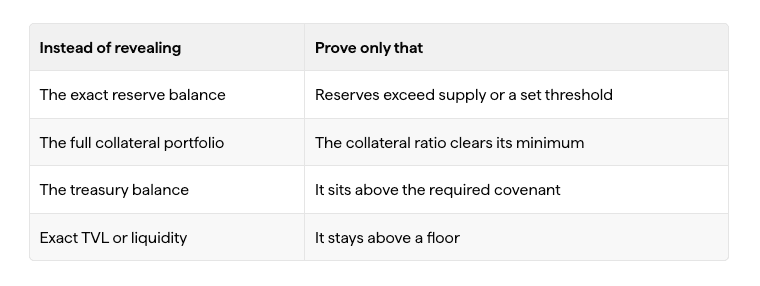
DIA is implementing **zero-knowledge (ZK) proofs** that verify financial statements without revealing underlying values. **Key applications:** - Curators can confirm reserves exceed supply without seeing exact balances - Lending markets verify collateral ratios without portfolio disclosure - Protocols maintain privacy while proving solvency This approach differs from DIA's existing Value oracle, which computes fair value from first-party reserve data for protocols like Zest Protocol's USDh integration. The selective disclosure model allows **verification without exposure** - proving the truth of a statement while keeping sensitive financial data private.