Decentralized Lending Protocol Explained
Decentralized Lending Protocol Explained
🤯 Mind-Bending Lending Protocol

According to recent updates from a decentralized lending protocol, when a borrower takes out a 2 BTC loan at 50% loan-to-value ratio, 1 BTC (in USDC) is removed from the system, while the other 1 BTC remains in the liquidity pools to generate yield through decentralized swaps. The borrowed 2 BTC is recorded as an outstanding debt until repaid, and no fees are charged as the protocol earns revenue from the yield generated. This mechanism differs from a pure mint-burn model and allows the network to honor future loans using the retained liquidity.

Correct way to think about it. For a 2 BTC loan at 50% LTV, 1 BTC is kept in the system (in the pools) making money for the network. It is then at the network’s disposal to honour loans in the future. This is completely different to a pure mint-burn mechanism (Luna)

How exactly does @THORChain sell the 1 BTC? It sends it to its BTC LP for an appropriate amount of RUNE. So the BTC isn't in a vault as collateral, but it is in the network. To worry that TC cannot repay BTC when the loan is paid off is to worry that the number of BTC in TC
If 2 BTC enters the system in a loan, 1 BTC (of USDC) leaves. The net gain of 1 BTC is captured by the system in liquidity pools, where it makes yield by providing decentralised swaps. That's it. (The borrower has 2 BTC ticked up as an IOU slip, with their debt entered as
Station Wallet Returns as Fully Agentic Wallet After Joint Acquisition
**Station Wallet is back** after being jointly acquired by Vultisig and RujiraNetwork, relaunching as a fully agentic wallet with the same interface but completely rebuilt infrastructure. **Key ecosystem launches:** - **LeoDEX** shipped a unified liquidity pool dashboard at leodex.io/earn for managing liquidity across THORChain and Maya Protocol - **THORDEX** added fiat on/off ramps with P2P trades secured by zkTLS via PeerXYZ, with v2 already in development - **RujiraNetwork** raised the bRUNE staking cap to 5 million, opening another 1M bRUNE for real yield from bonded RUNE on THORChain The updates reflect continued infrastructure development across the THORChain ecosystem, with focus on improved user interfaces and expanded staking capacity.
THORChain Nodes Vote on Three New Stablecoin Pools and xUSK Activation
**Node Vote Required: New Stablecoin Pools** THORChain nodes are being asked to vote on three new stable pools to strengthen the RUNE/USD price reference: - **BSC.USDT** - **BASE.USDC** - **TRON.USDT** All three pools are already live with meaningful depth. Adding them makes the TOR anchor more resilient to single-chain or single-issuer disruptions. The proposal is strictly additive with no downside if any pool becomes unhealthy. A 2/3+ supermajority is required to pass. **xUSK Activation Needed** Nodes also need to activate xUSK, the receipt token for USK deployed in Kujira's lending vault. With the merge request live in v3.17, nodes must set: `ENABLESWITCH-GAIA-XUSK: 1` Full details on the USK sunsetting: [RujiraNetwork announcement](https://x.com/RujiraNetwork/status/2040839475916624309)
THORChain Marketing Shift Delivers 27% Session Growth and Page-One SEO Rankings
THORChain's recent marketing efforts are showing measurable results. The protocol reported a **27% increase in website sessions** alongside improved search engine visibility, with SEO rankings now appearing on page one. Key developments include: - Full website redesign currently in progress - Growing presence through Messari and social channels - Improved organic discoverability This marketing update follows a strong Q1 2026 that saw $2.8B in trading volume and the integration of Solana. The protocol also shipped v3.17.0, a major upgrade featuring over 100 improvements to security, swaps, and cross-chain functionality. The team attributes the marketing momentum to strategic positioning and consistent execution. As THORChain expands to additional chains including Polygon, Cardano, and Monero, the increased visibility supports broader ecosystem adoption. [Read the full marketing report](https://blog.thorchain.org/marketing-update-feb-march-2026/)
THORChain Burns 64.9M RUNE, Reducing Max Supply to 360M
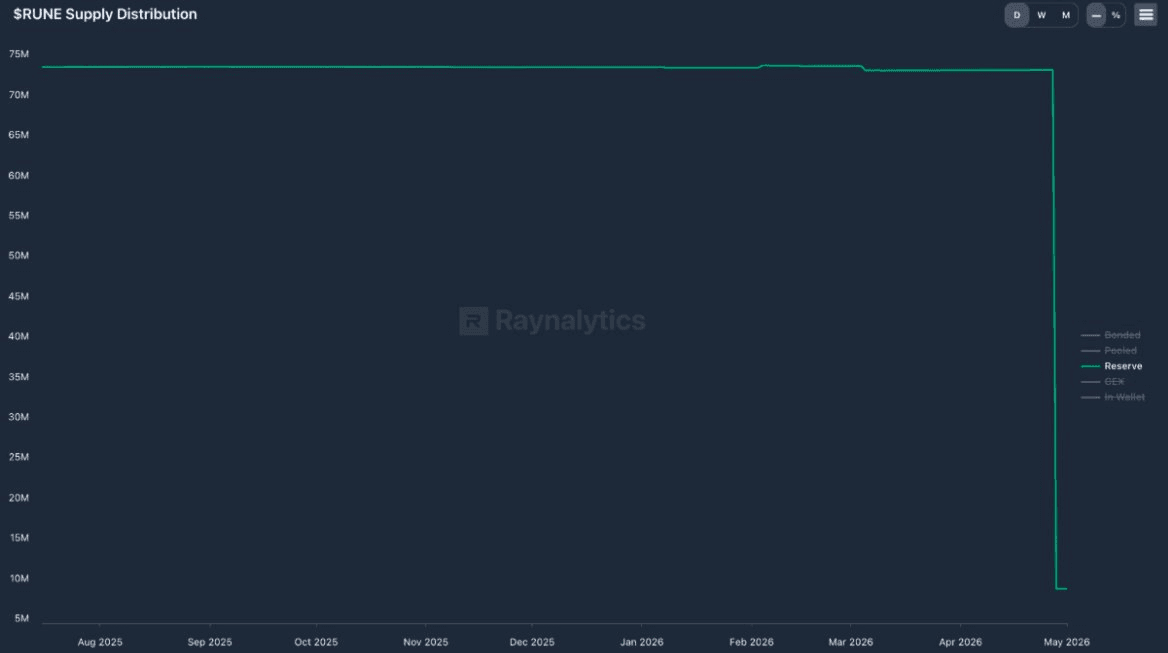
THORChain completed its largest token burn to date through ADR023, removing approximately 64.9M $RUNE from the Reserve. **Key Details:** - Total supply reduced to just above 360M $RUNE - Burn funded by system income, not external sources - Expected to reach exactly 360M within one month **What's Next:** Once the 360M target is reached, nodes will vote to update the MAXRUNESUPPLY Mimir setting from 500M to 360M. This will align the maximum supply with actual total supply, resolving discrepancies currently shown on analytics platforms. The burn represents a significant supply reduction for the cross-chain liquidity protocol.
Why Bridge Hacks Keep Happening and How Atomic Swaps Solve It
**Bridges don't actually move your assets** - they lock them in vaults and issue wrapped tokens as IOUs. When you bridge ETH to Solana, your real ETH sits locked while you receive a synthetic token representing a promise to unlock it later. **This architecture creates a critical vulnerability**: the system must maintain perfect synchronization between locked assets and minted synthetics. Major exploits include: - Wormhole: $320M lost - Ronin: $600M lost - Nomad: $190M lost **THORChain uses a different approach** with atomic swaps. When swapping ETH for SOL, your Ethereum enters a threshold-signature vault while native Solana from a separate vault goes to your address. No wrapped tokens exist. **Key differences**: - Bridge hack → your wrapped tokens become worthless - Atomic swap → transaction either completes or refunds, no synthetic tokens at risk **The tradeoff**: Native swaps are slower and more expensive than bridges, but eliminate the failure mode where users discover their wrapped tokens have no backing. With atomic swaps, you never hold someone else's promise.