🎬 DeAI Corner Debuts
🎬 DeAI Corner Debuts
🎬 New DeAI Show


DeAI Corner launches as a new segment highlighting builders in the decentralized AI space.
The inaugural episode features:
- Host @ghcryptoguy interviewing @vivian7days, CMO at @AskDollyToday
- Discussion on DeAI's impact on Dolly's platform
- Insights into why they chose 0G blockchain
- Vision for Web3 user experience improvements
This marks 0G's continued focus on DeAI development, following their recent Token2049 presentation where CEO @michaelh_0g outlined plans to make AI a public good through their tech stack.
🎓 First 0G Apollo Accelerator Cohort Graduates After Nine-Week Program
The inaugural 0G Apollo Accelerator cohort has completed its nine-week program, with ten teams graduating on Wednesday. **Key Outcomes:** - 100+ introduction requests received from investors, enterprises, and partners since Demo Day - Strong interest continues two weeks after the initial Demo Day presentation - Two founders shared their experiences from the program The accelerator focuses on the DeAI L1 ecosystem, supporting early-stage teams building decentralized AI infrastructure and applications.
UV Labs Integrates 0G in Under 30 Minutes, Cuts Costs for Financial AI Training
**UV Labs**, which builds training data for financial reasoning models, integrated **0G** in less than 30 minutes end-to-end. The integration delivered immediate benefits: - Reduced operational costs - Enhanced value proposition for their platform UV Labs specializes in data and infrastructure for training financial reasoning LLMs, focusing on risk management to enable models for real trading rather than just chatbots. The platform currently serves 6,000 users running approximately 8,000 agents, processing around $400M in volume.
0G Platform Now Hosts 23 AI Models with Transparent Trust Tiers
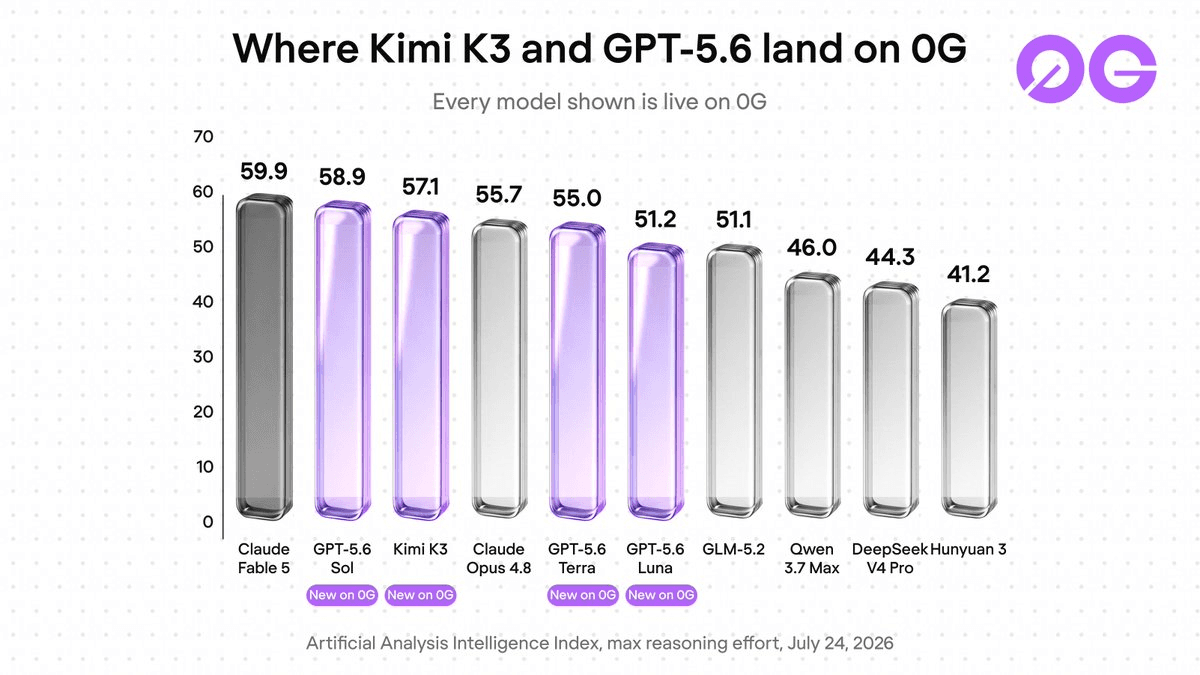
**0G has expanded its AI model offerings to 23 models**, including newly added Kimi K3 and GPT-5.6 series, all running on the 0G Private Computer. **Key features:** - Each model is labeled by trust tier: Private, Verified, or Standard Routing - Single endpoint and API key for all models - Usage settled in $0G tokens - OpenAI-compatible code works with minimal changes - GPT-5.6 offered at 10% below official pricing **Performance benchmarks:** - GPT-5.6 Sol: 58.9 on AA Intelligence Index - Kimi K3: 57.1 on AA Intelligence Index The platform now provides a unified interface for accessing models ranging from the sovereign 0GM to major commercial offerings like Kimi K3 (Moonshot's ~2.8T parameter flagship) and GPT-5.6 in three sizes. Full model catalog: [0g.ai/blog/kimi-k3-gpt-5-6-on-0g](https://0g.ai/blog/kimi-k3-gpt-5-6-on-0g)
0G Introduces Three-Tier Verification System for AI Models
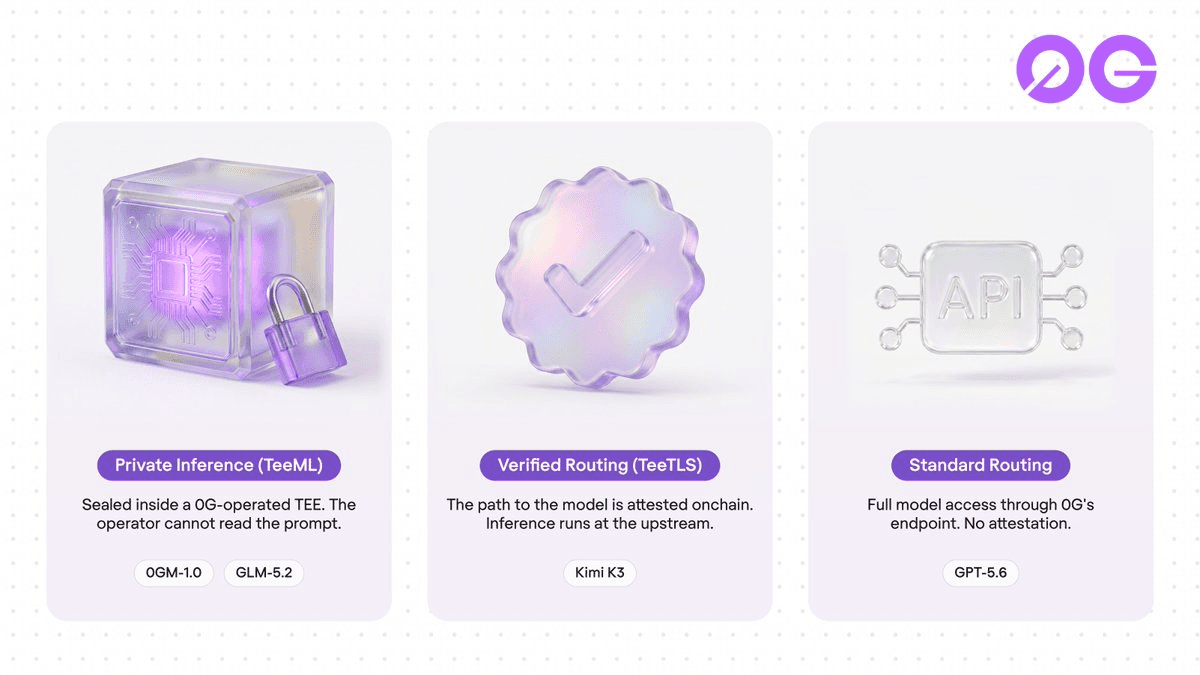
**0G has launched a three-tier verification framework for AI inference:** - **Private Inference**: Computations sealed in a Trusted Execution Environment (TEE) that operators cannot access - **Verified Routing**: Inference path is cryptographically attested and recorded onchain - **Standard Routing**: Traditional model access without attestation guarantees The system addresses a core challenge in decentralized AI: verifying that model outputs are authentic and unmanipulated. Kimi K3 currently operates under Verified Routing, while GPT-5.6 uses Standard Routing. This builds on 0G's earlier Private Computer initiative, which applies crypto's "don't trust, verify" principle to AI inference by attesting every output in a TEE.
0G Introduces Verifiable Model Labeling System for AI Agents
**Trust becomes measurable in AI deployment** Using frontier AI models typically requires blind faith in multiple providers' data policies - a critical vulnerability when agents handle sensitive code or user data. **Key development:** - 0G now labels every model by verification level - Two new models already deployed on the platform - Addresses the "weakest link" problem in multi-model agent systems This builds on 0G's earlier work with 0GM-1.0, which was trained, fine-tuned, and served entirely on their infrastructure - unlike most "Web3 AI" projects that simply rent frontier models through APIs while routing payments through blockchain. The labeling system aims to make trust explicit rather than assumed when deploying AI agents on production systems.