DAOs add LUSD to their treasury; LUSD dipping below peg offers buying opportunities
DAOs add LUSD to their treasury; LUSD dipping below peg offers buying opportunities


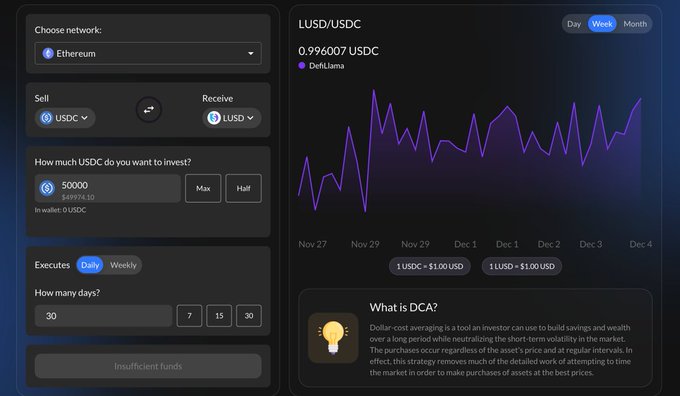
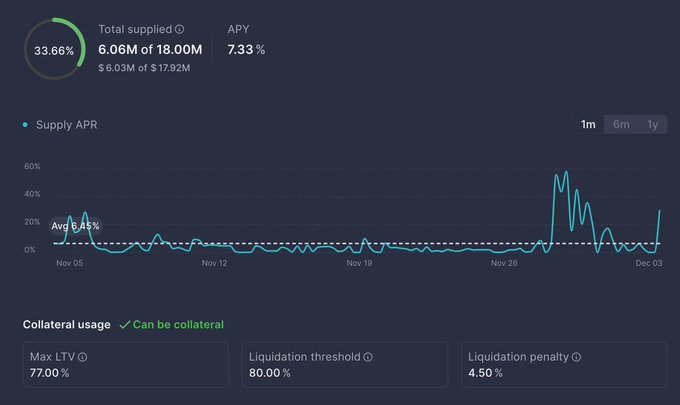
Multiple DAOs have added LUSD to their treasury, recognizing its value. Due to redemptions, LUSD has been slightly below its peg, creating buying opportunities. Users can take advantage by setting up limit orders on 1inch or using Mean.fi for dollar-cost averaging. Additionally, Aave is a good platform for borrowing against LUSD.

Many DAOs have come to the same conclusion, and added $LUSD to their treasury. Due to redemptions, LUSD has been dipping slightly below peg, offering great buying opportunities. Acquiring it that way also makes you immune to redemptions. One way users are taking advantage of


The @LiquityProtocol LUSD redemptions might seem bad for metrics and not great for trove holders' UX, but it is definitely a major benefit to LUSD holders who never have to worry about their stablecoin holdings dropping below 99c on the dollar There are trade offs to all designs
Liquity V2 Offers 0.5% Borrowing Rate with Redemption Protection
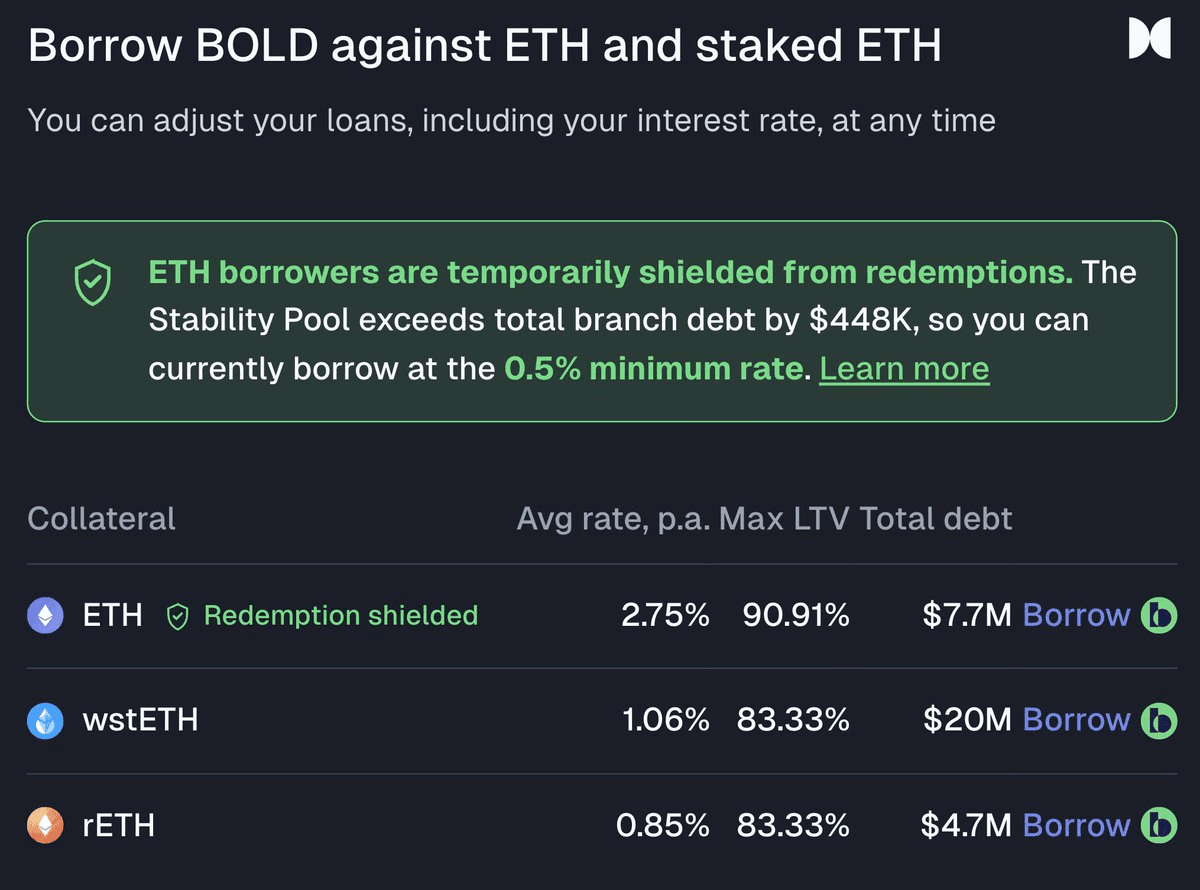
**Liquity V2 now features three isolated collateral branches:** - ETH - wstETH - rETH Each branch operates with its own Stability Pool. When a branch's Stability Pool exceeds its total debt, that branch becomes protected from redemptions. **Key rates:** - rETH: 0.5% (up to 700k) - wstETH: 0.9% - ETH: 2.79% The protocol uses immutable contracts with fixed rates set by individual borrowers. These features are now visible across Liquity frontends at [liquity.app/borrow](http://liquity.app/borrow).
BOLD Stablecoin Receives A- Rating from Bluechip, Outranking USDC and DAI
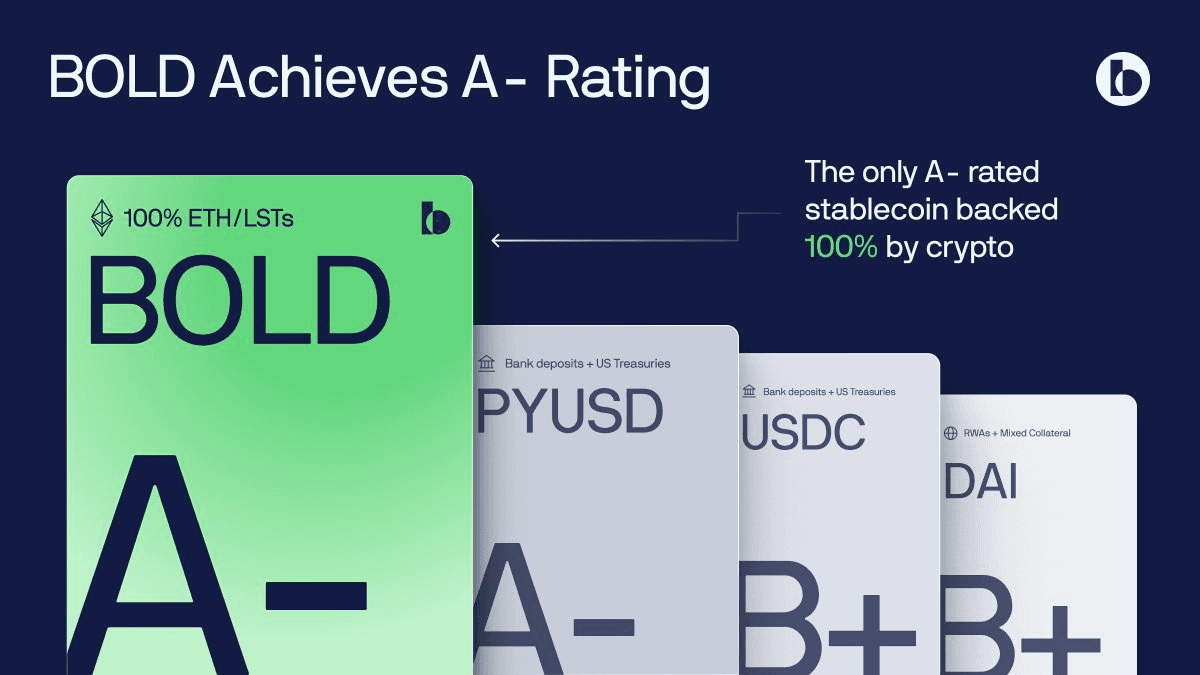
**BOLD stablecoin has secured an A- rating from Bluechip**, making it the only crypto-native stablecoin to achieve an A-tier rating. This places BOLD above established competitors like USDC and DAI, which both received B+ ratings. **Key highlights:** - First crypto-native stablecoin with A-tier rating - Rated higher than USDC (B+) and DAI (B+) - Cannot be frozen, unlike centralized alternatives The rating reflects BOLD's strong fundamentals and decentralized architecture. Users can access BOLD through [Liquity's platform](https://liquity.app/borrow) or purchase it via [DeFi aggregators](https://swap.defillama.com/). View the full Bluechip rating analysis at [bluechip.org](https://bluechip.org/en/coins/bold) and read the detailed breakdown at [Liquity's blog](http://www.liquity.org/blog/bold-receives-a--rating-from-bluechip).
🔄 Liquity Expands BOLD Liquidity Incentive Program
Liquity is calling for liquidity providers to support BOLD stablecoin across multiple decentralized venues. **Key Details:** - Protocol-incentivized liquidity program now active - Multiple venues available for BOLD liquidity provision - Track opportunities via [Dune Analytics dashboard](https://dune.com/liquity/protocol-incentivized-liquidity) **Available Venues Include:** - BOLD/USND on [Bunni](https://bunni.xyz/explore/pools/arbitrum/0x2edd6d9772510c6d661dae96ac65838fd18a535763aaed2b4d5311c87c1cdf95) - BOLD/USDQ on [Honeypop](https://honeypop.app/pools/45) - BOLD/USDFI on [Curve](https://www.curve.fi/dex/ethereum/pools/factory-stable-ng-524/deposit/) - BOLD/AXD on [Pharaoh Exchange](https://pharaoh.exchange/manage/v1/0x3fc764ae09eec2f54b1956febfeaa75d17a596bc) Liquidity providers can bridge BOLD to supported networks using [Transporter](https://www.transporter.io/). View the full [Liquity V2 ecosystem dashboard](https://dune.com/liquity/liquity-v2-ecosystem) for deposit venues.
Liquity V2 Stability Pools Offer 8% APR with Minimal Monitoring
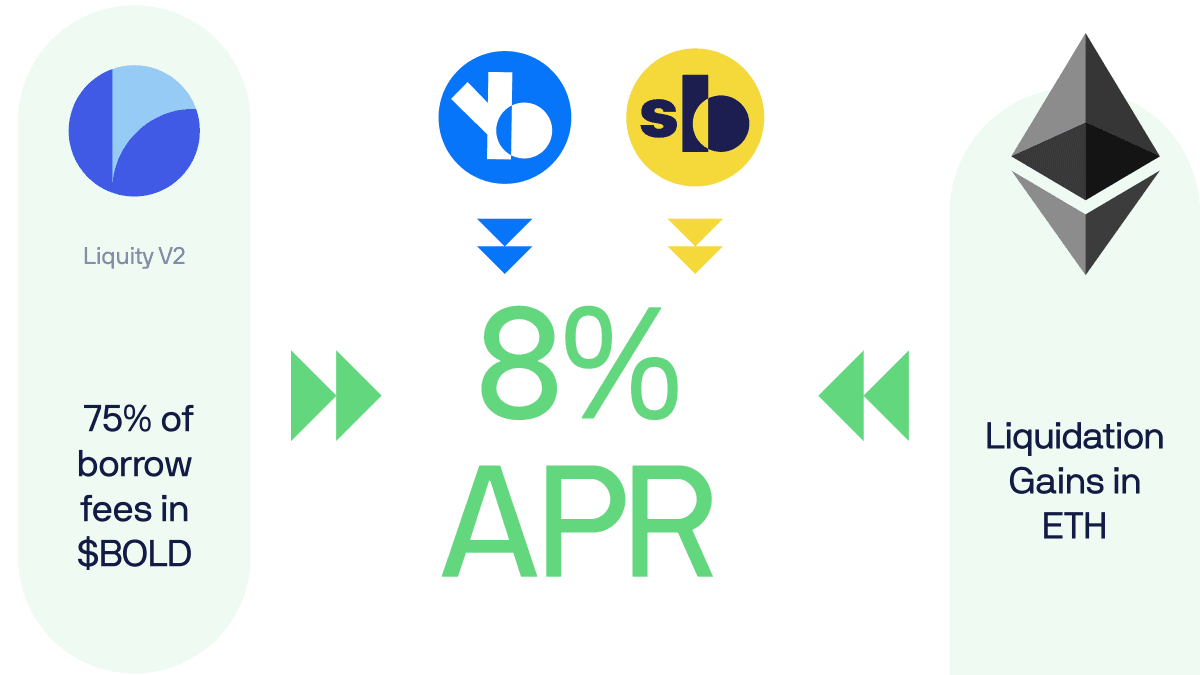
Liquity V2's Stability Pools provide a low-maintenance yield opportunity for DeFi users seeking steady returns. **Key Features:** - Earn approximately 8% APR without weekly monitoring - Functions as a DeFi savings account - Designed for passive income generation The platform positions itself as a lower-risk alternative in the DeFi lending space, emphasizing stability and ease of use. Users can deposit funds and earn yield without active management. **Additional Context:** - Liquity borrowers save around 2% compared to other platforms - Volatility remains below industry averages - Option to delegate to rate managers for optimized returns For users tired of constant portfolio adjustments, Liquity's Stability Pools offer a set-and-forget approach to earning yield in decentralized finance.
🔒 The Stablecoin Paradox
**The Challenge of Decentralized Finance** A critical perspective from Stacy Muur highlights a fundamental contradiction in Ethereum's DeFi ecosystem: true censorship resistance cannot exist when the primary stablecoins remain subject to centralized freezing mechanisms. **BOLD's Approach** - Earned an **A- rating** from Bluechip with perfect 1.0 decentralization scores - 100% backed by staked ETH with immutable, unstoppable protocol design - No admin keys, governance, or ability to freeze user funds - Passes Vitalik Buterin's five critical tests for decentralized systems **Key Distinction** The analysis emphasizes that crypto-backed stablecoins fundamentally differ from bank-backed alternatives, even when ratings appear similar. Technical implementation determines whether money can truly be censorship-resistant. [Read full analysis](http://www.liquity.org/blog/bold-receives-a--rating-from-bluechip) | [Get BOLD](https://liquity.app/borrow)