🔓 Critical Oracle Vulnerability Exposes DeFi Liquidity Layer
🔓 Critical Oracle Vulnerability Exposes DeFi Liquidity Layer
🚨 Oracle bypass exposed

A significant security flaw has been identified in the oracle validation process of DeFi protocols. The vulnerability exists in the gap between the PriceUpKeep forwarder and oracle validation, allowing attackers to bypass security checks.
Key Points:
- Once a signed payload passes initial validation, fabricated prices are treated as legitimate by the protocol
- The entire liquidity layer becomes exposed with no on-chain protection mechanisms
- This attack vector highlights the ongoing risks of oracle dependencies in DeFi
The Broader Context:
Oracle manipulation remains one of the most exploited vulnerabilities in DeFi history. Most protocols rely heavily on price oracles, creating a persistent attack surface. Some protocols are now exploring oracle-free architectures to eliminate this dependency entirely, removing the attack vector at its source rather than attempting to patch it.

The attack surface sits between the PriceUpKeep forwarder and the oracle validation step. Once the signed payload cleared, the protocol treated fabricated prices as canonical, exposing the entire liquidity layer without any on-chain guardrail.
Oracle Security Shifts from Operations to Core Design Priority
Protocols using external price feeds are fundamentally rethinking their security architecture. Signer compromise is now being treated as a primary design consideration rather than an operational risk to manage after deployment. The industry is moving toward: - **Multi-party computation** implementations for distributed trust - **Real-time report verification** systems to catch anomalies immediately - Architectural changes in upcoming protocol deployments This represents a maturation of the oracle security model, acknowledging that centralized signing keys create systemic vulnerabilities that must be addressed at the protocol level, not just through operational procedures.
Second Perp-DEX Exploit in 48 Hours Exposes Off-Chain Signing Vulnerabilities
Two perpetual decentralized exchanges have been exploited within 48 hours, both through compromised off-chain signing mechanisms rather than flaws in audited smart contract code. This marks a significant shift in the DeFi threat landscape. Traditional security audits focus on on-chain contract logic, but these attacks bypassed that layer entirely by targeting the off-chain infrastructure used for transaction signing. **Key implications:** - Smart contract audits alone are no longer sufficient protection - Key management and custody practices now represent the primary attack surface - Oracle and price feed authenticity verification becomes critical The pattern echoes a December 2023 incident where OKX DEX lost $2.7 million after a compromised private key enabled a malicious proxy contract upgrade. DeFi protocols must now prioritize: - Multi-signature schemes for critical operations - Hardware security modules for key storage - Robust monitoring of off-chain signing services - Verification mechanisms for external data feeds This evolution in attack vectors suggests the industry needs to expand its security framework beyond code audits to encompass operational security and infrastructure hardening.
Ostium Loses $23.75M on Arbitrum Through Compromised Oracle Signer Key

**Ostium suffered a $23.75M exploit on Arbitrum** - but it wasn't due to a smart contract vulnerability. **What happened:** - An attacker compromised an external oracle signer key - They injected future-dated oracle reports into a single executeBatch call - This enabled 20 looped profitable trades against the OLP vault **Key detail:** The exploit manipulated Ostium's price feed through the compromised signer, allowing the attacker to drain funds from the Arbitrum-based perpetuals exchange. The incident highlights the critical importance of securing oracle infrastructure and signer keys in DeFi protocols.
May CPI Hits 4.2%, Bitcoin Swings 1.3% in Five Minutes
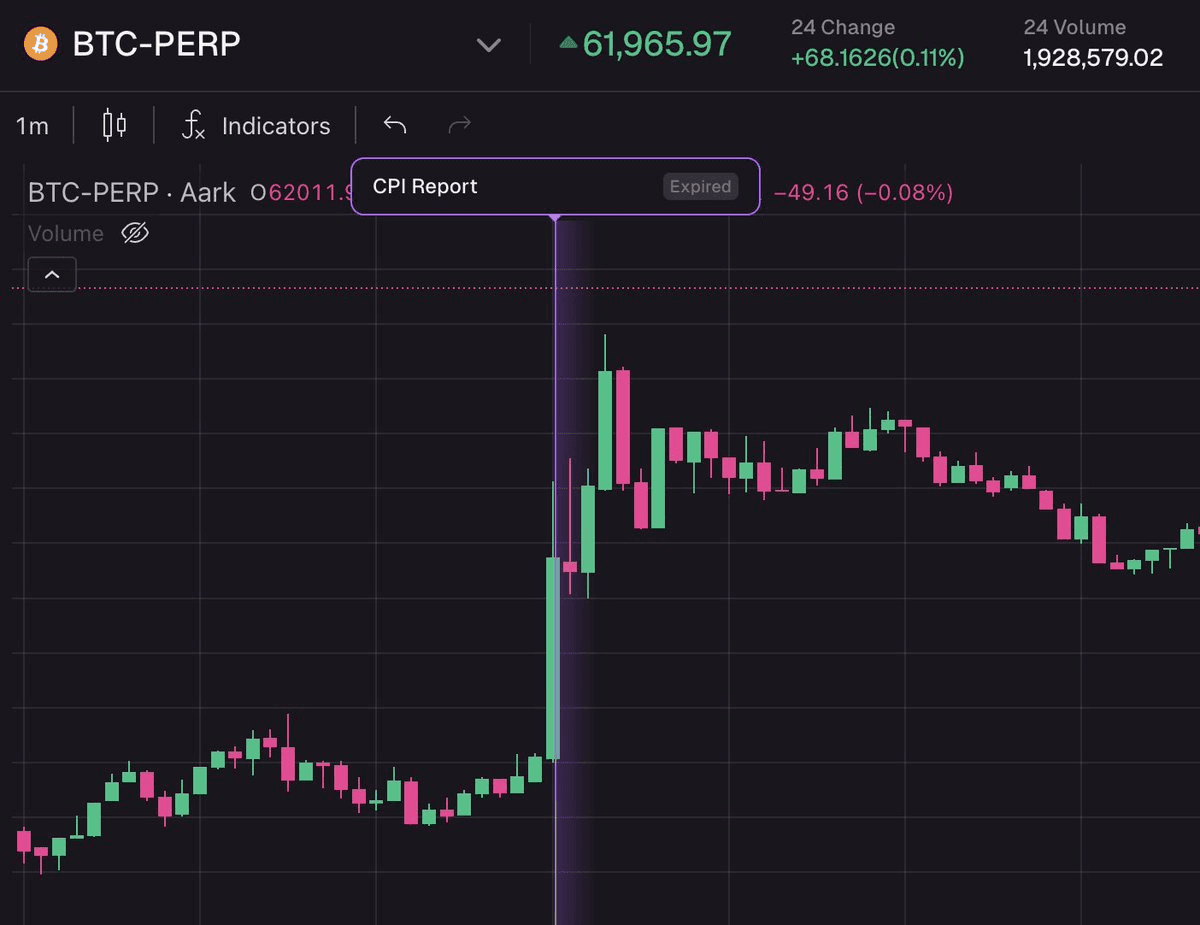
**May CPI Data Triggers Bitcoin Volatility** - May CPI came in at **4.2% year-over-year**, the hottest reading since 2023 - Bitcoin experienced a **1.3% high-to-low range** in the 5 minutes following the release - The move was **~7x larger** than the prior 5-minute period - First minute alone saw a **0.9% swing** **Market Reaction** Despite the hot headline number, Bitcoin caught a bid as core inflation metrics cooled. The volatility arrived precisely on schedule, consistent with historical patterns. Traders using 1000x leverage on Aark could have captured 500% returns on a 0.5% move, highlighting the extreme risk and opportunity during macro data releases.