Chainlink Facilitates Cross-Chain Interoperability for Tokenized Assets
Chainlink Facilitates Cross-Chain Interoperability for Tokenized Assets


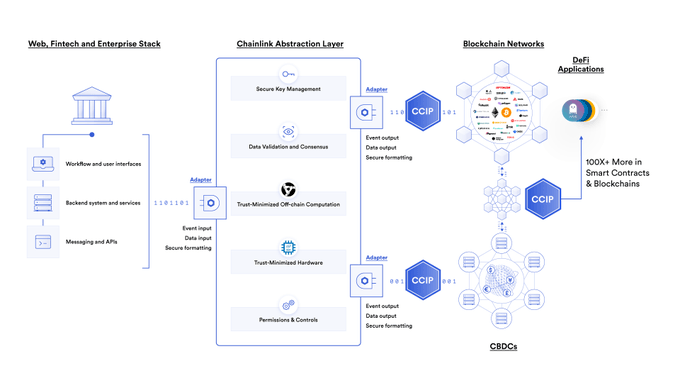
Chainlink provides the necessary tools for tokenized assets to gain liquidity by enabling cross-chain interoperability, verifying offchain reserves, providing mark-to-market valuations, and offering identity verification. Traditional financial institutions require data, compute, and cross-chain capabilities to adopt blockchain and tokenized assets, with Chainlink being the sole platform offering these features. The industry emphasizes the importance of cross-chain solutions, communication between traditional financial markets and blockchains, and the need for information networks and data sources to validate tokenized assets. Major financial institutions are already embracing tokenization, with collaborations involving Chainlink and other industry leaders in progress.

“The simplest way to enable interoperability is to use the same standards and underlying technologies across all platforms and ecosystems,” notes a recent industry report by Swiss Fintech Innovations, which references #Chainlink CCIP. Three key highlights from the report: 1.
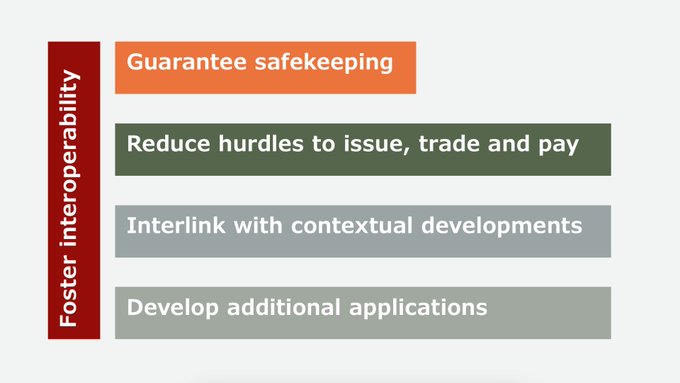
“The industry is ready for tokenization.” At Sibos 2023, Chainlink Labs team members met with world-leading financial institutions. One insight from talking with industry leaders was that the financial system is ready for tokenization. Since the September event, there have
“ETFs are step one in the technological revolution in the financial markets. Step two is going to be the tokenization of every financial asset”—Larry Fink, CEO of @BlackRock on @CNBC.
You just issued your first tokenized asset on your own private blockchain—a good first step. However, you quickly realize that most buyers reside on other blockchains. Your tokenized asset will have low liquidity—unless it is cross-chain interoperable. Furthermore: • Buyers
Traditional financial institutions need data, compute, and cross-chain capabilities to adopt blockchains and tokenized #RWAs at scale. Only the Chainlink platform provides all three. blog.chain.link/tokenization-f…
Lombard Finance Enables Cross-Chain Bitcoin Deposits via Chainlink Integration
**Lombard Finance has integrated Chainlink** to enable cross-chain distribution for its Bitcoin Onchain Credit Strategy, developed in partnership with Flow Traders. **Key developments:** - Chainlink powers secure cross-chain deposits of BTC.b and LBTC into the credit strategy - The integration expands institutional access to Bitcoin-based credit products - This builds on Lombard's October 2024 partnership with Chainlink, which included CCIP, Price Feeds, and Proof of Reserve The integration allows Bitcoin holders to participate in institutional credit strategies across multiple blockchain networks, removing previous barriers to cross-chain Bitcoin movement.
Chainlink Powers Instant Payouts for FIFA World Cup Prediction Markets

**Chainlink is enabling instant payouts for prediction markets during the 2026 FIFA World Cup.** The oracle network is powering immediate resolutions for three prediction market platforms: - Predictstreet (official FIFA World Cup prediction market partner) - Myriad Markets - World.xyz **Tournament Scale:** - 48 teams competing - 104 matches scheduled - 6 billion fans worldwide Chainlink's infrastructure allows these platforms to settle bets instantly as match results are confirmed, eliminating traditional waiting periods for payouts.
United Stables Selects Chainlink for $1B+ Stablecoin Infrastructure
United Stables has chosen Chainlink as its official data oracle and cross-chain infrastructure provider to expand distribution of its U stablecoin across DeFi platforms. **Key Details:** - U stablecoin has over $1 billion in value - Native to BNB Chain - Integration enables cross-chain expansion - Decision based on institutional-grade security requirements The partnership allows United Stables to leverage Chainlink's oracle network for secure data feeds and cross-chain functionality as it scales globally. [Full announcement](https://medium.com/@Ustables/security-first-growth-why-weve-adopted-chainlink-as-our-official-data-and-cross-chain-5458431ac579?sharedUserId=Ustables)
Spain Wins 2026 World Cup as Chainlink Powers Prediction Markets
Spain defeated Argentina 1-0 in the 2026 FIFA World Cup final. The tournament saw significant crypto integration, with prediction markets processing $50 billion in volume. **Key Highlights:** - Match predicted using [World.xyz](http://World.xyz) on Phantom wallet - Powered by Chainlink's oracle infrastructure - Major crypto platforms like Kraken and Avalanche participated - Prediction markets emerged as notable beneficiaries of the tournament The integration demonstrates blockchain technology's growing role in sports betting and real-world event predictions.
Agentic Payments Need Infrastructure to Scale Beyond Millions
**Agentic payments are currently moving real value**, but face a critical infrastructure challenge. **The scaling problem:** - Current systems handle tens of millions in transactions - To reach global financial flow levels, trusted infrastructure is required - The gap between current capacity and world-scale operations remains significant **Context from industry leaders:** Circles Chief Technology and AI Officer Li Fan highlighted a key comparison at SXSW: international calls became nearly free, yet cross-border money movement still faces substantial costs, delays, and friction. **The path forward:** The agentic economy requires financial infrastructure designed specifically for autonomous transactions operating at internet scale. Building this foundation is essential for the next phase of growth in automated payment systems.