🔗 Chainlink Brings Wall Street Data On-Chain with 24/5 Stock Feeds
🔗 Chainlink Brings Wall Street Data On-Chain with 24/5 Stock Feeds
🔗 Wall Street meets blockchain


Chainlink has launched continuous US stock and ETF data feeds, marking a significant step in connecting traditional finance with decentralized systems.
What's New:
- 24/5 coverage including pre-market, after-hours, and overnight trading data
- High-frequency, cryptographically signed price information
- Mid-prices, bid/ask spreads, volume, and last trade data
- Market status indicators and data freshness metrics
Why It Matters: This infrastructure enables on-chain applications to access real-time Wall Street data for trading, liquidation management, and risk assessment. With approximately $80 trillion in US equities now potentially accessible to decentralized finance protocols, the feeds provide the foundation for tokenized traditional assets to interact with blockchain-based systems.
The data feeds are designed specifically for on-chain use cases, bringing institutional-grade market information to smart contracts and decentralized applications.

🚨 DeFi x TradFi milestone Chainlink has launched 24/5 US stock & ETF data feeds, bringing pre-market, after-hours, and overnight Wall Street data fully on-chain for the first time. 🔗 What’s included • High-frequency, cryptographically signed data • Mid-prices, bid–ask,

ZSWAP Token Coming to BRIDGERS Cross-Chain Platform
**ZSWAP listing announcement** BRIDGERS will soon support $ZSWAP from ZSWAP_DEX, enabling users to move the token across different blockchains. **Key features:** - Non-custodial execution (users maintain control of their wallets) - Smart contract-based routing - Aggregated liquidity across chains **Recent BRIDGERS additions:** The platform has been expanding its token support, recently adding USAT (ERC20), BTC (CELO), WETH (POL), POL (ERC20), BNB (ERC20), and USDC.E (POL). BRIDGERS operates as a cross-chain routing service, allowing users to authorize transactions while the platform handles the technical routing across blockchain networks. [Access BRIDGERS](http://dapp.bridgers.xyz)
AI and Crypto Converge: Automation Meets Ownership in SWFTGPT
The integration of AI and cryptocurrency creates a framework where automation meets ownership. AI provides analytical capabilities for routing and optimizing decisions, while crypto infrastructure enables transparent execution and user control. **SWFTGPT** represents this convergence as an AI tool designed specifically for cryptocurrency users. The platform offers: - Real-time crypto price tracking - Market trend prediction using analytical models - News analysis with contextual insights - Automated research report generation This combination addresses a key challenge in crypto: making complex market data accessible while maintaining user sovereignty over assets and decisions. The approach differs from traditional financial tools by embedding transparency and user control into the core architecture. Learn more at [SWFT Blockchain](http://swft.pro/#Download)
🇭🇰 Hong Kong SFC Explores Retail Access to Tokenized Securities Trading
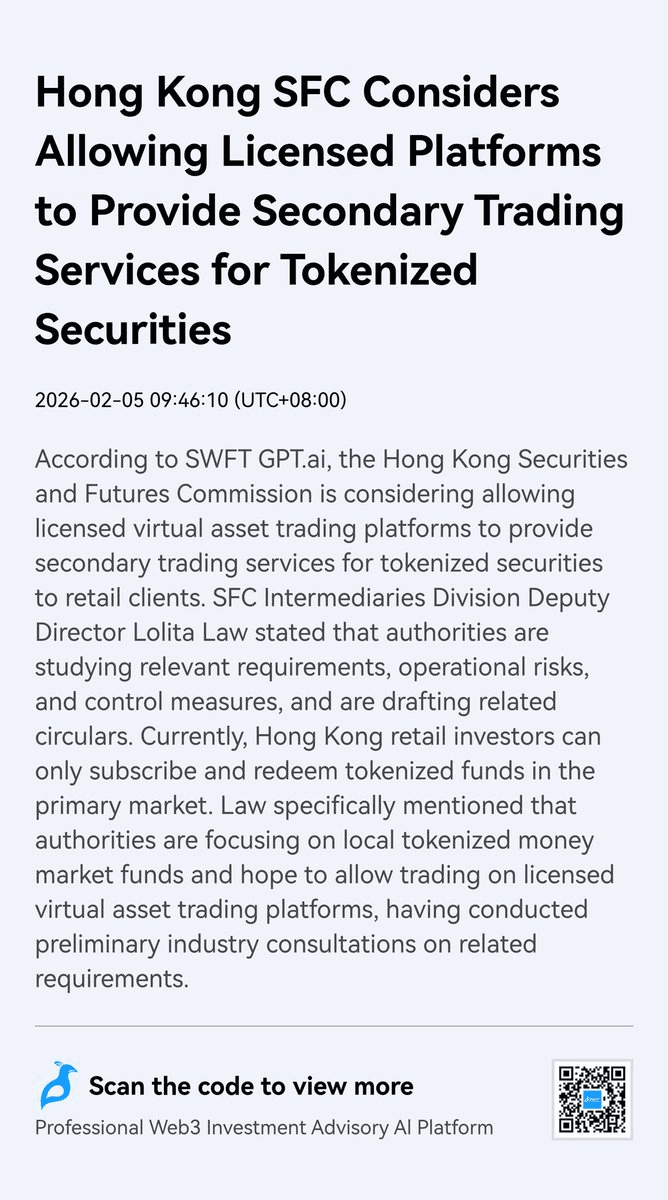
Hong Kong's Securities and Futures Commission is evaluating whether licensed virtual asset trading platforms can offer secondary trading of tokenized securities to retail investors. **Current Status:** - Officials are assessing risk controls and operational requirements - New regulatory circulars are being drafted - Retail investors currently limited to primary subscription and redemption only **What's Next:** Tokenized money market funds may be the first products eligible for broader retail trading access on licensed platforms.
Canada Introduces Four-Tier Custody Framework After QuadrigaCX Lessons
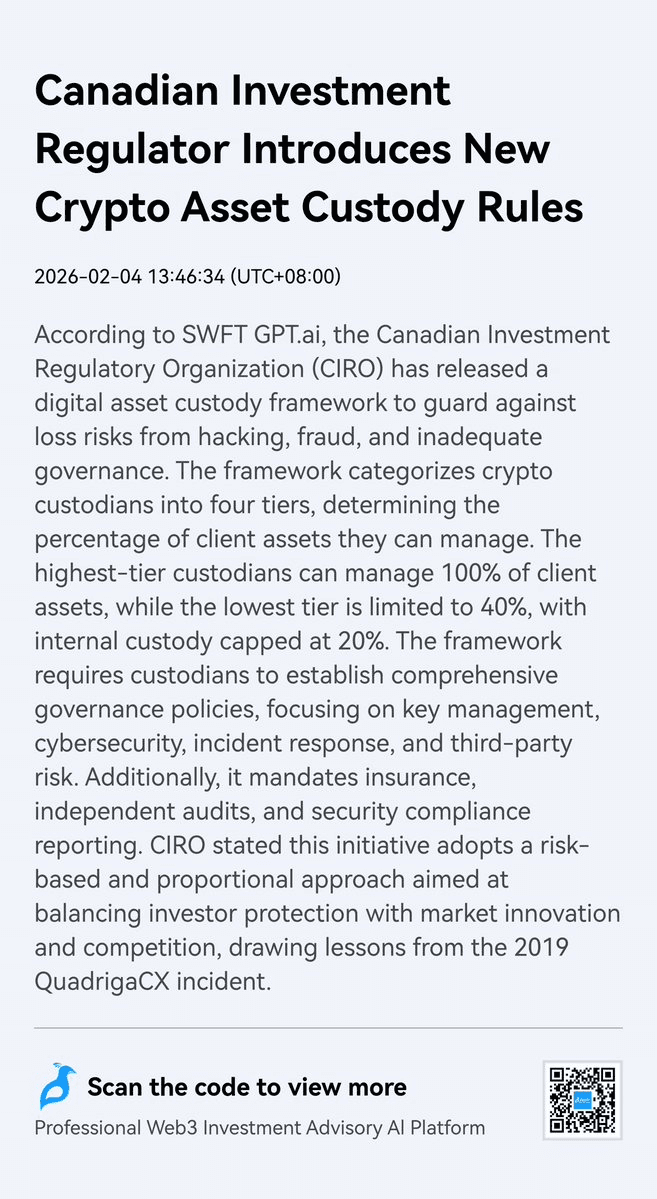
**Canada's New Crypto Custody Rules** CIRO has implemented a digital asset custody framework designed to protect investors from hacks, fraud, and governance failures. **Key Changes:** - Custodians ranked into 4 tiers based on security capabilities - Top-tier firms can manage 100% of client assets - Lower-tier custodians face strict asset caps - Mandatory requirements include key management protocols, cybersecurity measures, incident response plans, insurance coverage, and independent audits **Background:** The framework draws directly from the 2019 QuadrigaCX collapse, where investors lost access to funds after the exchange's founder died with sole control of private keys. The regulations aim to balance investor protection with continued industry innovation in Canada's crypto sector.
🇭🇰 Hong Kong to Issue First Stablecoin Licenses in March
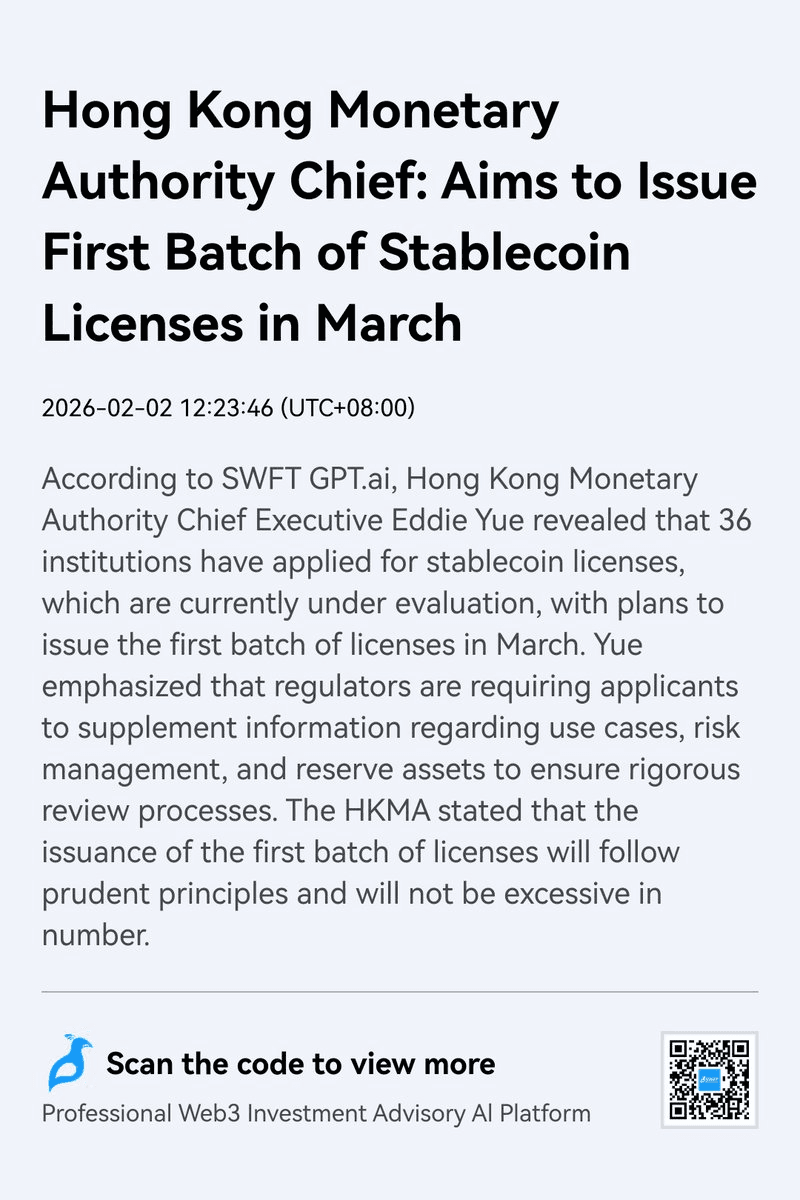
**Hong Kong's stablecoin licensing regime is moving forward with its first approvals expected in March 2026.** The Hong Kong Monetary Authority (HKMA) has received 36 applications for stablecoin licenses, according to CEO Eddie Yue. This represents a significant reduction from the 77 institutions that had expressed interest as of September 2025. **Key details:** - First batch of approvals planned for March 2026 - Approval process will be strict and selective - Regulators are conducting thorough reviews of use cases, risk management frameworks, and reserve asset structures - Previous applicants included major banks like HSBC, ICBC (Asia), Bank of China (HK), and Standard Chartered The regulatory approach signals Hong Kong's cautious but progressive stance on stablecoin regulation, balancing innovation with financial stability concerns. The limited number of initial licenses suggests authorities are prioritizing quality over quantity in establishing the market.