🔗 Centrifuge Joins Ethereum Economic Zone Alliance
🔗 Centrifuge Joins Ethereum Economic Zone Alliance
🔗 Same block, no bridge


Centrifuge has joined the Ethereum Economic Zone Alliance (EEZ), a coalition working toward synchronous composability across rollups.
Key development:
- EEZ enables tokenized assets on one network to be used as collateral on another
- Same block execution, no bridge required
- Critical infrastructure for multichain tokenization
Why it matters: This addresses a fundamental challenge in tokenized asset deployment. Previously, moving assets between chains required bridges and multiple transactions. With synchronous composability, a tokenized treasury on one rollup could instantly serve as collateral on another—within the same block.
Context: Centrifuge recently integrated LayerZero for multichain deployment across Ethereum, Solana, Avalanche, BNB Chain, Base, Optimism, and HyperEVM. The EEZ alliance extends this capability by enabling seamless cross-rollup composability.
This infrastructure layer transforms how tokenized assets operate in DeFi, making them truly interoperable without the friction of traditional bridging.
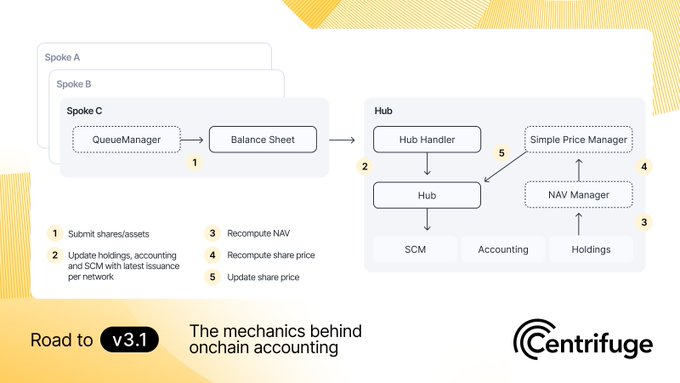
V3 built the rails for multichain tokenization. V3.1 brings the operations onchain: automated NAV, share pricing, and updates pushed across 10 supported networks.

“Minting a token is easy. Tokenizing something with real value behind it is the hard part.” In Episode 4 of the V3 Series, @offerijns & @mustermeiszer2 explain how Centrifuge V3 automates the entire tokenization flow, launching assets across multiple chains with a single call,
The conversation around tokenization has shifted. Institutions are no longer deciding whether to tokenize; they're evaluating which infrastructure to trust with production. Here's what that clarity means: > Issuance is only the starting point. > Tokenization without

Multichain is how institutions operate now. Infrastructure should match. With Centrifuge V3.1 expanding support to 10 chains, teams using Whitelabel will launch tokenized assets on any supported chain in minutes. Hub-and-spoke architecture simplifies deployment and operations.

More assets. More holders. More distribution. The growth is coming from what tokenized assets can do once they're onchain; lending markets, RWA looping, multichain availability. Every new integration creates another reason to hold.
Tokenization doesn't wait for sentiment. Utility sets the pace. · Accounting, pricing, reporting. The full lifecycle runs onchain now · Composability across DeFi is pulling institutional demand forward · TradFi isn't watching anymore. It’s actually involved

Tokenization is only as good as what assets can do once they're onchain. Lending, collateral use, distribution. Without these, tokens sit idle. DeFi is what turns tokenized assets into functioning instruments. The next phase isn't about more tokens. It's about more utility.

Issuance solved the first problem: getting private credit, treasuries, and indices onchain. But issuance alone is half the job. Assets get minted, sit in one venue, and DeFi never touches them. deRWA tokens do the other half. They wrap tokenized assets into freely transferable

Index tokenization goes beyond single assets. It requires infrastructure that handles daily rebalancing while staying auditable. Centrifuge's Proof-of-Index framework, built with licensed data from @SPDJIndices, delivers that: verifiable, programmable, institutional-grade.
Centrifuge started building tokenization infrastructure in 2017. Before most of the market knew what RWAs were. Eight years later: • $1.3B in assets onchain. • Revenue live. • A vault standard powering treasuries, credit, and equities across 8+ chains.
Token standards are how DeFi scales. ERC-20 gave every token the same interface. Any wallet, any protocol, it just works. ERC-4626 did the same for vaults. One standard for deposits, withdrawals, and yield. That's why @Aave, @Morpho, and @eulerfinance are interoperable; they

This is what happens when tokenized assets are built for utility. They're not just issued or held, but deployed as collateral and integrated into lending markets. They're used as building blocks for strategies that didn't exist before.

$AAVE has become the first lending protocol to have $1 billion in RWAs deposited. Are you paying attention to the RWA sector yet?

ERC-7540 is the standard that lets tokenized funds operate natively in DeFi, handling async settlement so real-world assets can plug into onchain markets. @offerijns co-authored it. More than just talking about RWAs onchain: building the infrastructure to make it happen.

Real-world assets, working onchain. Jeroen Offerijns (@offerijns), Co-Founder & CTO at @centrifuge, will discuss how tokenized credit and structured RWAs are unlocking the next wave of capital allocation for digital assets.

Tokenization turns static holdings into transferable positions.
Tokenization was never the hard part. Market integration is. Tokenized assets on @Morpho and @Aave Horizon aren't passive yield products. They're collateral. They're the base layer for strategies that compound capital efficiency far beyond what holding alone can do.

Tokenizing assets was the easy part. Making them useful is essential. This is why what @centrifuge is doing stands out to me. I've been following Centrifuge, and it isn’t just focused on putting RWA onchain. 𝘐𝘵 𝘪𝘴 𝘧𝘰𝘤𝘶𝘴𝘦𝘥 𝘰𝘯 𝘮𝘢𝘬𝘪𝘯𝘨 𝘵𝘩𝘰𝘴𝘦 𝘢𝘴𝘴𝘦𝘵𝘴 pic.x.com/NrJqA4b2Yl

Launching tokenized assets is step one. Operating them reliably across chains without losing visibility is where infrastructure actually gets tested.
Underlying data verifiable at the asset level in real time. That’s the only way tokenized products can scale. Tokenization demands institutional standards for verifiability, risk management, and transparency. That’s why we chose @ChronicleLabs as our primary oracle partner.
Builders can deploy their own vault system: custom multichain deployments, bespoke DeFi integrations, standalone compliance modules, and months of audits. Or they can deploy on Centrifuge. Audited infrastructure. DeFi reach. Live in weeks, not quarters.
Multichain is how institutions operate now. Infrastructure should match. With Centrifuge V3.1 expanding support to 10 chains, teams using Whitelabel will launch tokenized assets on any supported chain in minutes. Hub-and-spoke architecture simplifies deployment and operations.
Tokenized assets are no longer a bet on the future. They're a structural edge in the present.
This week reinforced a simple reality about tokenization: the hard part isn’t issuing assets, it is operating, monitoring, and proving how they behave across chains. 1️⃣ Visibility and verification matter more than launch speed. Monitoring, data integrity, continuous

Security doesn't move the needle for allocators until it's demonstrated over time. A badge from one audit reads like a checkbox. Multiple audits, live bounties, continuous scanning, real capital flowing. That pattern is what institutional investors actually trust. For
Tokenization means nothing without operations. V3.1 moves the entire fund lifecycle onchain: accounting, pricing, distribution, and reporting across 10 networks from a single hub.

A tokenized fund deployed across 10 networks would normally require 10 separate price update transactions, gas management on each chain, and monitoring across all of them. Centrifuge V3.1 fixes this.
Tokenizing an asset is step one. Operating it across chains, allocating into DeFi, managing subscriptions and compliance at scale: that's the hard part. Centrifuge Vaults handle the infrastructure, allowing issuers to focus on product development: structuring strategies,

Institutions don’t test infrastructure. They allocate to what’s already trusted. In 2025, that trust showed up as real capital on Centrifuge rails: • TVL grew to $1.3B following allocations from @grovedotfinance and @sparkdotfi. • JAAA consolidated as the largest
Distribution is the product. The token is just the beginning.
Tokenization is becoming a core product and distribution lever. Real-world assets are integrating directly into lending, trading, and collateral workflows onchain. Insightful report by @block_stories featuring @itsbhaji.

.@centrifuge CEO @itsbhaji expects asset management and tokenzation to move closer in 2026. Key insight: Bonds, equities, and private credit will drive the next wave of RWA growth, with yield-generating assets increasingly being looped through onchain lending markets.

Sustained demand for tokenized assets won't come from issuance. It'll come from what holders can do with them. Deploy them as collateral. Use in DeFi strategies. Move them across chains. Put yield to work. That's the infrastructure layer that turns tokens into markets.

Building Secondary Markets for Onchain Real-World Assets Issuing tokenized RWAs is only the starting point. Long-term viability depends on pricing, liquidity and credible exit. The speakers will look into how secondary markets for onchain RWAs can be structured, the

Earning yield on an asset is one thing. Borrowing against it, redeploying it, putting it to work as collateral while it still accrues. That's where tokenization actually matters.
The most important thing happening in onchain finance isn't new assets arriving. It's existing assets becoming usable: as collateral, as yield sources, as building blocks for new categories of financial products.
Centrifuge introduced deRWA tokens in mid-2025. Here's how they work and why they matter: centrifuge.io/blog/centrifug…
Most explorers weren't built for tokenized products that operate across chains. But asset managers and allocators need to see the full picture: price updates, mints, redemptions. Unified status, not disconnected events. Centrifugescan was built for this. centrifuge.io/blog/centrifug…
Tokenization runs regardless of market swings. · Institutional credit now usable in DeFi lending markets · Multichain infrastructure upgrading with v3.1 · Distribution outpacing issuance as the differentiator The gap between traditional assets and DeFi markets is closing.

Centrifuge is joining the Ethereum Economic Zone Alliance. EEZ is working toward synchronous composability across rollups, where a tokenized asset on one network could be used as collateral on another. Same block, no bridge. Exactly what multichain tokenization infrastructure

Welcome to the Ethereum Economic Zone (EEZ), a framework for synchronously composable rollups. What does that mean? One deployment. Shared liquidity. Single transactions across L1 & L2. Identity verified anywhere. Smart wallets connected everywhere. No additional trust
Fully onchain and automated accounting of tokenized assets. One of the key features coming with Centrifuge V3.1: Traditional accounting logic, but implemented onchain. Double-entry bookkeeping that's transparent and auditable by default. · Automated NAV calculations and share
Tokenized assets have real momentum. And real expectations. In 2026, RWA security is about defensibility under scrutiny, not just audited contracts. That means financial correctness, constrained admin power, continuous security in production, and explicit offchain trust

RWAs are moving from pilots to production finance. Going into 2026, the gating factor is security maturity, not narrative. Cantina and @Centrifuge published a practical guide on securing real-world assets. Details below.

Tokenization keeps compounding steadily: · Distribution gaining ground as the real growth driver · New holders showing up independent of sentiment · Assets moving into lending markets, collateral pools, and cross-chain infrastructure Utility sets the pace now.

Tokenization is behaving like infrastructure, not a narrative. > Daily market operations become programmable > Asset managers already see a tool, not a bet > Real utility attracts capital even when attention moves elsewhere Compounding starts from here.

Tokenized assets need to be where the liquidity is. On every chain where demand is forming. Centrifuge integrated @LayerZero_Core to enable simplified multichain deployment across Ethereum, Solana, Avalanche, BNB Chain, Base, Optimism, and HyperEVM. One token, one supply,
We built for scale. @LayerZero_Core extends that scale across its ecosystem. Broader distribution. Deeper utility. Stronger markets for tokenized products. Tokenize with Centrifuge. Distribute everywhere with LayerZero.
Infrastructure for multichain products: Sees across all venues, reconstructs intent through execution, and surfaces failures in product terms. centrifuge.io/blog/centrifug…
When tokenized assets can be used as collateral and moved across lending markets: yield stops being passive. That's what composability actually changes.

Tokenization is just the gateway. 2026 is about what happens next: real assets that actually work onchain. Composable, integrated into protocols, ready for programmatic use.
We built for scale. @LayerZero_Core extends that scale across its ecosystem. Broader distribution. Deeper utility. Stronger markets for tokenized products. Tokenize with Centrifuge. Distribute everywhere with LayerZero.

Billions in RWAs issued today. Trillions tomorrow. @Centrifuge is building with LayerZero to advance its tokenization infrastructure across blockchains.
Tokenization now includes onchain pricing, reporting, and DeFi integrations. Minting was step one.
Tokenized real-world assets in DeFi liquidity markets isn't a concept anymore. It's a live use case.
Real-world assets are scaling inside DeFi. Graham Nelson (@0x4Graham), DeFi Product Lead at @centrifuge, takes part in Stable Summit IV to discuss institutional tokenized funds and integrating RWAs into DeFi liquidity markets. JW Marriott · Cannes · 27-28 March

Centrifuge vaults were built for assets that don't settle instantly. Async deposits, multichain redemptions, modular compliance powered by ERC-7540. @daylightenergy building toward bringing a new asset class onchain: energy infrastructure. Their model: solar and battery systems
Tokenization-as-a-Service just leveled up. ⚡ Introducing Centrifuge Whitelabel — the platform that lets anyone build, launch, and scale tokenized assets faster than ever. First builders: @daylightenergy, the decentralized energy company backed by Framework Ventures, a16z
Make it tokenized. Make it collateral. 24/7 markets are inevitable.

Everyone in the world deserves the same wealth creation opportunities. Currently this isn’t possible. The solution is clear: Tokenization.

A tokenized treasury you can't borrow against is an isolated yield. The real test for onchain assets is whether they can move from reserve to collateral to liquidity. The kind of optionality that makes an onchain asset a real financial instrument. How that's working now ↓
Tokenized US Treasuries and Private Credit ETFs aren’t “new onchain yield.” What’s new is what holders can do once they’re usable in markets: • deposit as a collateral in lending • trade freely on secondary markets • loop in DeFi strategies Tokenization is just the first

For years, tokenization had a utility problem. Assets could be represented onchain. But most couldn't be borrowed against, used as collateral, or composed into DeFi strategies. Tokenized, but static. Onchain, but isolated. Projects that change this don't just issue tokens.
Tokenization means investors read the ledger, not wait for transparency to be delivered.
deRWAs explained in simple terms by @0xnairolf. Tokenized assets rebuilt as DeFi-native instruments and designed to be borrowed against, traded, and looped across protocols. The asset class that bridges institutional capital and onchain markets.

“bro wat is centrifuge” An explanation of @centrifuge, in (very) simple terms. 🧵

Token standards are how DeFi scales. ERC-20 gave every token the same interface. Any wallet, any protocol, it just works. ERC-4626 did the same for vaults. One standard for deposits, withdrawals, and yield. That's why @Aave, @Morpho, and @eulerfinance are interoperable; they
The question isn't how many assets get tokenized. It's how many of them can actually be borrowed against, used as collateral, freely moved onchain or traded on secondary markets.
Coming in V3.1: sharper multichain execution. · Expanded network support · Automated onchain accounting built in · Modular architecture that adapts to different asset structures Real-world assets are gaining DeFi's utility and composability.
“V3 is built to support multiple asset types onchain, from complex credit like AAA CLOs, to index funds like the tokenized S&P 500, and freely transferable tokens called deRWAs.” In the final episode of the V3 Series, @offerijns and @mustermeiszer2 show how Centrifuge V3 enables
"Tokenization is key to making abundance assets compatible with DeFi." Centrifuge is built for exactly this: modular infrastructure for tokenizing, managing, and distributing new asset classes onchain.

Build for Aave with Centrifuge - junior/ senior tranches - already integrated with Aave - experience building with solar
Once a fund is onchain, scaling toward demand is the natural next step. @JHIAdvisors started with tokenized Treasuries on Centrifuge. Then CLOs. Then S&P500 Index Fund. Each one shaped how they think about tokenization infrastructure. What they keep choosing isn't the
Tokenization will turn every fund into a globally distributable product.
The conversation with asset managers has changed. They're not asking whether to tokenize. They're asking how to issue, manage, and distribute funds onchain and how to start capturing the operational efficiencies that come with it. Infrastructure is what makes that possible.
Centrifuge V3.1 is live. Issuance is just the starting point. With V3.1, Centrifuge becomes the first protocol to run accounting, pricing, and reporting fully automated onchain. Distribution across 10 networks in a single transaction. centrifuge.io/blog/centrifug…
Tokenization rewires finance at the layer no one sees until everything runs on it.
Tokenization is only the first step. Whether institutional capital can operate onchain depends on access and distribution infrastructure. Centrifuge × @pharos_network Expanding the environment that connects wallet access, enterprise channels, and execution capacity for
Apollo Global Witnesses ACRDX Leverage on Morpho at EthCC
Apollo Global, a $900 billion asset manager, observed their ACRDX product being leveraged on [Morpho](https://morpho.org) in real-time during a presentation at EthCC. **Key Points:** - Representatives Bhaji and Chris Moyall from Apollo Global presented on stage - ACRDX, Apollo's institutional credit product, demonstrated live onchain utility - The event showcased traditional finance integration with DeFi protocols This follows Apollo's February launch of ACRDX on Morpho, marking a significant step in bringing institutional credit products onchain. The live demonstration at EthCC highlighted how major asset managers are actively exploring decentralized finance infrastructure for real-world financial products.
Centrifuge Launches DespXA on Base Network
Centrifuge has announced the launch of **DespXA on Base**, expanding its onchain finance infrastructure to Coinbase's Layer 2 network. **Key highlights:** - DespXA now available on Base network - Extends Centrifuge's real-world asset (RWA) tokenization capabilities - Leverages Base's lower transaction costs and faster settlement times This integration allows users to access Centrifuge's financial products with improved efficiency on Base's growing ecosystem. [Read the full announcement](http://centrifuge.io/blog/despxa-on-base)
🏦 Tokenized S&P 500 Launches on Base for DeFi Trading
**deSPXA**, a tokenized version of the S&P 500 index, has launched on Base, bringing traditional market exposure to decentralized finance. **Key Features:** - Trade, borrow against, short, or deploy in DeFi strategies - Built by Centrifuge using their deRWA framework - Provides exposure to the [S&P 500 Index Fund](https://twitter.com/JHIAdvisors) managed by JHI Advisors - Licensed by S&P Dow Jones Indices **Integration with Euler Finance:** The token will be available as collateral on [Euler Finance](https://twitter.com/eulerfinance), enabling users to borrow against their S&P 500 exposure, hedge positions, or take directional bets. This development transforms a traditional index into a composable onchain financial instrument, bridging conventional markets with DeFi infrastructure.
Centrifuge Expands Role as Sky Agent in Obex Cohort 1
Centrifuge, a participant in the Sky Ecosystem since 2021, is expanding its role through Obex Cohort 1. The platform is now operating as a Sky Agent, deploying USDS into tokenized yield strategies across institutional-grade assets. **Key Development:** - Evolution from early onchain credit collateral provider to active Sky Agent - Focus on institutional-grade tokenized yield strategies - Part of broader Obex initiative deploying up to $1B across 8 projects **Context:** Obex Cohort 1 includes multiple participants working across structured credit, fintech lending, AI infrastructure, and energy finance sectors. The expansion represents a shift toward more active deployment of stablecoin liquidity into real-world asset strategies.
DeFi Rebuilds Fixed Income Infrastructure for Institutional Capital
DeFi protocols are **quietly reconstructing the traditional fixed income stack** to accommodate institutional capital flows. This development represents a significant shift in how institutional investors can access yield-generating opportunities onchain. **Key developments:** - Traditional fixed income infrastructure being replicated in decentralized finance - Institutional-grade solutions emerging to bridge TradFi and DeFi - Spark protocol expanding its liquidity-as-a-service offerings for institutions [Read the full analysis](https://www.coindesk.com/opinion/2026/03/21/how-defi-is-quietly-rebuilding-the-fixed-income-stack-for-institutional-capital)