Building Conflict-Resistant Systems: The Foundation of Digital Security
Building Conflict-Resistant Systems: The Foundation of Digital Security
🛡️ The survival layer

The foundation of secure digital infrastructure relies on three critical defense mechanisms:
- Anti-collusion voting systems that prevent coordinated manipulation
- Privacy-preserving cryptography that protects sensitive data
- Open source security that enables transparent verification
These baseline defenses are designed to prevent catastrophic system failures. Without these fundamental protections in place, higher-level applications and services cannot function securely.
The emphasis on "survive" highlights that these aren't optional features—they're essential infrastructure. Recent breaches, including the theft of Social Security numbers, demonstrate why conflict-resistant systems matter.
These foundational technologies create the necessary conditions for communities to safely fund, build, and protect their digital resources.

🛡 Survive: baseline defense Anti-collusion voting, privacy-preserving cryptography, open source security. Systems that prevent catastrophic failure. Without these, nothing above them works.
🌊 Cypherpunkfish Builds Ocean Conservation Protocol
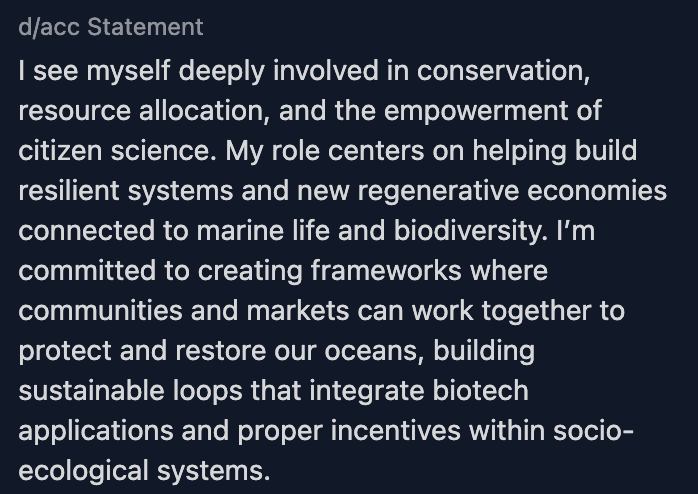
**d/acc framework moves from theory to practice** as @Cypherpunkfish1 develops regenerative conservation systems linking ocean health with economic sustainability. **Key development:** - Protocol creates feedback loop between marine ecosystems and dependent economies - Represents practical application of defensive acceleration principles - Follows recent d/acc Design Workshop on resilient funding architecture The project demonstrates how decentralized protocols can support environmental protection while maintaining economic viability.
Why Physical Resilience Lags Behind Digital Coordination in Web3
A new analysis reveals a significant gap in the web3 ecosystem: **fewer teams are building in physical resilience sectors** like biosecurity and decentralized energy compared to digital coordination tools. **Key observations:** - Physical-layer defense technologies (biosecurity, open source hardware, decentralized energy) protect bodies and critical infrastructure, not just information - These sectors appear underdeveloped relative to their digital counterparts - The disparity raises questions about resource allocation and priorities The analysis suggests that **interrogating these gaps** is essential for understanding where the ecosystem needs to grow. While digital coordination has seen substantial development, technologies that protect physical infrastructure and human health may require more attention and investment.
Gitcoin Expands d/acc Market Map Beyond Crypto
Gitcoin has released an expanded version of its **d/acc Market Map**, a living document that maps technologies favoring defense over offense. The framework, based on Vitalik Buterin's concept of defensive acceleration, examines how systems can distribute rather than concentrate power. **Key developments:** - The map now covers the full defensive acceleration stack, extending beyond cryptocurrency - Focus on how funding mechanisms determine what gets defended - Document remains open for ongoing refinement and expansion The research explores how defensive acceleration exists in currently deployed systems, examining the relationship between funding structures and defensive capabilities. Read the full research: [Gitcoin d/acc Market Map](https://www.gitcoin.co/research/d-acc-market-map)
Capital Allocation as Strategic Defense in d/acc
**Funding mechanisms are strategic tools** in the defensive acceleration (d/acc) framework, not just administrative processes. - Capital allocation directly determines which defensive technologies receive resources to develop and survive - The *how* of funding shapes the *what* of protection - This positions financial infrastructure as a critical layer in building resilient systems The insight reframes funding decisions as strategic choices that influence the entire defensive technology landscape.