🔐 Blind Signing: Why Crypto Wallets Are Unreadable
🔐 Blind Signing: Why Crypto Wallets Are Unreadable
🔐 Signing blind

The Problem with Transaction Signing
Most crypto users approve transactions without understanding what they're signing. The issue isn't user negligence—it's poor wallet design.
What Users Actually See
- Walls of hexadecimal code
- Cryptic function names with no context
- Meaningless strings of numbers
- Example:
0x7a250d5630B4cF539739dF2C5dAcb4c659F2488D approve: 115792089237316195423570985008687907853269984665640564039457584007913129639935
The Core Issue
DeFi transactions, especially batched calls, display technical data that's incomprehensible to average users. This creates a security risk—people sign contracts they can't read.
The Question
Would you sign a legal contract written in a language you don't understand? That's essentially what happens with most crypto transactions today.
Wallet interfaces need better human-readable transaction previews to make informed consent possible.
Almost nobody reads what they're signing. Not because users are careless. Because what wallets show them is genuinely unreadable. A batch of any amount of DeFi calls looks like walls of hex and function names that mean nothing. So everyone just confirms.

x.com/i/article/2049…
Onchain Orchestration Volume Surpasses $700M Milestone
A significant milestone has been reached with onchain orchestration volume crossing **$700 million**. This achievement comes just over two months after the platform hit $250M in orchestration volume in late February. The rapid growth from $250M to $700M demonstrates strong adoption of orchestration infrastructure. **What is orchestration?** - Acts as the backbone for onchain execution - Routes agents, intents, and cross-chain transactions through a unified layer - Enables seamless coordination of complex blockchain operations The platform continues to expand its role in facilitating smoother interactions across different blockchain networks and applications.
ERC 8211 Smart Batching Released in Partnership with Ethereum Foundation
A new Ethereum standard called **ERC 8211** (Smart Batching) has been released through a collaboration with the Ethereum Foundation. The proposal has generated significant interest from the community since its launch. A video explainer is available that breaks down the technical details and use cases of Smart Batching. **Key points:** - Co-developed with the Ethereum Foundation - Aims to improve transaction efficiency through batching - Community response has been positive with strong engagement The standard represents a step forward in optimizing Ethereum operations.
🎯 Biconomy Nears 1M Active Smart Accounts
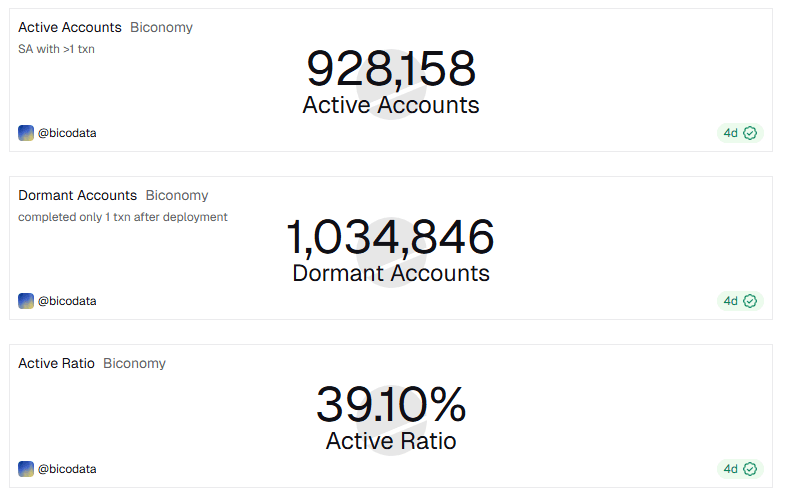
**Biconomy approaches milestone with 928,158 active smart accounts** The platform reports a **39.10% activity ratio** - meaning nearly 4 out of 10 deployed accounts show sustained usage rather than one-time deployments. **Key metrics:** - 928,158 accounts with ongoing activity - 1,034,846 dormant accounts (used once) - Focus on engagement over vanity deployment numbers This data suggests **lasting value delivery** in the smart account ecosystem, distinguishing between accounts that are merely deployed versus those actively used by developers and users. The milestone reflects growing adoption of account abstraction infrastructure in web3 applications.
OverHerd Pays 500K+ Users Across Multiple Chains Using Biconomy's Invisible Web3 Infrastructure
**OverHerd leverages Biconomy Nexus to create seamless Web2-like experience** while running on Web3 infrastructure, paying over 500,000 users for content creation. **Key features enabling mass adoption:** - Gasless transactions eliminate user friction - Multi-chain support across Sei, Base, and Worldcoin - Zero blockchain knowledge required from users - Infrastructure remains completely invisible to end users This case study demonstrates how **account abstraction can bridge the gap** between Web2 user experience and Web3 functionality, allowing platforms to reward users without exposing blockchain complexity. The implementation shows practical Web3 adoption where users earn rewards through familiar interfaces while benefiting from decentralized infrastructure behind the scenes.