Bitcoin Deposits Surge to Exchanges Despite 26% Drawdown—Breaking Historical Pattern
Bitcoin Deposits Surge to Exchanges Despite 26% Drawdown—Breaking Historical Pattern
🔄 Bitcoin breaks the pattern


Bitcoin's latest correction is showing unusual behavior. Despite a 26% drawdown and $1.84bn in liquidations (the second-largest since October), BTC is flowing into exchanges rather than out.
Key developments:
- Exchange reserves climbed back to 2.72m BTC, reversing months of outflows
- 272,000 traders liquidated on June 3rd alone
- $883m in BTC long positions wiped out
Why this matters: Previous local bottoms typically saw coins moving off exchanges as holders accumulated. This reversal suggests different market dynamics at play—potentially indicating distribution rather than accumulation.
The pattern breaks from historical precedent where drawdowns marked buying opportunities. Instead, holders appear to be moving coins to exchanges, possibly preparing to sell or responding to liquidity needs.
May's leverage buildup was cleared in a single sweep, but the directional flow of coins suggests caution among market participants.
Despite the large liquidations and a 26% drawdown, $BTC deposits to exchanges are climbing. Reserves back to 2.72m, reversing months of outflows. Previous drawdowns that marked local bottoms saw coins moving off exchanges. This one did the opposite. x.com/bitfinex/statu…


$BTC just saw its second largest liquidation event since 10/10. $1.84bn in crypto positions wiped on 3 June, $883m in BTC longs alone. 272,000 traders liquidated. The leverage that built up through May has come out in a single sweep.

Bitfinex margin longs hit 82,681 BTC last week as $BTC slid 10%. The highest level since November 2023, even as the macro tightened. Bitfinex Alpha 206 reads what comes next. go.bitfinex.com/BFXAlpha206

$BTC just saw its second largest liquidation event since 10/10. $1.84bn in crypto positions wiped on 3 June, $883m in BTC longs alone. 272,000 traders liquidated. The leverage that built up through May has come out in a single sweep.
$BTC funding has rebounded to +10.95% annualised within 72 hours of the largest liquidation in 3 months, while OI sits at its lowest since 11 April. Retail is re-engaging longs. Institutional books are not following. Tomorrow's PCE is the next trigger. blog.bitfinex.com/bitfinex-alpha…
“Bitfinex margin longs expanded to 82,681 $BTC last week, the highest reading since November 2023 and an 88 percent increase from July 2025 lows.” - @TheBlockCo Our data. Bitfinex Alpha tracks it every week. ✅ Full read 👇 theblock.co/post/402552/op…
$584m in longs were wiped on Monday, yet $BTC still holds above the May Monthly Open. Meanwhile: ▫️ Exchange reserves: 7-year lows ▫️ Stablecoin market cap: +$2bn in a week The ammo for an $80k reclaim is there. The trigger just hasn’t been pulled. blog.bitfinex.com/bitfinex-alpha…
Open interest has dropped by roughly $1.5bn in recent sessions, clearing much of the leverage built up during $BTC’s move toward $82k. With short-side fuel exhausted and long positioning reset lower, the next major move likely depends on spot demand.

Bitcoin Perpetual Futures Reset After $72k to $59k Decline
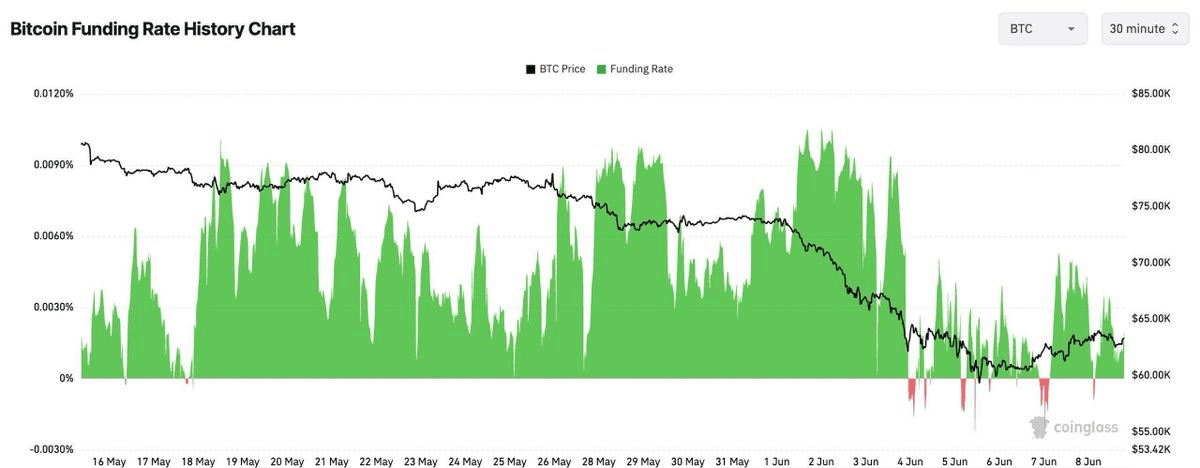
**Market Reset Signals Potential Bottom** Bitcoin's perpetual futures positioning has reset following a decline from $72,000 to $59,000. Key developments: - Funding rates remained positive as long positions accumulated during the gradual price decline - On June 4th, funding flipped negative, indicating leveraged open interest was likely liquidated - This reset represents one of the necessary conditions for a market bottom The shift from positive to negative funding suggests overleveraged long positions have been cleared from the market, potentially setting the stage for price stabilization.
Bitcoin Enters Distribution Phase as ETF Outflows Hit $4.2B
**Bitcoin is currently in a distribution phase rather than accumulation**, with several concerning indicators: - **Spot CVD (Cumulative Volume Delta) has turned negative**, suggesting more selling pressure than buying - **Short-term holders are underwater on their positions**, creating incentive to sell - **ETF outflows have reached $4.2 billion over three weeks**, indicating institutional money is leaving - **Bitcoin has slipped below $63,000** as rallies are being sold rather than bought The key concern is that **yields are rising for the wrong reason** - not due to economic strength but other factors that make risk assets less attractive. This creates a challenging environment where each price rally faces selling pressure from holders looking to exit at breakeven or minimal loss. Read the full analysis: [The Block article](https://www.theblock.co/amp/post/404082/stuck-in-distribution-bitcoin-slips-below-63000-as-analysts-warn-rallies-are-being-sold-not-bought)
Bitcoin Markets Turn Defensive as Traders Sell Rallies Instead of Accumulating
Bitcoin markets have entered a **structurally defensive phase**, according to Bitfinex Alpha's analysis for the Wall Street Journal. **Key Market Dynamics:** - Traders are increasingly **selling rallies rather than accumulating** positions - Market fragility reflects weakened spot demand - Recovery depends on meaningful return of buying pressure The shift in trader behavior signals a fundamental change in market sentiment, with participants taking profits on upward moves rather than building long-term positions. This defensive posture will likely persist until genuine spot demand re-emerges to support sustained price appreciation.
Bitcoin and Lightning Network as Foundation for AI Agent Payment Systems
Paolo Ardoino discussed the technical infrastructure needed for AI agent economies on the CRYPTO101 podcast, focusing on Bitcoin and Lightning Network as core payment rails. **Key Points:** - Lightning Network enables fast, low-cost transactions suitable for machine-to-machine payments - Bitcoin's programmable money features align with autonomous AI agent requirements - Infrastructure for automated payments between AI systems is becoming operational The discussion highlights how existing Bitcoin technology can support emerging AI-driven economic models without requiring new payment systems.