Biconomy Network Introduces Unified Multichain Composability
Biconomy Network Introduces Unified Multichain Composability
🔗 Chain-Hopping Just Died


Biconomy Network launches a breakthrough in blockchain interoperability with Unified Multichain Composability. Key features:
- Single signature executes complex cross-chain actions
- Dynamic transaction adaptation eliminates failed transfers
- Cross-chain app development without smart contracts
- Universal gas payment from any chain
- Direct chain-to-chain communication
- One-click execution of multi-step sequences
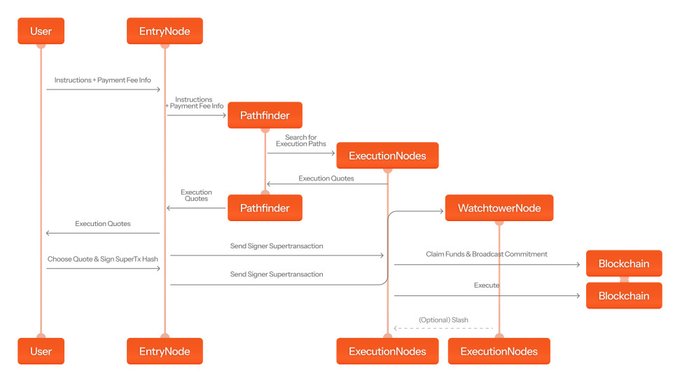
The system operates at the DApp Layer, requiring no modifications to underlying chains. Implementation uses Collaborative Architecture where specialized nodes work together:
- Pathfinder nodes discover optimal routes
- Execution nodes handle chain operations
- Watchtower nodes ensure security

Introducing the Biconomy Network Litepaper! Following our recent Network announcement, it's time to share how things work under the hood! What is the Biconomy Network? What is asynchronous orchestration? Supertransactions? Learn about all of this in the Litepaper 👇 🧵

No more complicated chain-hopping. That ends with Unified Multichain Composability Get one key to unlock every blockchain. Here's what it can do for you and why you should care: ➤ One signature executes complex actions across multiple chains instantly ➤ Transactions adapt on
How can Biconomy execute transactions across 1000+ blockchains? It's called Collaborative Architecture and it's genius in its simplicity. Here's what you need to know: ➤ Pathfinder nodes discover optimal routes by using existing cross-chain liquidity providers ➤ Execution
Cross-Chain DeFi Automation: One Signature, Two Chains, Zero Manual Steps
A new cross-chain workflow enables users to execute complex DeFi operations across two blockchains with a single signature. **How it works:** - User signs once to authorize the entire process - Origin chain batch unwinds lending position and creates an intent - Solver bridges funds between chains - Destination chain batch waits for funds, verifies amount, and supplies to yield farm **Technical stack:** - **ERC-7964** handles signature authorization - **ERC-8211** encodes chain-specific steps with live values and conditions - **Open Intents Framework** manages cross-chain liquidity movement The system eliminates manual intervention between steps, automating what previously required multiple transactions and constant monitoring. Users initiate complex multi-chain strategies without touching anything after the initial signature.
🔗 Cross-Chain Transactions Get Dynamic Value Resolution
A new approach to cross-chain transactions eliminates hardcoded values in favor of **dynamic resolution**. Instead of specifying exact amounts like "supply 487 USDC," each step now resolves values in real-time based on what actually arrives. Key features: - Steps carry their own conditions and can wait for prerequisites - Destination batches gate on fund arrival confirmation - Relayers only submit once conditions are met - **No glue contract needed** - ERC-8211 reads state directly, not the bridge - Compatible with Open Intents Framework or other underlying layers The system stacks into a single flow: one ERC-7964 signature authorizes the plan, ERC-8211 encodes each chain's steps with live values and conditions, and the Open Intents Framework handles liquidity movement while destination batches wait before continuing.
Open Intents Framework Tackles Cross-Chain Liquidity Fragmentation
The **Open Intents Framework** addresses fragmented cross-chain liquidity through an open-source, solver-agnostic standard. **How it works:** - Users sign an intent and lock funds on the origin chain - Competing EVM solvers front the funds on the destination chain - A proof releases locked funds to reimburse the solver The framework enables complex cross-chain operations—like unwinding a lending position, bridging funds, and supplying to a yield farm—through a single intent. Learn more at [openintents.xyz](https://openintents.xyz)
ERC-8211 Solves Cross-Chain Script Execution Problem
**ERC-8211** addresses a critical gap in cross-chain operations: the inability to write scripts when you don't know exact amounts until execution. **The Problem:** - Bridge transactions create uncertainty - you can't predict final amounts before execution - Supply steps can't fire until funds actually arrive - Traditional scripts require hardcoded values **The Solution:** ERC-8211 enables dynamic value resolution: - Steps resolve values live ("supply whatever just arrived" vs "supply 487 USDC") - Built-in conditions allow steps to wait for confirmation - Destination batches gate on "have funds landed?" - Relayers submit only when conditions are met - No glue contracts needed - reads state directly, not the bridge - Works with OIF or any underlying layer Learn more at [erc8211.com](https://www.erc8211.com)
ERC-7964 Enables Single Signature for Multi-Chain Transactions
**ERC-7964** introduces cross-chain signature capability for EVM transactions. Traditional EVM signatures authorize execution on only one chain at a time. This creates friction when actions need to span multiple chains. The new standard allows developers to: - Encode multiple calls across different chains into a single EIP-712 object - Sign the entire array once - Execute the complete cross-chain workflow with that one signature This removes the need for separate signatures on each chain, streamlining multi-chain operations. [Read the full EIP specification](https://eips.ethereum.org/EIPS/eip-7964)