Base Expands Carbon Retirement Options with Multi-Chain Asset Support
Base Expands Carbon Retirement Options with Multi-Chain Asset Support
🌍 Carbon credits go multi-chain

Base network now accepts additional carbon retirement assets through Aerodrome Finance, expanding cross-chain compatibility.
The platform now supports:
- Native Aerodrome Finance tokens
- Solana-based assets (cbBTC)
- Ethereum-wrapped assets (WETH)
This integration allows users to retire carbon credits using assets from multiple blockchains, streamlining the process for climate-conscious crypto holders. The move follows Aerodrome's track record of attracting protocol-owned liquidity on Base, where projects can earn AERO rewards while maintaining deep liquidity pools.
Key benefit: Users can now offset their carbon footprint using their preferred blockchain assets without complex bridging steps.
The expansion demonstrates growing infrastructure for on-chain environmental impact, making carbon retirement more accessible across the crypto ecosystem.

New carbon retirement assets accepted on @base using aerodrome-finance:native solana:cbbtcf3aa214zXHbiAZQwf4122FBYbraNdFqgw4iMij and ethereum:0xc02aaa39b223fe8d0a0e5c4f27ead9083c756cc2

GM. I now accept AERO, cbBTC, and WETH assets as capital for carbon retirements. Find the updated leaderboard here: klimalabs.com/auto-retire-bot #blockchain #climatefinance #DeFi #x402
Klima Protocol Launches Native Incentives for Carbon Market Infrastructure
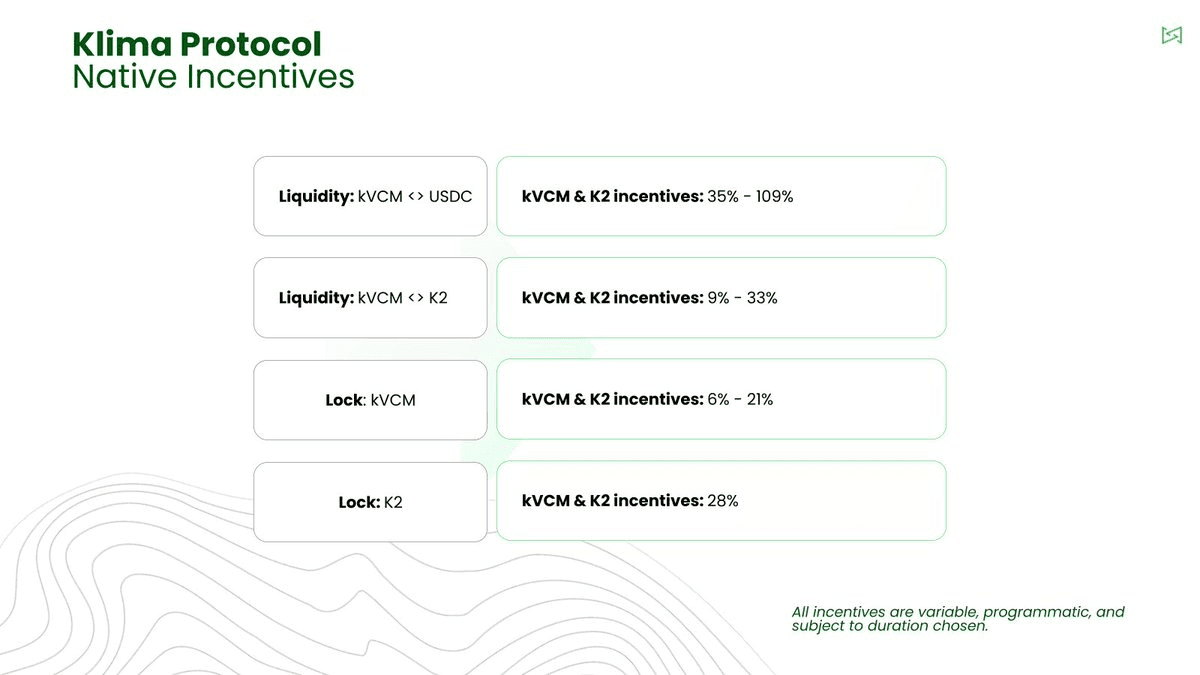
Klima Protocol has activated its native incentive system, rewarding participants who build the infrastructure for its automated carbon credit marketplace. **Who Gets Rewarded:** - Liquidity providers on kVCM trading pairs - Token lockers who vote on carbon credit classes **How It Works:** - Rates adjust automatically based on lock duration - Incentives are programmatic and variable - Designed to scale the protocol's infrastructure The incentives target two key groups: those providing liquidity so users can easily trade between kVCM and USDC, and those locking tokens to signal preferences for different carbon credit types (forestry, carbon capture, etc.). This builds on Klima's automated carbon marketplace where companies can supply or retire carbon credits through transparent, blockchain-based rules rather than opaque traditional markets.
Klima 2.0 Defines Five User Groups for Carbon Market Infrastructure
Klima 2.0 outlines five distinct participant categories for its carbon market infrastructure: **Carbon suppliers** (project developers and traders) receive a predictable, rules-based route to market with clear execution terms and no opaque spreads. **Carbon buyers** access verified retirements with transparent pricing. Credits cannot be resold—retirement is permanent, ensuring environmental claims remain auditable. **Coordinators** (kVCM and K2 participants) signal preferences that shape execution conditions within fixed bounds, enabling distributed decision-making without centralized control. **Liquidity providers** maintain continuous protocol access through open markets, ensuring reliable entry and exit without embedding carbon in automated market makers. **Builders and integrators** can develop against open-source smart contracts and APIs to embed carbon functionality into workflows. All groups operate under identical rules. The system aims to coordinate different interests without collapsing them into a single financial abstraction.
Klima Foundation Partners with Regen Network to Launch New Carbon Credit Class
**Klima Foundation announces strategic partnership with Regen Network** through the Klima Partnership Program to advance digital carbon market infrastructure. **Key developments:** - New carbon class launching on Klima platform featuring City Forest Credits - Regen Network brings blockchain-based ecological verification expertise - Partnership focuses on digital MRV, registry interoperability, and carbon asset innovation **Technical integration includes:** - Seamless data integrations for cross-chain retirement and tracking - Advanced standards for on-chain issuance and transfers - Enhanced access to high-quality urban forest credits The collaboration combines Regen's technical capabilities with City Forest Credits' high-impact credits to create **scalable, transparent climate finance tools**. This partnership represents a significant step toward building trusted digital infrastructure for carbon markets.
City Forest Credits Sets National Standards for Urban Tree Carbon Removal
**City Forest Credits** launches as a nonprofit carbon registry establishing national standards for greenhouse gas reductions through urban tree planting and preservation across U.S. metropolitan areas. **Key Features:** - ICROA-endorsed registry based on rigorous urban forestry science - Delivers verifiable carbon removals with measurable co-benefits - Targets 80% of Americans living in urban settings **Additional Benefits:** - Enhanced air quality in cities - Reduced stormwater runoff - Energy savings for residents - Greater social equity outcomes The initiative addresses climate change while improving urban living conditions through scientifically-backed tree preservation and planting programs.