🔷 Balancer V3 Launches on Monad
🔷 Balancer V3 Launches on Monad
🔷 Balancer hits Monad


Balancer V3 has officially launched on Monad, bringing capital-efficient liquidity infrastructure to one of the fastest EVM chains.
What's Live:
- syzUSD/AUSD stable pool
- AUSD/USDC/USDT0 three-token stable and boosted pool
- Multiple liquidity pools optimized for Monad's throughput
Why It Matters: Monad delivers 10,000 TPS with sub-second finality and parallel execution, but high throughput without efficient liquidity creates slippage. Balancer's V3 stable pools solve this by matching the chain's speed with deep, capital-efficient liquidity.
The Infrastructure Match: Balancer's programmable liquidity brings three pool types designed for different use cases on high-throughput chains. The stable pools enable complex multi-token configurations that can operate efficiently thanks to Monad's low latency and parallel execution.
Partners like Yuzu Money and Neverland Money are already building on this infrastructure, with more lending markets and integrations coming soon.
Monad's parallel execution handles volume. But throughput without capital-efficient liquidity means slippage eats into every trade. Stable + boosted combination solves that friction ⚖️
Access the pool at: balancer.fi/pools/monad/v3… 80% project token. 20% stables. Better capital efficiency. This is how protocols scale liquidity on Monad.

More project tokens. Fewer stablecoins. Capital efficient liquidity. The DUST/AUSD 80/20 pool is live on @monad, providing liquidity for @Neverland_Money's token. Want to understand why are weighted pools are a capital-efficient way to sustain protocol liquidity? Read below 🧵

Fast execution demands efficient liquidity. That's why we're bringing Balancer V3 to @monad 💜 One of the fastest EVM chains with 10,000 TPS and sub-second finality is now powered by programmable liquidity. But what does that mean? 🧵

Monad built infrastructure for speed. Balancer brings infrastructure for liquidity. Follow @Balancer for launch updates and partner announcements.
Fast execution demands efficient liquidity. That's why we're bringing Balancer V3 to @monad 💜 One of the fastest EVM chains with 10,000 TPS and sub-second finality is now powered by programmable liquidity. But what does that mean? 🧵
This is where V3's programmable liquidity becomes critical. It brings three pool types built for different liquidity needs on high-throughput chains. Each designed to match Monad's speed while serving specific use cases. Here's how they work 👇
This is Balancer's infrastructure enabling a new layer of DeFi composability. More lending markets and integrations are coming (stay tuned 👀) Build on Balancer 🥷
What if your Balancer LPs could do more than earn fees and yield? They are now accepted as collateral across lending markets, opening up new possibilities on top of your position. Here's how it works 🧵
Monad demands capital efficiency. This pool delivers. Explore the syzUSD/AUSD pool at: balancer.fi/pools/monad/v3… And don't forget to follow @Balancer for product updates and fresh new pools 🥷
The syzUSD/AUSD Balancer V3 pool is live on @monad! @YuzuMoneyX's DeFi-native stablecoin meets the high-performance EVM chain. Let's break down the mechanism that makes this work 🧵

Balancer V3 solves that. Our stable pools bring optimized liquidity that matches Monad's speed. Proven infrastructure ready for the volume this chain will generate. And it goes deeper:
Three-token stable AND boosted pool. This is what Balancer V3 was made for. Explore the AUSD/USDC/USDT0 pool on Monad 👇 balancer.fi/pools/monad/v3…
Three stablecoins in a single pool? V3 makes it possible on @monad. The AUSD/USDC/USDT0 pool is live, bringing deep liquidity to @withAUSD and stacking swap fees on top of lending yield. How it works 🧵

But high-throughput creates a new challenge: Speed without liquidity is like empty highways. Fast execution means nothing if pools can't handle the volume. 10,000 TPS demands deep, capital-efficient liquidity that can absorb serious trading activity without breaking.
To power this amazing set of features, Monad brings the infrastructure. 10,000 TPS + sub-second blocks provide a serious throughput. But speed without liquidity mean nothing. Balancer's capital-efficient stable pools match the volume this chain will generate.
Liquidity is simple when the infrastructure is right. Here's what's live on @monad. Built on Balancer 🥷

Monad makes this possible at scale. Sub-second finality and parallel execution mean complex multi-token pools can operate without the latency or cost that would make this inefficient elsewhere. The infrastructure matches the ambition.
Monad rebuilt the EVM from scratch. Big blocks. Sub-second finality. Lot of block space. This is the infrastructure Balancer needed to deploy there. @TomFastlane from @0xFastLane breaks down exactly why 👇
Capital efficiency needs a chain that can keep up. @monad is that chain, and that's why Balancer and @Neverland_Money are building there. @alice_nvr explains it better in this clip from our Monad livestream 👇
The syzUSD/AUSD Balancer V3 pool is live on @monad! @YuzuMoneyX's DeFi-native stablecoin meets the high-performance EVM chain. Let's break down the mechanism that makes this work 🧵
Monad brings 10,000 TPS + sub-second blocks + parallel execution, enabling the kind of throughput that can handle institutional-scale volume. But high throughput alone, without capital efficiency, means trades slip, users leave, and ecosystems stall.
DFB Network Manages $3M+ in Stablecoin Liquidity Across 12 Chains
**DFB network** operates as an institutional stablecoin liquidity specialist, managing over **$3 million across 12+ blockchain networks**. **Key Operations:** - Handles multiple stablecoins including BRZ and IDRX - Deploys automated cross-chain arbitrage strategies - Utilizes stable pools designed for institutional liquidity management **Market Context:** This development aligns with broader industry trends showing stablecoin B2B payment volumes growing 60% year-over-year, particularly in cross-border flows and treasury management where traditional banking remains slow and costly.
Balancer Launches First FX Pool on Monad Enabling Direct Access to Korean Government Bonds
Balancer has deployed its first foreign exchange (FX) pool on Monad, pairing USDC with tokenized Korean Treasury Bonds (KTB). **What's New:** - Single-swap access to Korean sovereign debt without Korean brokerage accounts - Traditional barriers (local accounts, complex onboarding) eliminated - StableSurge hook mechanism protects the peg **How It Works:** Unlike traditional Stable Pools that pair similar assets, this FX pool creates a liquid market between USD exposure and Korean government bonds, enabling institutional-grade cross-border swaps. **Why It Matters:** This represents a significant step in tokenizing traditional finance assets and making them accessible globally through DeFi infrastructure.
Korean Treasury Bonds Go Onchain via USDC Integration
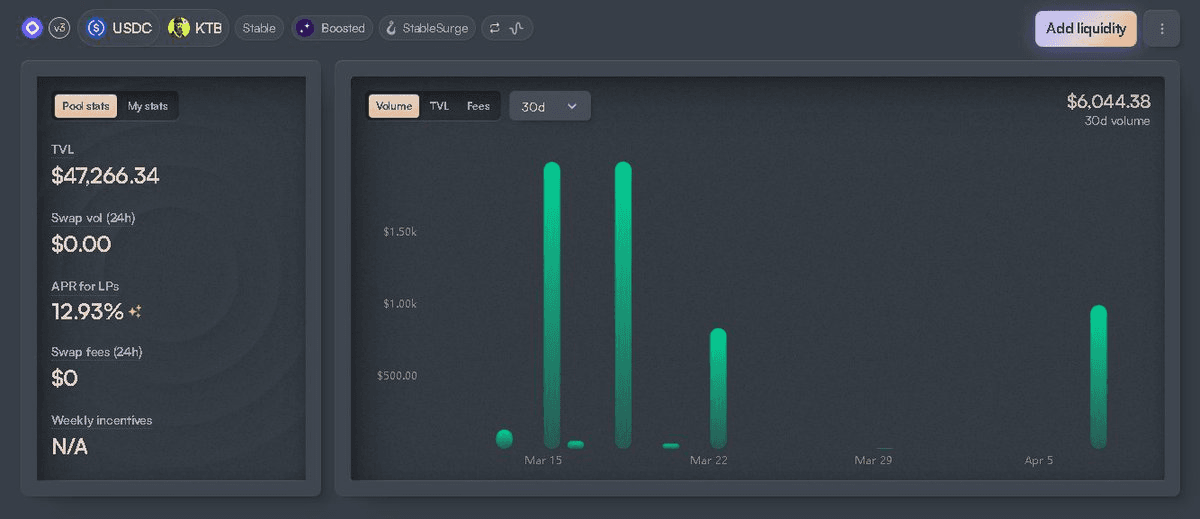
**Tokenized Korean Government Debt Now Accessible Onchain** Korean Treasury Bonds (KTB) from @etherfuse are now available through @DFB_DeFi, backed by USDC from @circle and boosted via @neverland_money. **Key Details:** - Real sovereign debt tokenized for blockchain access - First onchain gateway to Asian government bonds - USDC serves as the dollar-backed stablecoin foundation - Builds on Circle's existing South Korean presence through @Korbit_exchange This integration creates a bridge between traditional Asian sovereign debt markets and decentralized finance infrastructure.
🚀 Amplify Launches LBP on Balancer Infrastructure
**AmplifyWorld has officially launched its Liquidity Bootstrapping Pool (LBP) using Balancer's infrastructure.** - The launch follows an announcement from late March confirming Amplify's plans to utilize Balancer's platform - LBPs are a mechanism for fair token distribution that helps projects launch with better price discovery - This deployment demonstrates Balancer's continued adoption as infrastructure for DeFi projects Balancer's infrastructure enables projects to create customizable liquidity pools with dynamic weighting, making it a popular choice for token launches and liquidity management.
🎯 Balancer Launches $500K veBAL Holder Compensation Campaign
Balancer has announced a **$500K compensation campaign** for veBAL holders, following the approval of **BIP-919**. **Key Details:** - Distribution will occur **proportionally over 6 months** - Further implementation details to be announced - This follows previous unwinding efforts where 134 accounts claimed ~$5,000 worth of unlocked veBAL The compensation represents Balancer's continued effort to address veBAL holder concerns through structured, transparent distribution mechanisms.