AutoRange Pools: Self-Adjusting Liquidity Ranges on Balancer V3
AutoRange Pools: Self-Adjusting Liquidity Ranges on Balancer V3
🔄 Liquidity that rebalances itself

AutoRange Pools are now live on Balancer V3, offering concentrated liquidity that manages itself. The system automatically adjusts price ranges as markets move, eliminating manual rebalancing for liquidity providers.
Key features:
- Range shifts automatically when price drifts, keeping positions active
- No gas fees or transactions needed from LPs
- All LPs share the same ERC-20 position, preventing JIT attacks
- Oracle-free design derives price from internal trading activity
- $DUST/$USDC pool demonstrated 35% price swing over three weeks while staying in range
How it works: When price approaches range edges, the pool gradually shifts its window to follow market movement. The adjustment happens smoothly using the pool's own trade history—no external keepers or oracles required.
Target users:
- DAOs managing treasury liquidity without third-party managers
- Passive LPs seeking concentrated liquidity efficiency minus maintenance overhead
- Protocols wanting composable positions with no oracle dependencies
Balancer runs simulations for specific token pairs before deployment to optimize parameters.

A DAO that wants to concentrate liquidity for its token usually picks between three options: paying a quant desk, letting a static position drift out of range, or trusting a third-party ALM. None of those sit well with governance-controlled capital.
Every LP in an AutoRange Pool holds the same ERC-20 position, sharing the same price range and earning fees proportionally. This also prevents JIT liquidity attacks by design. No one can deploy a tighter range ahead of a large swap when all LPs are already in the same one.

AutoRange Pools are built for established pairs with real volume. If you want to know whether your token is the right fit, the Balancer team runs a simulation for your pair before you commit. Talk to us.

DAOs struggle with token liquidity. Running concentrated liquidity on the treasury side means picking ranges, monitoring drift, and executing rebalances through governance. Most treasuries aren't built for that. AutoRange Pools are. 🧵

Concentrated liquidity promised passive yield. For most LPs, it turned into a maintenance problem. Ranges expire, fees stop, and the position sits idle until someone rebalances it. AutoRange Pools handle that automatically. 🧵

DAOs struggle with token liquidity. Running concentrated liquidity on the treasury side means picking ranges, monitoring drift, and executing rebalances through governance. Most treasuries aren't built for that. AutoRange Pools are. 🧵
An AutoRange Pool is a concentrated liquidity pool on Balancer V3 where the range readjusts from the pool's own trading activity. The treasury provides liquidity and the pool handles the range, with no oracle dependency or third-party manager in the loop.
Reach out if you: → Want concentrated liquidity fees without managing a range → Run a treasury that needs liquidity working without oversight → Build protocols and want LP positions with no oracle in the loop We'll run a simulation for your pair. More details:
AutoRange Pools shift the price range on their own. When the price drifts far enough, the range glides after it until things balance out. Your position keeps earning fees the whole time, with no transaction on your end.
That shared structure also keeps price internal. AutoRange Pools derive it from their own trading activity, no external oracle needed. For protocols, this eliminates an entire attack vector. The pool has no external feed to manipulate and no price source in the critical path.
AutoRange Pools are live on Balancer V3. Add liquidity once. The range handles itself from there. Learn more: docs.balancer.fi/concepts/explo… Check the pools at: balancer.fi/pools?poolType…
Concentrated liquidity promised passive yield. For most LPs, it turned into a maintenance problem. Ranges expire, fees stop, and the position sits idle until someone rebalances it. AutoRange Pools handle that automatically. 🧵
DeFilytica: Open-Source Analytics Tool Maps Pool Range Movements
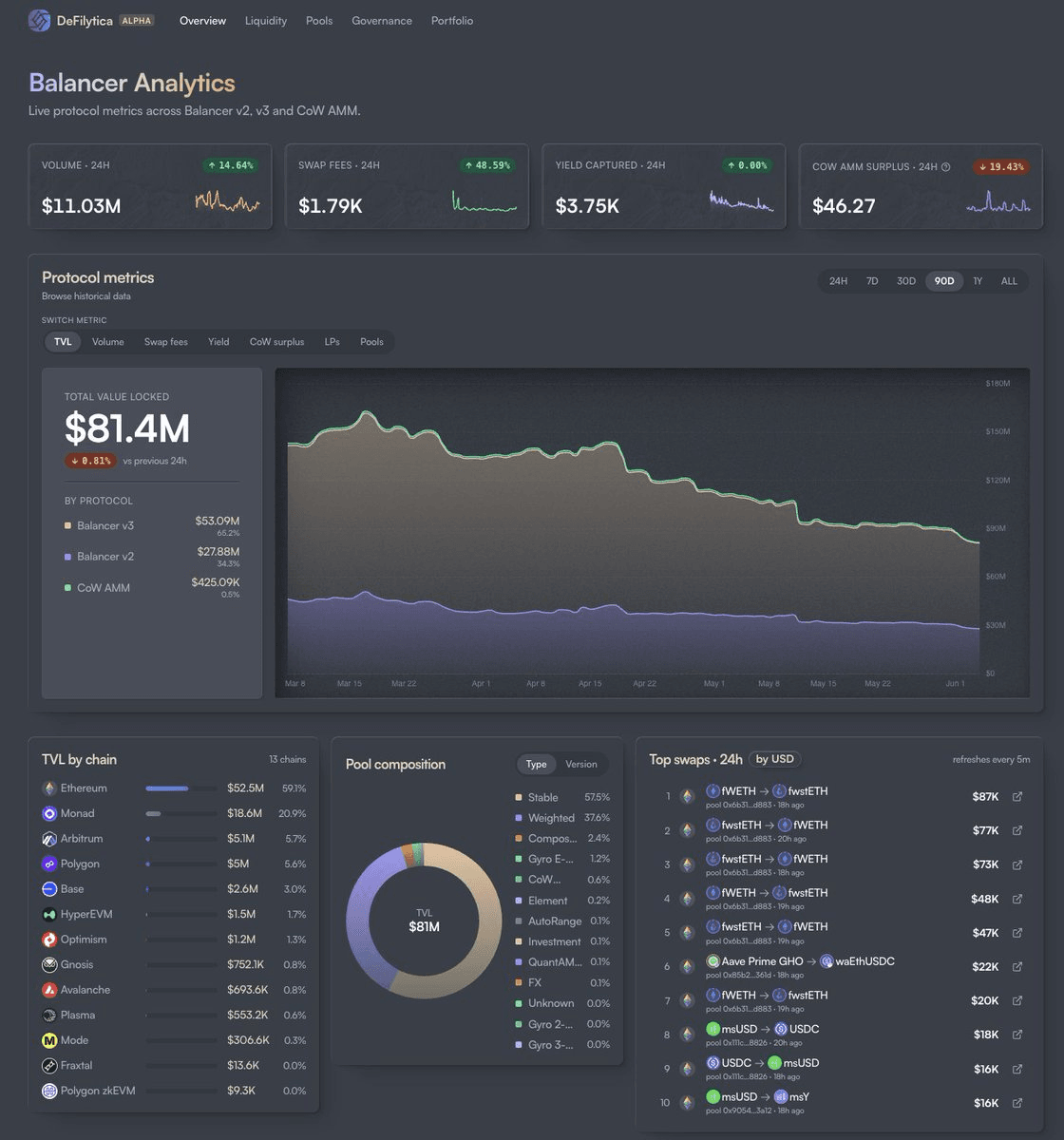
**DeFilytica**, an analytics tool by @Xeonusify, offers detailed tracking of liquidity pool ranges over time. **Key features:** - Maps pool range movements down to each adjustment - Built on top of Balancer's frontend - Open source and freely available The tool provides visual insights into how pools evolve, helping users analyze liquidity positioning strategies. DeFilytica represents another step in making DeFi data more accessible to liquidity providers and analysts.
Neverland Community Votes Balancer as Core DUST Liquidity Hub on Monad
**Neverland Money's community has spoken with a decisive vote.** The community voted with an overwhelming **84.79% majority** to designate Balancer as their core liquidity hub for the DUST token on Monad. This partnership solidifies Balancer's position as the official liquidity infrastructure for DUST. **Key details:** - Community-driven decision through governance vote - Strong consensus with nearly 85% approval - Establishes Balancer as the primary venue for DUST trading on Monad The vote and full community discussion are available for review, demonstrating transparent governance in action.
Fungible Positions Enable Direct DeFi Integration Without Wrappers
Two key properties—fungible positions and oracle-free mechanics—are unlocking new integration possibilities that traditional concentrated liquidity can't achieve. **Direct integration paths now available:** - Lending collateral - Yield aggregator entries - Portfolio tracking out of the box The breakthrough eliminates the need for wrappers or custom infrastructure maintenance, streamlining DeFi composability.
Why Token Standards Matter for DeFi LP Integration
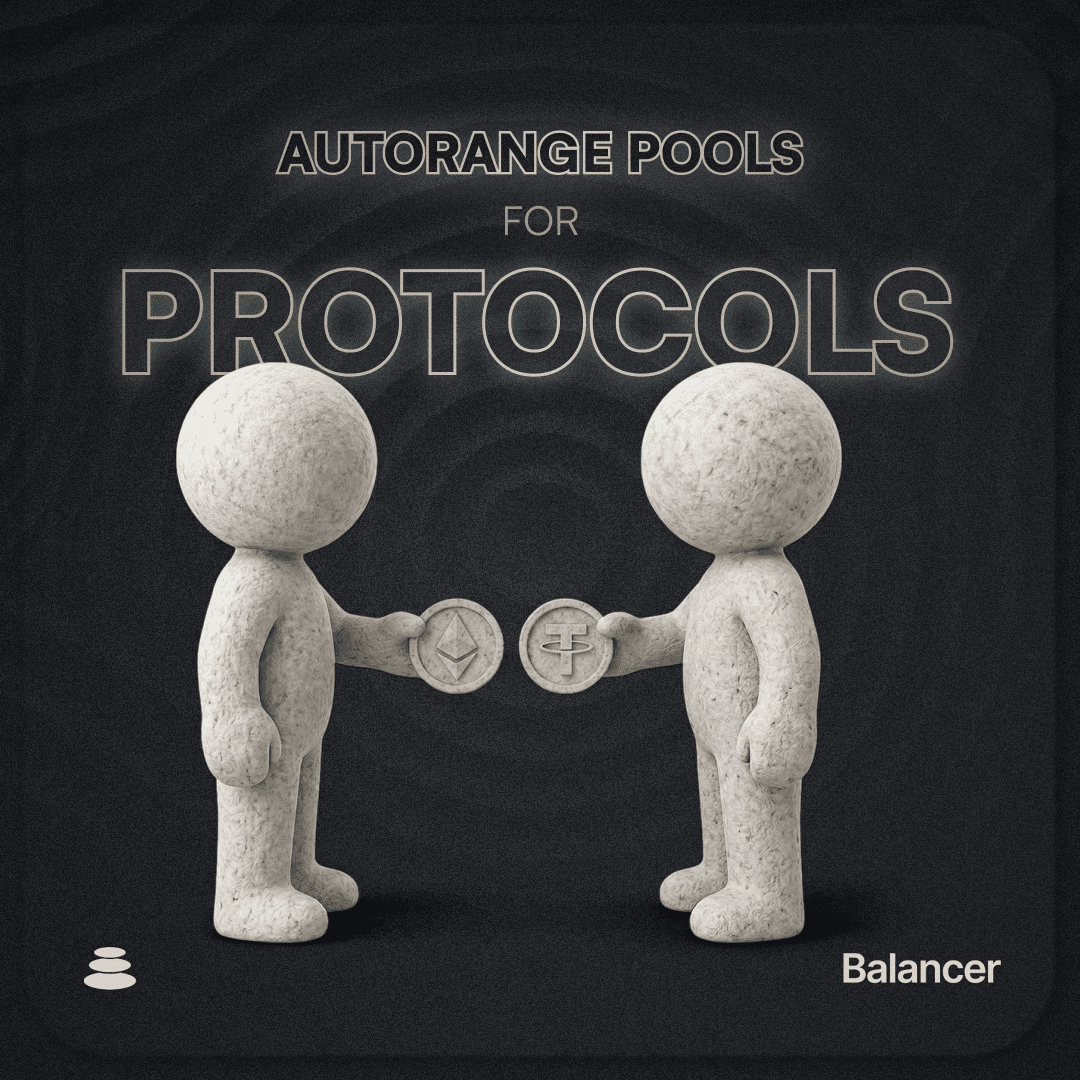
**Token standards determine how easily liquidity provider positions integrate with DeFi protocols.** - **NFT-based concentrated liquidity** requires custom wrappers for lending platforms, yield aggregators, and portfolio tools - **Fungible positions** integrate directly without additional development work **AutoRange Pools solve this by:** - Issuing **ERC-20 tokens** where all LPs share the same price range - Enabling **proportional fee distribution** across all position holders - **Preventing JIT attacks** by design—no one can front-run swaps with tighter ranges when everyone shares the same position This standardization makes LP positions more composable across the DeFi ecosystem while improving capital efficiency and security.