atvPTmax Delivers 11% USDC Yield Through Automated Pendle PT Strategy
atvPTmax Delivers 11% USDC Yield Through Automated Pendle PT Strategy
🔒 11% fixed USDC yield


atvPTmax, an automated vault by aarna, has achieved ~11% annualized APY in pure USDC returns over two months, outperforming traditional stablecoin lending by approximately 80% on a risk-adjusted basis.
Key Performance Metrics:
- +1.8% absolute USDC return over 2 months
- NAV progression: 1.0000 → 1.01821 with zero drawdowns
- TVL scaled 3x ($150k → $482k) without degrading returns
How It Works:
The vault uses Pendle Principal Tokens (PTs) to lock in fixed yields at discounted rates. Capital is deployed across 11 PT markets with automated rebalancing—15 rebalances executed to manage maturity timing, liquidity conditions, and position sizing.
Technical Advantages:
- Powered by TARS AI agent for real-time market scanning
- Positions capped at <5% of pool TVL to minimize slippage
- Automated maturity rolls prevent idle capital
- Strict risk controls: no leverage, oracle verification, concentration limits
Why PTs Outperform Variable Yield:
Pendle PTs provide fixed, predictable carry that excels during market volatility. Recent examples show PT strategies capturing 3-3.5% alpha over variable staking when funding rates compress or points programs fade.
Manual PT strategies struggle at scale due to liquidity fragmentation across isolated pools, but atvPTmax's automated execution solves this for institutional-grade deployment.

atvPTmax consistently outperforms popular stablecoin yield venues. Currently at approximately 11% in pure USDC APY Below is a two-month performance report:

Pendle PTs let you lock in fixed USDC/ETH yields at a discounted, predictable carry that crushes variable farming when rates swing. This thread dissects PT mechanics vs. variable exposure, backed by Q4 2024/2025 examples from PT-weETH, PT-sUSDe, and PT-rsETH. 1/ PT Mechanics:

Pendle PTs deliver one of DeFi's cleanest fixed-yield plays on stablecoins, but liquidity fragmentation makes large-scale accumulation tough for manual strategies. Especially institutional treasuries deploying $1M+. This post examines PT market dynamics, why manuals hit walls

atvPTmax: 2-Month Performance Update atvPTmax is built to do one thing well: Turn Pendle PTs into a scalable, fixed-carry USDC strategy, without users managing sizing, rolls, or liquidity. Over the last 2 months, that design has been tested under live capital, and it held up.

Crypto Markets Face $5B Liquidation Wave Amid Geopolitical Tensions
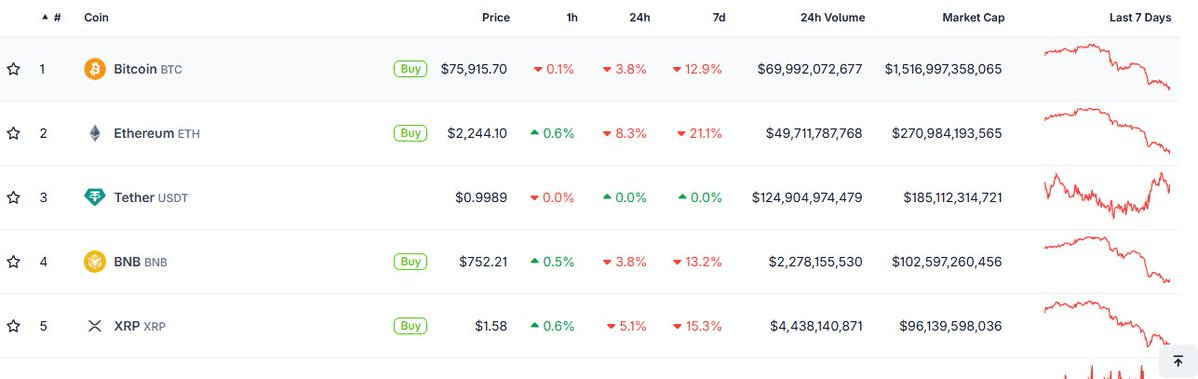
The crypto market experienced over **$5 billion in forced liquidations** across four days—the largest deleveraging event since October 2025. On February 1 alone, nearly **$2.2 billion in futures contracts** were liquidated, affecting more than 335,000 investors. **Key drivers of the selloff:** - Escalating U.S.-Iran tensions and a looming government shutdown triggered global risk-off sentiment - January 2026 saw **~$1.7 billion in weekly outflows** from U.S. Bitcoin and Ether spot ETFs—the largest since mid-November 2025 - A single-day withdrawal of nearly $1 billion on January 29 amplified selling pressure During the turbulence, structured yield products remained stable. Products like [aarna's atvPTmax](http://app.aarna.ai) delivered consistent **10-12% APY in USDC** through Pendle PT strategies, unaffected by market chaos. The event mirrors October's $9.9 billion liquidation, highlighting the risks of leveraged directional strategies versus structured yield approaches that prioritize capital preservation.
🤖 Aarna's TARS Agent Manages DeFi Risk

Aarna's onchain execution agent, TARS, addresses risk management for autonomous DeFi operations through four key mechanisms: **Continuous monitoring**: Tracks portfolio exposure and market conditions block-by-block, enforcing diversification caps and position limits at execution. **Policy constraints**: Deploys capital only into whitelisted markets meeting liquidity, maturity, and withdrawal criteria. **Automated de-risking**: Reduces exposure or reallocates when thresholds are breached due to maturity compression or liquidity changes. **Safety controls**: All actions pass through oracle validation, slippage checks, and multisig-gated execution. The system operates on Pendle PT markets, automatically rolling or reducing allocations as tokens approach expiry to maintain yield and capital discipline.
Vivek Ramaswamy Discusses Crypto Policy and Regulation
A comprehensive conversation with Vivek Ramaswamy covering cryptocurrency policy and regulatory frameworks is now available for viewing. **Key Points:** - Full interview accessible at [unhashed.co/vivek](http://unhashed.co/vivek) - Discussion spans multiple days of content (January 27-30) - Focuses on crypto regulation and policy perspectives The conversation provides insights into regulatory approaches and policy considerations for the digital asset space.
Why Institutions Are Finally Ready for Public Blockchains
Sri and Vivek Raman from Etherealize discuss the barriers preventing institutional adoption of public blockchains and the emerging solutions. **Key Points:** - Institutions have avoided public blockchains due to privacy and compliance concerns - Zero-knowledge proofs and programmable privacy now enable institutions to use public infrastructure without compromising confidentiality - This shift allows institutions to leverage public rails instead of building parallel off-chain systems **The Multi-Chain Debate:** - The conversation challenges the multi-chain narrative, arguing that Ethereum plus Layer 2s offers the optimal path forward - Spreading financial infrastructure across multiple chains fragments composability and weakens shared security - A unified settlement layer with multiple execution environments preserves the benefits of public infrastructure The discussion highlights how technical advances in privacy are removing the final obstacles to institutional participation in public blockchain networks.