Arbitrum's ArbOS Upgrade Delivers Predictable Trading Fees During Market Volatility
Arbitrum's ArbOS Upgrade Delivers Predictable Trading Fees During Market Volatility
🎯 Fees That Actually Make Sense


Arbitrum's recent ArbOS performance upgrade has resulted in lower and more predictable transaction fees for traders using gTrade, particularly during periods of market volatility.
Key improvements:
- Transaction costs are now more consistent across different market conditions
- Fee predictability enables better cost modeling for businesses operating on-chain
- The upgrade supports reliable system design for programmable economies at scale
The enhancement builds on the earlier ArbOS Dia upgrade from March 2026, which first introduced more predictable fees during peak demand periods. This consistency in transaction costs addresses a critical need for traders and businesses requiring dependable infrastructure, especially when markets experience high volatility.
The upgrade demonstrates progress in making Layer 2 solutions more practical for real-world trading applications and business operations.

Thanks to the recent ArbOS performance upgrade, transactions via gTrade on Arbitrum are lower and much more predictable, especially during volatility. Traders need platforms they can rely on. Arbitrum delivers consistent, predictable fees across all market conditions.

Remember ArbOS? Another unlock 👀 Thanks to @arbitrum’s upgrade, trading on gTrade for Arbitrum users just got meaningfully better. Minimum fees to execute trades are now ~50% cheaper ($0.3). Cheaper trades. More predictable gas. This is what scaling Ethereum looks like for

Arbitrum Analyzes Network Performance During High Traffic Periods
Arbitrum has published a detailed analysis examining how its Layer 2 network handles peak demand periods. The blog post explores the network's predictability and performance metrics when transaction volumes surge. **Key Focus Areas:** - Network behavior during high-traffic events - Transaction processing consistency - Performance predictability under stress The analysis provides data-driven insights into Arbitrum's infrastructure capabilities during periods of increased user activity. Read the full technical breakdown: [Predictability at Peak Demand](https://blog.arbitrum.io/predictability-at-peak-demand/)
Jumper Users Favor Arbitrum for DeFi Execution

**Jumper Exchange users are increasingly selecting Arbitrum as their go-to Layer 2 network for transaction execution.** The trend is driven by two key factors: - **Predictable fees**: Transaction costs on Arbitrum remain stable and forecastable - **Deep liquidity**: Sufficient market depth enables efficient trades Jumper, powered by LI.FI Protocol, functions as an aggregator that consolidates access to Arbitrum's leading DEXs, bridges, and DeFi applications into a single interface. This allows users to swap tokens and deploy assets across the Arbitrum ecosystem without navigating multiple platforms. The combination of cost efficiency and liquidity depth positions Arbitrum as a natural infrastructure choice for DeFi aggregation services.
🤖 ArbiLink Agentic Challenge: Build AI Workflows on Arbitrum

The **ArbiLink Agentic Challenge** is now accepting submissions with a **$250 prize** and a trip to Open House London for winners. **What to Build:** - Agentic skills or framework extensions - Full workflows for trading, swaps, and perpetuals - Smart wallet integrations on Arbitrum **Key Details:** - Online submissions close **April 3rd** - Focus on building autonomous agent capabilities for DeFi operations [Learn more and submit](https://www.notion.so/arbitrumfoundation/ArbiLink-Challenge-Agentic-Bounty-32c90457c3268012b69efd3a5ee7ea46)
Usher Web3 Launches Fiet on Arbitrum to Bridge DeFi and Traditional Capital Systems
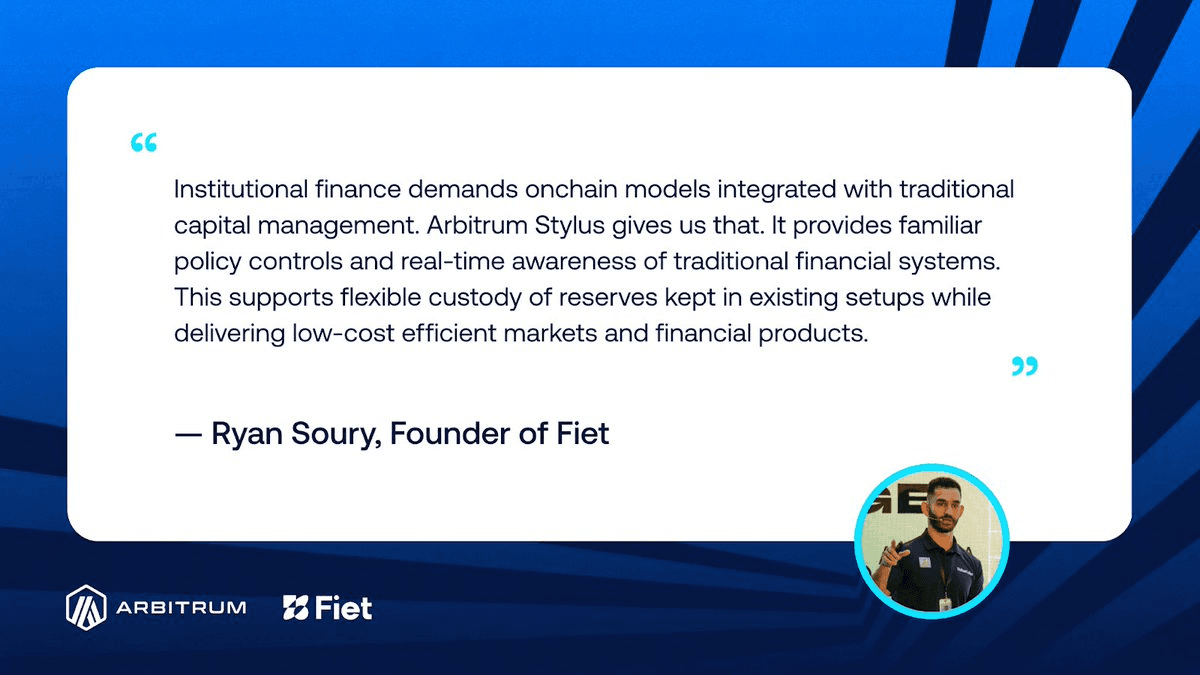
**Capital efficiency takes center stage** as institutions explore onchain infrastructure. **Usher Web3 has launched Fiet** on the Arbitrum Platform, designed to integrate DeFi protocols with existing capital systems. The platform aims to provide institutions with a more practical pathway for building on the programmable economy. **Key focus areas:** - Bridging traditional capital infrastructure with DeFi - Enabling institutional participation in onchain markets - Leveraging Arbitrum's L2 scaling capabilities The move reflects growing institutional interest in capital-efficient DeFi solutions that can work alongside existing financial systems rather than requiring complete infrastructure overhauls.
Arbitrum Introduces Fiet Model for Reserve-Backed Institutional DeFi
Arbitrum has launched the **Fiet model**, a new approach to reserve-backed liquidity designed for institutional adoption in DeFi. **Key features include:** - Reserve-backed liquidity without requiring idle capital - Integration with existing custody and treasury systems - Onchain policy enforcement at execution level - Lower-cost, scalable market infrastructure Built by @usher_web3 on the Arbitrum Platform, Fiet addresses a critical challenge: **capital efficiency for institutions moving onchain**. The model allows DeFi protocols to integrate with traditional capital systems, creating a more practical pathway for institutional participation in the programmable economy. This development represents a bridge between traditional finance infrastructure and decentralized systems, potentially lowering barriers for institutional entry into onchain markets. [Read the full technical details](https://blog.arbitrum.io/how-fiet-made-reserve-backed-liquidity-practical-onchain/)