Aragon Pushes Automated Governance to Replace Endless DAO Proposals
Aragon Pushes Automated Governance to Replace Endless DAO Proposals
🤖 Governance without the votes

Aragon is shifting onchain governance from constant proposal voting to rule-based automation. Their new approach addresses a core inefficiency: DAOs shouldn't need human approval for routine tasks like payroll or treasury rebalancing every month.
Key developments:
- Launching the Token Ownership Index to verify which tokens grant actual control rights versus speculative assets
- Introducing governance automation that executes recurring decisions based on predefined rules
- Distinguishing "ownership tokens" (like Aave, Lido, Curve) from memecoins through verifiable onchain rights
The timing aligns with maturing capital flows and regulators favoring transparent, rule-based systems over discretionary control. Vitalik Buterin's 2026 forecast similarly emphasized automated governance design.
Aragon argues proposal-based governance doesn't scale when communities vote on the same actions repeatedly. Their solution: define rules once, automate execution, and reserve human discretion for decisions that truly require it.
Read the full framework: Beyond Proposals Part I

In 2026, Aragon is committed to making crypto-native tokens investable through ownership, automation, and value accrual. If you’re building a protocol and want your token to have real rights and defensible value, let’s talk. 🤝 Read @A_Leutenegger's the full post:
"2026 will decide the future of crypto-native tokens. Either most will keep bleeding credibility and be written off as memecoins. Or a new class emerges where tokens are truly worth owning." Here’s how Aragon plans to help crypto-native tokens stand the test of time in 2026 by
This is precisely why Aragon is building the Token Ownership Index - to help investors have clear and verifiable information about the rights they have as tokenholders, starting with what’s actually enforceable onchain. In 2026, we are committed to making crypto-native tokens

🚨 NEW: Over 11.6 million cryptocurrencies failed in 2025 alone, per Coingecko.

In his 2026 forecast, @VitalikButerin himself speaks to the evolution of governance design as being more automated and straight forward. Self-sovereignty isn’t just about nodes, wallets, and privacy. It’s also about reducing discretionary control and replacing it with
But ownership alone isn’t enough. Governance by endless proposals doesn’t scale. So in 2026, Aragon also plans to help teams shift towards governance automation that: • Streamlines repeatable decisions • Reduces governance overhead • Keeps community members focused on what
The Ownership Token Index makes tokenholder rights explicit and verifiable. 📊📉📈 It also helps answer a core question - does this token actually control anything that matters?🧐 Ownership tokens appreciate. Memecoins are fleeting. A clear separation will be available at last
Our latest post explores the other half of that solution: automation, constraints, and the art of not governing. blog.aragon.org/beyond-proposa…
Because onchain systems are maturing. Capital flows are repeatable. Regulators increasingly favor rule-based infra over discretionary control. This year we're going to see onchain governance become sharper through automation. Read "Beyond Proposals Part I: Automation & the Art
The problem? Investors can’t easily verify ownership. • Onchain rights are hard to inspect • Offchain structures are opaque • Token + equity misalignment hides real risk That’s why we’re building the Ownership Token Index. Launch of V1 will be out very soon! 👀
Proposal-based governance treats every action like a referendum: - Paying rent - Rebalancing treasury - Sending incentives Humans continuously deciding the same thing over and over doesn’t scale. What's more, it's not productive.
Onchain governance shouldn’t feel like approving payroll every month. Every transaction once required a proposal, but not in 2026. Now, governance actions can be executed automatically according to rules that only need to be defined once. This is automation and the art of not
A few projects did it differently and have launched what we're calling "ownership tokens" that clearly demonstrate verifiable rights. Some examples for you are: • Control over protocol parameters by @aave and @LidoFinance • Control over incentives and capital flows by
Aragon Launches Tokenomics Stack for Protocol Value Accrual
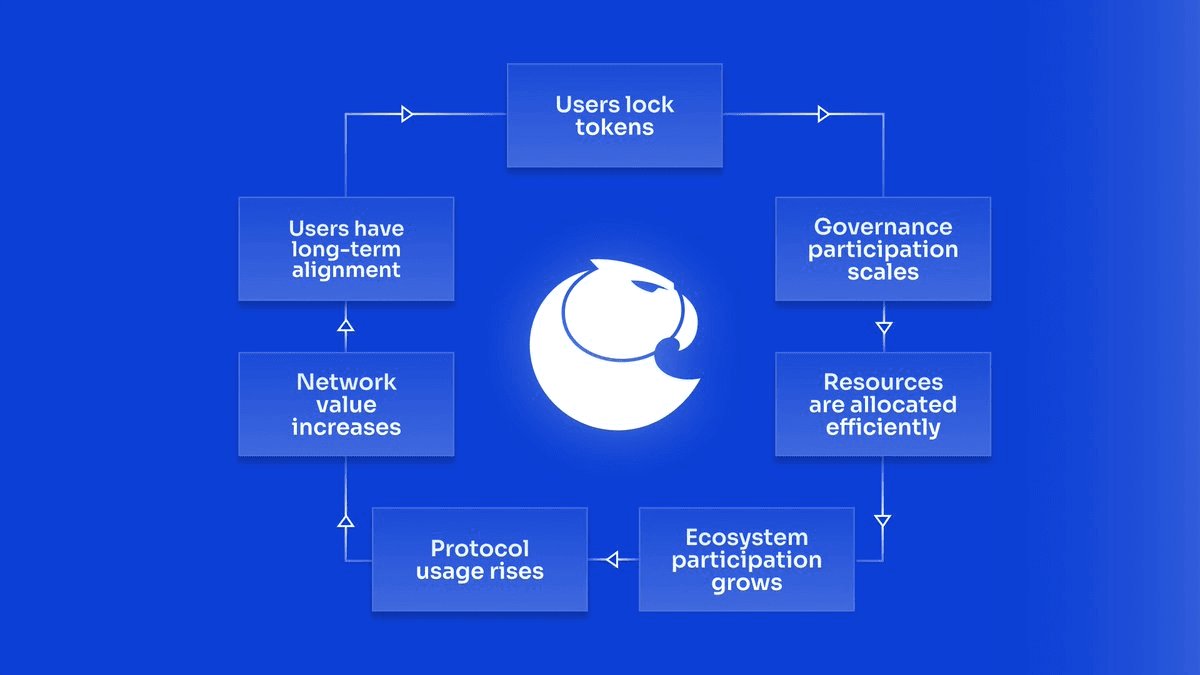
Aragon has released a tokenomics infrastructure stack that enables protocols to deploy ve-lockers, gauges, and capital routing mechanisms. The modular system aims to convert token emissions into measurable value accrual. **Key components:** - **ve-lockers**: Allow token holders to lock assets for time-weighted voting power - **Gauges**: Enable veToken holders to vote on directing emissions - **Capital routing**: Automates treasury spending and resource allocation The framework integrates with Aragon's governance tools, allowing protocols to align incentives and track outcomes onchain. The system is designed for both early-stage and established protocols. Learn more: [Aragon Tokenomics](https://www.aragon.org/tokenomics)
Aragon Tackles Token Ownership Rights Gap
Aragon is addressing a critical issue in crypto: **tokenholders lack enforceable legal rights**. The company is developing solutions to give token investors clear, verifiable ownership rights. **Key developments:** - Building a Token Ownership Index to provide transparent information about tokenholder rights - Focus on what's actually enforceable onchain, not just promises - 2026 roadmap centers on making crypto-native tokens investable through ownership, automation, and value accrual The initiative responds to a fundamental problem highlighted by industry observers: many tokenholders believe they have rights that simply don't exist in any legal framework. Aragon aims to bridge this gap by creating verifiable, onchain ownership structures. More details available at [Aragon's blog](https://blog.aragon.org/making-tokens-investable-in-2026-through-ownership-automation-and-value-accrual/)
Pendle AIM Showcases Real Token Ownership Model
Pendle's AIM system demonstrates practical token ownership through three key features: - **Verifiable value flows** that can be tracked and confirmed - **Durable economic rules** providing long-term stability - **Reduced governance overhead** streamlining decision-making The model will be featured in the upcoming Ownership Token Index, which aims to identify projects with genuine token utility. This follows a broader industry shift toward tokens that offer clear, verifiable rights rather than speculative value. The Index will highlight projects demonstrating measurable ownership characteristics.
Aragon Partners with Generic Money for Onchain Yield Generation
Aragon has announced a partnership with Generic Money to enable networks to generate onchain yield for ecosystem development. **Key Points:** - Generic Money's neutral stablecoin infrastructure integrates with Aragon's value accrual primitives - The collaboration aims to help web3 projects capture and distribute more value - Partnership builds on Aragon's existing multi-chain presence across Ethereum, Polygon, Base, Arbitrum, Optimism, zkSync, BNB Chain, and Peaq The integration allows organizations using Aragon's governance and tokenomics tools to direct generated yield toward ecosystem growth initiatives.
Status L2 Alpha Drop: Aragon Pre-Deposit Vault Details Coming Wednesday
**Status L2** is hosting a Twitter Spaces session next Wednesday to reveal details about their **gasless network bootstrap strategy**. The session will focus on how **Aragon-powered pre-deposit vaults** are being used to launch the network. These vaults allow users to: - Contribute liquidity before mainnet launch - Stake assets and earn Karma tokens - Help bootstrap network from day one **Key Status L2 features:** - Gasless user experience - Shared-yield model instead of sequencer fees - Native privacy layer with shielded assets - Karma token for governance and gas-free transactions The pre-deposit vaults are built on **Aragon OSx** and deployed on Ethereum L1 and Linea, creating a foundation for the network's liquidity and governance systems. [Join the Twitter Spaces](https://x.com/i/spaces/1mrGmBRaOmNJy?s=20) to learn the implementation details.