Aragon Integrates ENS Profiles to Humanize DAO Governance Participation
Aragon Integrates ENS Profiles to Humanize DAO Governance Participation
🏛️ DAOs get readable names

Aragon has launched ENS-powered profiles to address a fundamental usability challenge in decentralized governance. The integration replaces cryptic wallet addresses with human-readable names, making it significantly easier to identify participants in governance votes, approvals, and delegation processes.
Key improvements:
- Participants now display as readable names (like alice.eth) instead of hexadecimal addresses
- Enhanced transparency in understanding who holds governance power
- Simplified tracking of delegation relationships
- Better accountability through verified identity display
This builds on earlier ENS developments that enabled wallets to show verified names for AI agents and autonomous onchain actors. The move reflects growing recognition that Web3 interfaces need to bridge the gap between blockchain's technical requirements and human comprehension.
By leveraging ENS's existing infrastructure for mapping Ethereum addresses to memorable names, Aragon aims to lower participation barriers and improve governance transparency without compromising decentralization.

Wallet addresses are great for computers. Not so great for humans. Aragon's new ENS-powered profiles make it easier to understand who's participating in governance, approvals, and delegation.

Introducing onchain profiles for council members, multisig signers, and delegates. Publish profiles and statements in Aragon via @ensdomains, improving opsec hygiene and making approval flows easier to track. Built on open infrastructure, so profiles stay portable across apps.
Turkey's Government Adopts ENS for Official Blockchain Identity

**Turkey makes official move into web3 infrastructure** Turkey's Directorate of Communications has registered **cbiletisim.eth**, marking the government's first step in establishing an official onchain identity through the Ethereum Name Service. The initiative is part of Turkey's broader digital transformation strategy, which centers on AI and blockchain technologies. ENS was prominently featured at the Directorate's offices in Ankara as a core component of this infrastructure. **Key developments:** - First government entity to adopt ENS for official communications - Part of Turkey's national AI and blockchain initiative - Demonstrates ENS functioning as internet infrastructure at governmental level This represents a practical application of blockchain naming systems beyond cryptocurrency, with a national government choosing ENS for its digital identity framework. [Official announcement](https://www.iletisim.gov.tr/english/duyurular/detay/press-release-digital-transformation-breakthrough-building-the-future-of-our-communication-ecosystem-via-ai-and-blockchain-technologies)
ENSv2 Launches Universal Resolver for Cross-Chain Name Resolution
**ENS is upgrading its resolver system with ENSv2** The Ethereum Name Service is introducing a Universal Resolver - a single smart contract that can resolve names across multiple environments: - ENSv1 names - ENSv2 names - Layer 2 networks - Offchain names via CCIP-Read **What developers need to know:** Applications using ENS should update their libraries to ensure compatibility with the new Universal Resolver. The system uses CCIP-Read protocol to fetch data from L2s and offchain sources. This consolidation simplifies the resolution process by eliminating the need for separate resolvers for different name types and networks. Developers can find implementation details in the [ENSv2 readiness documentation](https://docs.ens.domains/web/ensv2-readiness/). **Action required:** Review your ENS integration and update libraries to support cross-chain resolution.
ENS Launches registerAgentIdentity() for On-Chain Agent Verification
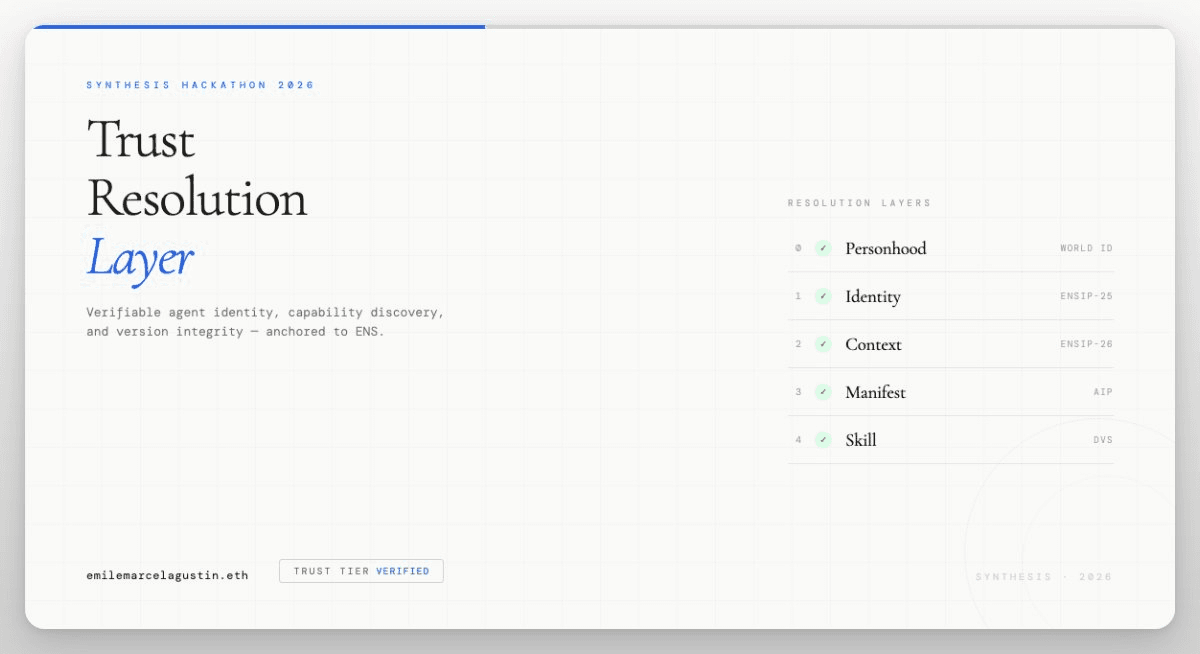
ENS has introduced `registerAgentIdentity()`, a new function that provides AI agents with on-chain identity infrastructure. When called, agents receive: - A human-readable ENS subname - An on-chain passport - Cryptographic proof linking the agent to its owner This builds on ENS's evolving role beyond simple name resolution. The system now supports: - **Arbitrary records** that carry an agent's full trust stack - **Identity scoring** (none, registered, discoverable, verified, full) - **Programmable resolvers** that execute logic like token swaps or privacy routing ENS serves as the accountability layer, transforming raw cryptographic keys into verifiable, human-readable identities. One ENS name can hold everything: identity, discoverability, code integrity, and capabilities. The infrastructure makes agents resolvable and accountable while maintaining the flexibility to chain complex actions through custom resolver logic.
🏆 Trust Resolution Layer Wins First Place for Verifiable Agent Identity
A **Trust Resolution Layer (TRL)** has taken first place for establishing verifiable AI agent identity through ENS. The system combines multiple components: - World ID verification - ENSIP-25 agent registration standard - ENSIP-26 context records - Novel AIP manifest system These elements work together to create a **progressive 5-tier trust scoring system** for autonomous agents. This infrastructure addresses a critical need as AI agents increasingly sign transactions, hold assets, and interact with blockchain protocols. The TRL builds on ENSIP-25, which introduced standardized verification that an onchain-registered AI agent is genuinely associated with an ENS name. The solution provides essential identity infrastructure for the growing ecosystem of autonomous agents operating in web3.