Algebra Dynamic Fees Beat Static by 3.5% in ETH/USDT Tests
Algebra Dynamic Fees Beat Static by 3.5% in ETH/USDT Tests
📊 Fees That Actually Adapt

Algebra Labs tested its Dynamic Fee mechanism against static fees using real ETH/USDT data from 2025. The results show adaptive fees outperformed matched static fees by generating ~3.5% more cumulative fees for liquidity providers.
Key findings:
- Dynamic Fee achieved 18.0% fee APR vs. 16.9% for static fees at the same average level
- The mechanism adjusts fees based on market volatility—keeping them low during calm periods to attract organic traders, and raising them when arbitrage risk increases
- Performance remained consistent across parameter ranges, indicating robustness
How it works:
The system distinguishes between two trader types:
- Noise traders (organic users) generate real revenue and prefer competitive fees
- Arbitrageurs extract value from LPs through price misalignments
Algebra's Sliding Fee plugin complements this by targeting repeated same-direction trades (typical arbitrage patterns) while preserving low fees for natural users—improving LP outcomes by up to 15% in certain conditions.
The trade-off: Static fees remain simpler and work well in low-volatility environments. But when markets move, adaptive mechanisms capture more value without overcharging users.
Algebra powers 90+ DEXes including Camelot, THENA, and QuickSwap.
Algebra DEXs Outperform Major Protocols in Capital Efficiency
**Capital Efficiency Breakthrough** Algebra-powered DEXs are demonstrating significant efficiency gains over established protocols. Over 30 days, Blackhole CLMM generated 4.86% fees per $1 TVL, while nest CL achieved 2.85%—both outperforming Uniswap V3's 2.41%. Curve, Balancer, PancakeSwap, and SushiSwap all registered under 0.35%. **Key Developments** - **nest Case Study**: Reached $10M TVL in 14 days on HyperEVM, processing $1.784B volume and generating $1.85M in fees using Algebra Integral - **Data Infrastructure Report**: SQD and Algebra released analysis of DEX data architecture across QuickSwap, Hydrex, nest, and Blackhole - **Uniswap's CCA Model**: Algebra published breakdown of Continuous Clearing Auctions on Robinhood, noting Algebra Integral can power similar models Algebra's concentrated liquidity engine continues powering 100+ DEXs across EVM chains, with the infrastructure enabling higher capital utilization compared to traditional AMM designs. [Read full report](https://blog.algebra.finance/dex-data-infrastructure-sqd-algebra-report)
Algebra Powers $200B+ Trading Volume Across 10+ Chains
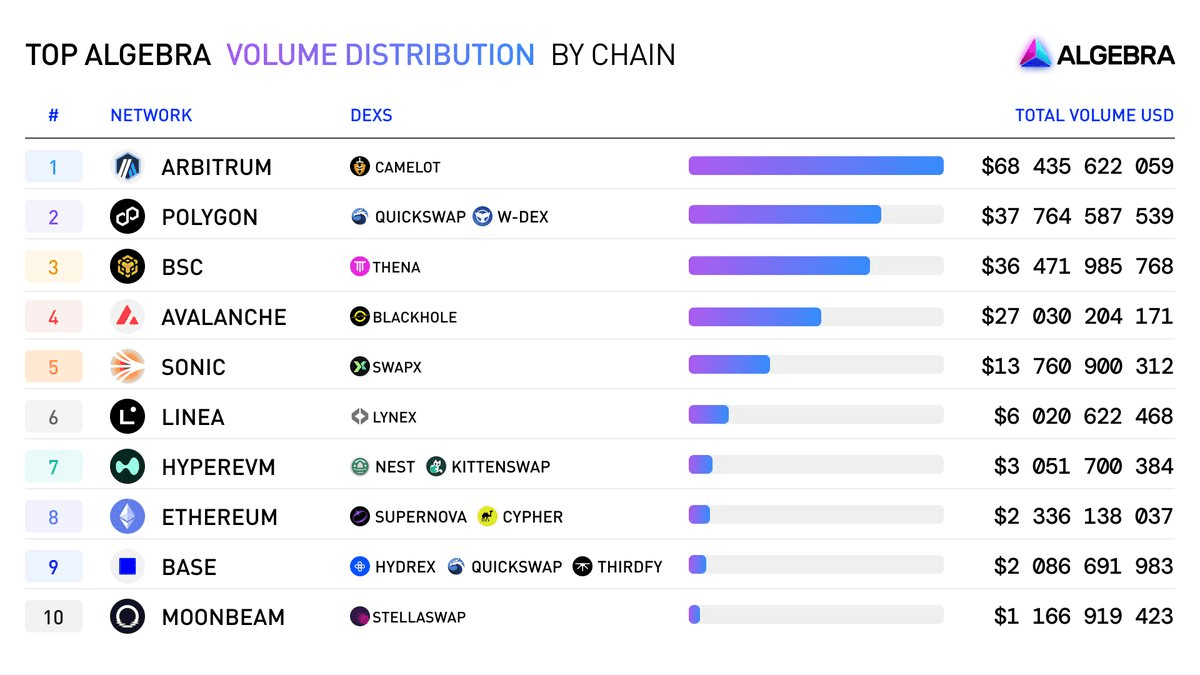
Algebra's liquidity engine has processed over $200 billion in trading volume across multiple blockchain networks and decentralized exchanges. **Network Distribution:** - Arbitrum leads through CamelotDEX - Polygon hosts QuickswapDEX and W-DEX - BNB Chain features ThenaFi - Additional deployments on Avalanche (BlackholeDEX), Sonic Labs, Linea, Ethereum, Base, Moonbeam, and Hyperliquid The protocol provides a unified liquidity infrastructure that powers multiple top-tier DEXs across different ecosystems. This multi-chain approach demonstrates how a single AMM engine can serve diverse blockchain networks while maintaining capital efficiency. Previous data showed seven major Algebra-powered DEXs by total value locked and volume, including BlackholeDEX, SupernovaDEX, CamelotDEX, QuickswapDEX, ThenaFi, HydrexFi, and SparkDexAI. Algebra's concentrated liquidity model includes adaptive fees, built-in farming capabilities, and support for deflationary tokens across its network of integrated exchanges.
Algebra Launches Access List Plugin for KYC-Compliant DEX Operations
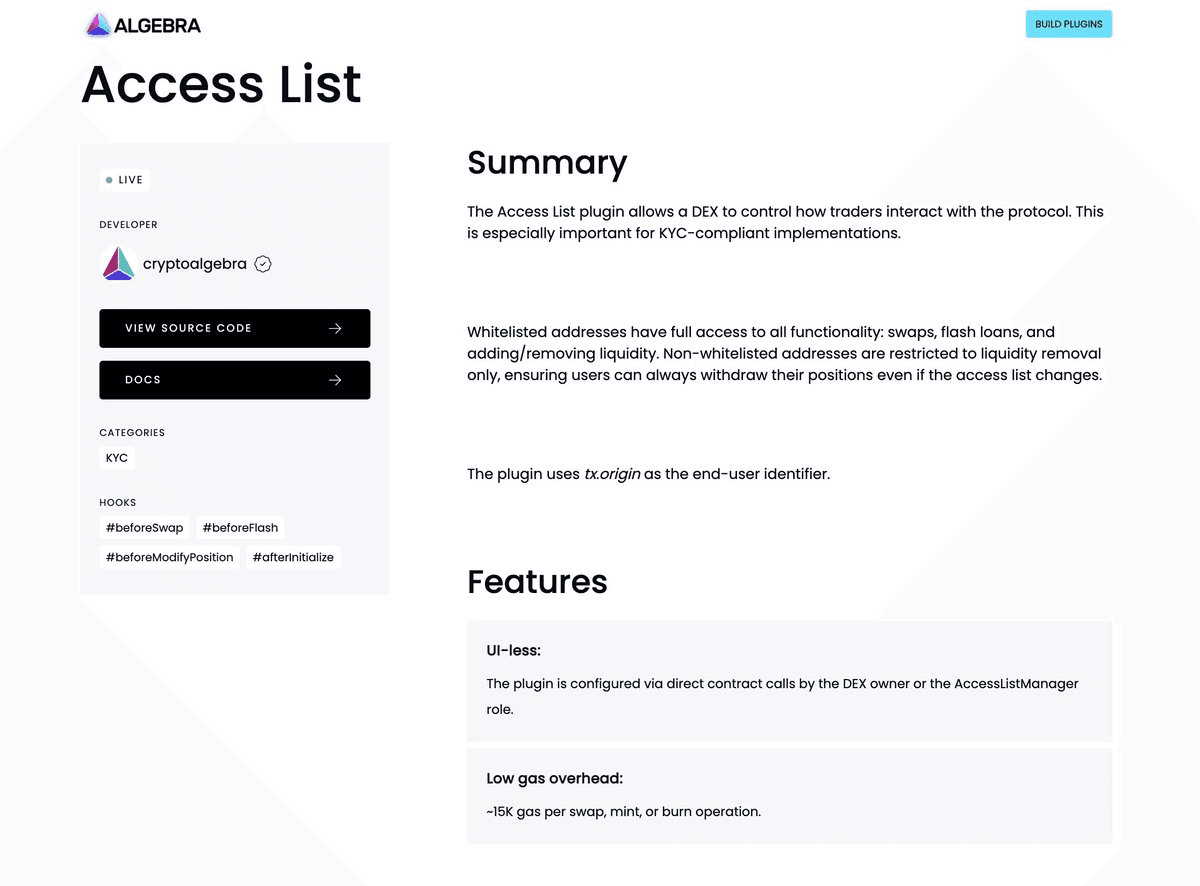
Algebra has released a new Access List plugin that enables decentralized exchanges to implement user permission controls. **Key Features:** - **Whitelisted users** receive full platform access including swaps, flash loans, and liquidity provision - **Non-whitelisted users** can only remove liquidity, ensuring funds remain accessible - Designed for DEXs requiring KYC compliance while maintaining decentralization The plugin is part of Algebra's modular Integral architecture, where core liquidity and swap functions remain immutable while additional features can be customized through interchangeable plugins. This approach allows DEX operators to meet regulatory requirements without compromising the security of user funds. [Learn more about the Access List plugin](http://market.algebra.finance/plugin/access-list/)
🤝 Tempo Mainnet Launches with Algebra Integration
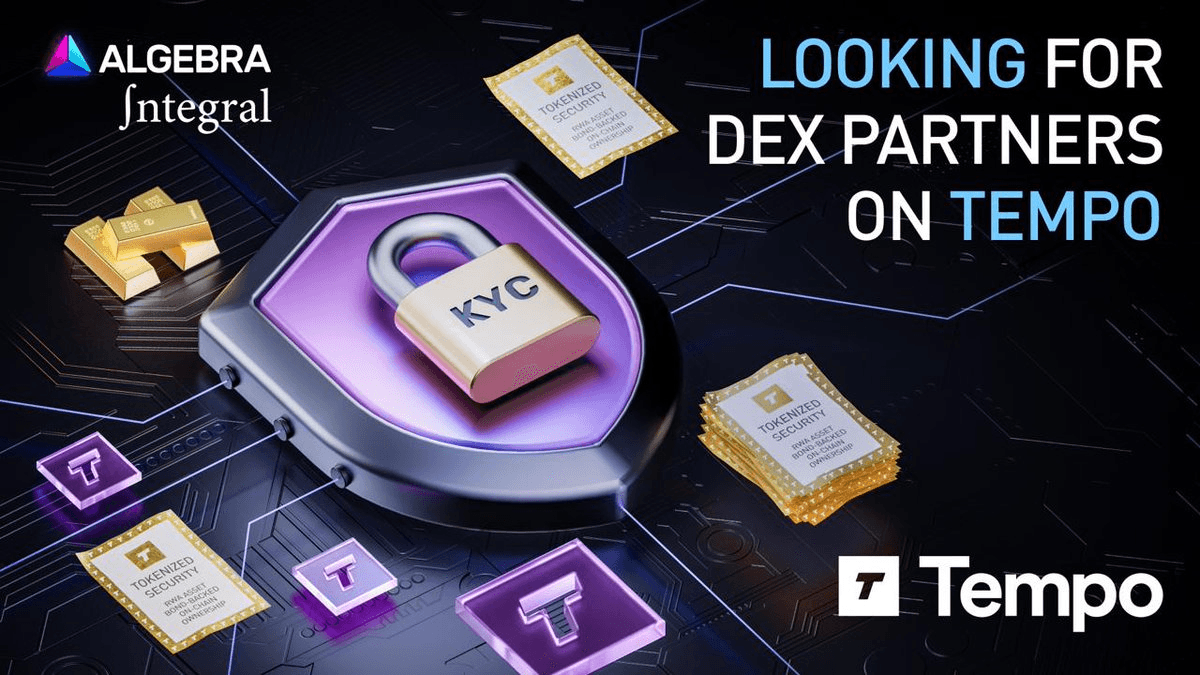
**Tempo mainnet is now live**, offering developers the opportunity to be among the first to deploy using Algebra's technology. **Key Features Available:** - Algebra Integral's modular DEX architecture - Enhanced performance capabilities for decentralized exchanges - Access to customizable liquidity solutions Developers interested in deploying can access the integration form at algebra.finance/form/. This launch follows Algebra Integral's recent deployment powering BEAM DEX on Zeta blockchain.
🤖 Algebra Launches AI-Ready DEX Infrastructure with Adaptive Trading Plugins
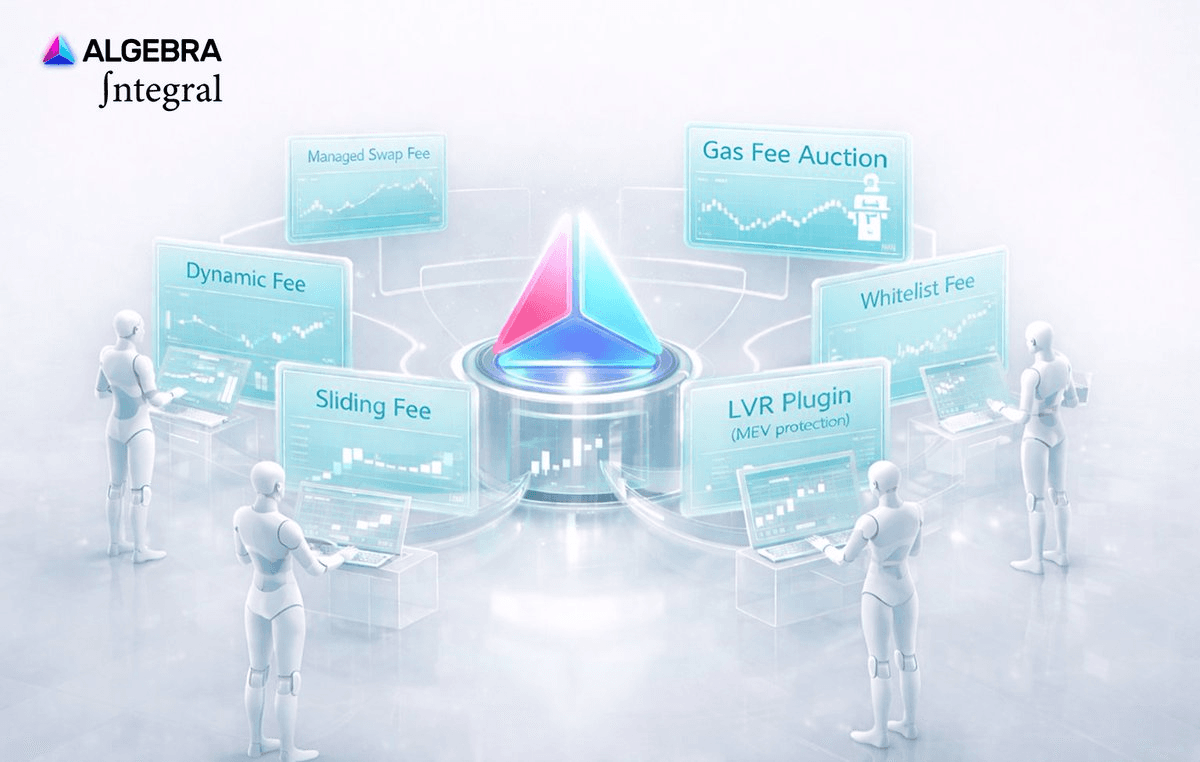
Algebra's plugin architecture is positioning itself for the emerging AI-driven trading landscape with tools designed for algorithmic actors. **Key Features for Machine-Driven Trading:** - **Managed Swap Fee**: Enables automated execution without manual intervention - **Dynamic Fee Plugins**: Offers adaptive fee tiers through Dynamic, Sliding, and Whitelist options - **LVR Plugin**: Provides MEV protection combined with intent-based execution These modular tools create adaptive environments specifically built for algorithmic trading systems. The infrastructure allows DEX builders to integrate AI-native features without rebuilding their entire platform. The plugin system works by adding independent smart contracts on top of Algebra's Integral engine. Each pool can run one plugin at a time, with the ability to swap plugins seamlessly without moving liquidity or redeploying contracts. This approach addresses a growing need as AI agents become more active in DeFi markets, requiring infrastructure that can respond dynamically to machine-driven trading patterns. [Build with Algebra](http://algebra.finance/form/)