Aave Processes $4.65B in Liquidations Since 2020, Recaptures $16M in MEV
Aave Processes $4.65B in Liquidations Since 2020, Recaptures $16M in MEV
💰 Aave's $4.65B liquidation milestone

Key Liquidation Metrics
Since launching in 2020, Aave has processed over 310,000 liquidations worth $4.65 billion across all networks. Liquidation activity typically spikes during sharp market downturns.
Network Distribution
- Ethereum accounts for 75% of total liquidation volume in USD terms
- Non-Ethereum networks represent the majority when counting individual liquidation events
MEV Recapture Success
In March 2025, Aave integrated Chainlink's Smart Value Recapture (SVR) into its Ethereum market. By February 2026, the system:
- Processed $675M across ~3,900 liquidations
- Captured ~$16M in MEV for the Aave DAO
- Achieved a 73% non-toxic MEV recapture rate
This integration allows the protocol to reclaim value from liquidation-related MEV that would otherwise go to external actors.

Read the full analysis here: aave.com/blog/historica…
From Aave's launch in 2020 through the first week of February, the protocol processed over 310,000 liquidations, totaling $4.65 billion in value. Liquidations typically surge during sudden, steep price drops in the market.
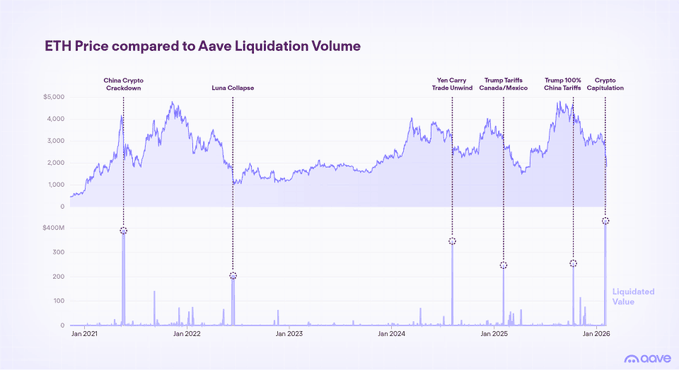
Across all networks, three-quarters of Aave's total liquidation volume (in USD terms) has occurred on Ethereum. However, when measured by the total count of liquidation events, the pattern reverses with non-Ethereum networks accounting for the majority of transactions.

In March 2025, Aave integrated @chainlink SVR into its Ethereum market, reclaiming liquidation-related MEV for the Aave DAO. By February 2026, it processed $675m across ~3,900 liquidations, capturing ~$16 million and achieving a 73% non-toxic MEV recapture rate.

Arbitrum DAO Votes to Unfreeze ETH for rsETH Recovery Effort
**Arbitrum community reaches quorum on ETH release** Over 1,600 addresses representing 190+ million ARB tokens voted to unfreeze ETH held by Arbitrum DAO following the April 18 rsETH bridge exploit. The vote passed with strong delegate approval, marking progress for the DeFi United recovery initiative. **Key developments:** - Attacker's rsETH positions liquidated on Aave (Ethereum and Arbitrum) - Liquidated collateral now held by Recovery Guardian - No other users affected during liquidation process - Frozen ETH would support efforts to restore rsETH backing **Background:** The rsETH incident began April 18 when Kelp DAO's bridge was exploited. Aave froze rsETH markets across multiple chains and WETH reserves to contain exposure. Multiple protocols including Lido, EtherFi, Ethena, and LayerZero committed to the DeFi United recovery fund. The Arbitrum governance proposal requested release of Security Council-frozen ETH to advance restoration of rsETH's full backing and normalize market conditions. [View snapshot vote](https://snapshot.org/#/s:arbitrumfoundation.eth/proposal/0xb32581468bece42245fa267ea86156a621ae77f61bb866118189b5d50155b051/discussion)
Aave V4 Raises Supply and Borrow Caps to Support Growing Deposits

Aave V4 continues its measured expansion by **increasing supply and borrow caps** across multiple assets in response to growing deposit inflows. This adjustment follows the protocol's **security-first growth strategy**, which prioritizes gradual scaling as the system matures. The protocol previously surpassed $10 million in deposits during its initial growth phase in April 2026. **Key points:** - Supply and borrow caps raised across several assets - Changes accommodate increasing user deposits - Maintains focus on security while scaling The cap increases represent a continuation of Aave's cautious approach to growth, balancing user demand with protocol safety as V4 establishes itself in the market.
Aave Raises USDe Supply Cap to 100M on MegaETH Market

Aave has increased the **USDe supply cap to 100 million** on its MegaETH market, responding to strong demand. **Key details:** - USDe by Ethena is now available on the market - Caps are filling quickly, indicating high user interest - USDm incentives are currently live on the same market This expansion follows a pattern of Aave adjusting supply caps based on utilization rates. Previously, the protocol raised USDS supply caps to 200M after reaching 100% utilization for multiple days. The move provides more capacity for users looking to supply USDe on the MegaETH market.
Aave Pro Interface Launches for V4 Protocol
Aave has launched **Aave Pro**, a new interface for interacting with Aave V4 Protocol. **Key features include:** - Earning and borrowing capabilities - Token swapping functionality - Position monitoring tools The interface is now available at [pro.aave.com](https://pro.aave.com/) This follows the V4 testnet launch in November 2025, which included a developer preview of the Pro interface. The full announcement details are available on the [Aave blog](https://aave.com/blog/aave-v4-live-ethereum). Aave Pro provides users with a streamlined way to access V4's liquidity protocol features through a web-based interface.
Sherlock Audit Contest 1209 Now Live
A new audit contest is available on Sherlock's platform. Security researchers and auditors can participate in **Contest 1209** to identify vulnerabilities and earn rewards. - Contest accessible at [Sherlock platform](https://audits.sherlock.xyz/contests/1209) - Open for community participation - Part of ongoing security review process This follows previous contest activity, indicating continued focus on protocol security through community-driven auditing.