Three Market Shifts Driving DeFi Treasury Infrastructure Evolution
Three Market Shifts Driving DeFi Treasury Infrastructure Evolution
🏦 When vaults pretend


aarna is addressing a critical gap in DeFi treasury management with its Agentic Onchain Treasury (AOT) system.
The Problem:
- Over $21B in protocol treasuries sits largely idle
- 35-40% held in stablecoins earning minimal yield
- Current systems rely on manual processes across disconnected tools
- Most treasuries are "vaults pretending to be systems"
The Solution - AOT Features:
- Smart contract-enforced policies: Transparent allocation bands, diversification rules, and risk triggers
- 24/7 autonomous management: TARS agents monitor markets continuously and execute real-time optimizations
- Unified risk framework: Modular vault system (tv) provides exposure to fixed income, indices, and stablecoins under consistent policy controls
- Full transparency: Every decision recorded onchain with explainable reasoning
- Accessible entry: Deposits as low as 100 USDC
Key Advantages Over Traditional Finance:
- Continuous operation vs. 9-5 trading hours
- Automated rebalancing achieving 25-40% higher yields
- Complete transparency vs. quarterly reporting
- Programmable logic eliminating human bias
The system formalizes onchain allocation with defined constraints, continuous oversight, and transparent reporting - transforming treasury management from a manual process into institutional-grade infrastructure.

Institutions don’t allocate into black boxes. DeFi’s next phase requires transparent, auditable treasury policy infrastructure. Here’s what that looks like in practice -- and how it connects to AOT. > Policy Layer as Infrastructure aarna's AOT architecture introduces smart
Most crypto treasuries are vaults pretending to be systems. No unified infrastructure. No risk framework. No reporting. Capital is deployed manually, across disconnected tools, by teams that were never meant to be trading desks. DeFi markets have matured. The infrastructure

Three shifts that validates the need for a full-stack treasury management layer in DeFi ⬇️ Link to full breakdown in comments

Gm If you're an allocator, don’t ask: “What’s the APY?” ask: • What’s the mandate? • What are the risk bounds? • What’s the liquidity profile? • How is execution governed? Yield is an output. Policy is the product. aarna's AOT formalizes onchain allocation the way
DeFi needs a full-stack treasury management layer. aarna is building it with an Agentic Onchain Treasury. Full deep dive coming soon.

Over $21B in on-chain treasury capital now sits inside crypto protocols. Yet a significant share of it is barely working. Roughly 35–40% of these treasuries sit in stablecoins, often parked with little to no yield, while the same capital could be actively compounding onchain.

how to manage a Stablecoin treasury 101 > unhashed.aarna.ai/p/smarter-trea…
Learn why DeFi needs a full-stack treasury management layer, not just vaults and reporting dashboards: aarna.ai/blogs/defi-nee…
Traditional asset management operates on decades-old infrastructure that's fundamentally misaligned with 24/7 crypto markets. Agentic onchain treasury systems represent the natural evolution toward autonomous, transparent portfolio management. > Operating Hours vs Always-On

Most onchain treasuries today are still managed the same way: Capital sits in a multisig. Occasionally, someone deploys it into a DeFi protocol. Everything else happens across spreadsheets, dashboards, and governance votes. This worked when treasuries were small. But as more
Canton Network's Eric Saraniecki on Rethinking Blockchain Architecture for Institutional Finance
A new podcast episode features Eric Saraniecki from Canton Network discussing blockchain infrastructure design for financial applications. **Key Points:** - Challenges the assumption that decentralization is universally optimal - Argues different system layers require different configurations - Proposes institutions need autonomy while connecting to a neutral, composable network - Explores DeFi's multi-leg transaction logic and globally composable financial apps - Presents a pragmatic approach to blockchain architecture at scale The conversation examines how blockchain systems can balance institutional requirements with network-wide composability.
🔧 aTars Expands Real-Time Crypto Data Pipeline Beyond Initial Token Set
**aTars is expanding its MCP server infrastructure to cover more crypto assets and signal types.** The platform pre-computes 40+ technical indicators on 1-minute candle updates, eliminating calculation lag when AI agents query data. **Technical architecture:** - Continuous ingestion of 1-min OHLCV candles with hourly resampling - Pre-computed indicators using TA-Lib and custom engines - Perplexity AI integration for daily news sentiment - MCP endpoints exposing structured tools to Claude **The approach is domain-agnostic** - any real-time data pipeline can follow this pattern: pre-compute signals, expose typed MCP endpoints, and let AI agents decide which tools to call. The team emphasizes that **the challenge isn't building the MCP server itself, but maintaining the data pipeline behind it.** Currently supports 9 major tokens (BTC, ETH, SOL, XRP) with 90-day rolling windows. [Try the endpoint](https://mcp.aarna.ai/mcp)
AI Spots Market Contradiction in 3 Seconds Using Live Data Pipeline
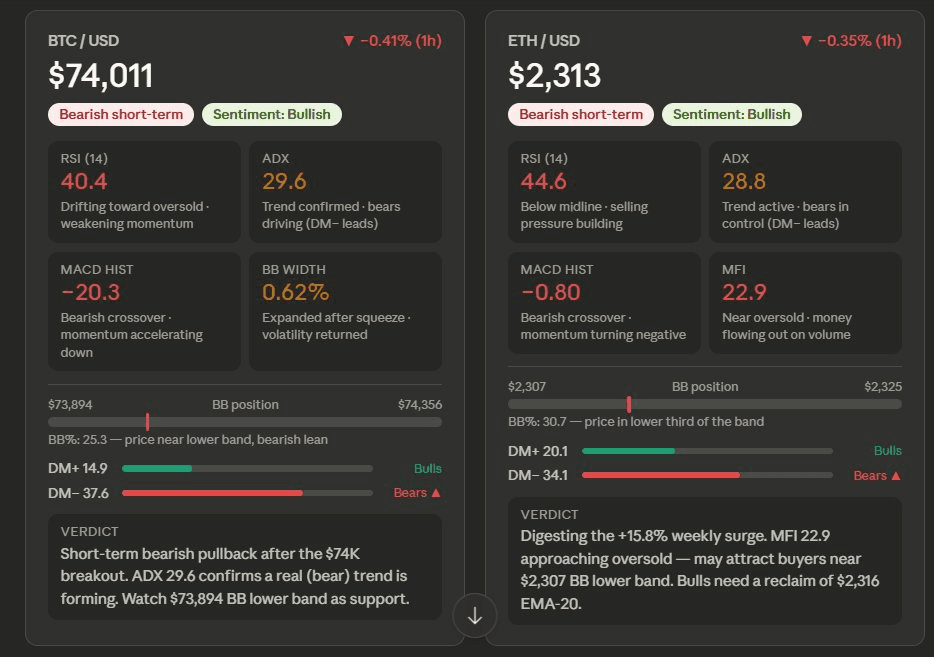
**When prices fall but sentiment stays bullish, something's off.** On March 17, 2026, both BTC and ETH dropped while news sentiment remained bullish—a contradiction Claude AI identified in just 3 seconds. The aarna team built this capability using a live data pipeline that feeds **40+ real-time indicators** directly into Claude via MCP (Model Context Protocol). This architecture enables instant analysis of market discrepancies that human traders might miss. **How it works:** - Real-time data from multiple sources flows through MCP - Claude processes price movements, sentiment analysis, and market indicators simultaneously - Contradictions between price action and sentiment are flagged immediately This represents a shift in how AI can assist with market analysis—not by predicting the future, but by spotting inconsistencies in present data faster than manual review allows. The system demonstrates practical applications of connecting AI models to live data streams, moving beyond static analysis to dynamic market monitoring.
aarna Launches AOT: Policy-First Framework for Institutional DeFi Allocation
**aarna introduces AOT (Autonomous Onchain Treasury)**, a new framework that shifts institutional DeFi allocation from yield-chasing to policy-driven management. **Key principles:** - Focus on mandate, risk bounds, liquidity profile, and execution governance rather than APY alone - Formalizes onchain allocation with defined constraints and continuous oversight - Addresses treasury-scale challenges: deep pool liquidity limits, manual operation inefficiencies, dynamic risk management **Problem solved:** Large treasuries (DAOs, protocols, foundations) face slippage on mid-six-figure positions, concentration risk from manual rebalancing, and lack of transparent audit trails. Traditional approaches either park stables at low yields or chase variable returns that collapse during downturns. **AOT's approach:** Provides autonomous, agentic treasury management with onchain verifiability and programmable policies, allowing teams to focus on product development rather than position management. Targeted at allocators managing multi-million to billion-scale treasuries seeking risk-managed yield with institutional-grade transparency.