0G Launches $150K APAC Hackathon for Decentralized AI Infrastructure
0G Launches $150K APAC Hackathon for Decentralized AI Infrastructure
🤖 AI agents go sovereign


The 0G APAC Hackathon is now accepting submissions, offering a $150,000 prize pool in partnership with HackQuest. The competition focuses on building AI agents with decentralized infrastructure across four key tracks:
- Agent frameworks & orchestration
- Verifiable on-chain trading
- Autonomous agent economies
- Privacy-preserving AI applications
Participants gain full access to the 0G stack, including Chain, Compute, Storage, and Data Availability layers. The hackathon features in-person Open Days across the APAC region, with winning teams presenting at the Hong Kong Web3 Festival.
This follows the success of previous winner Ajently, a unified AI agent marketplace built on 0G's infrastructure that enables users to build, deploy, and monetize AI agents for content creation, research, and automation.

AI agents need infrastructure they can trust. Not rent. The 0G APAC Hackathon is now live with @HackQuest_ $150K prize pool. IRL Open Days across APAC. Top teams demo at Hong Kong Web3 Festival. 4 tracks. One decentralized AI stack: → Agent frameworks & orchestration →


Builders, it’s time — our 0G APAC Hackathon is live 🐼 Here’s what builders can expect: ▫️ 5 core tracks ▫️ Full access to the @0G_labs & @0g_CN AI infra stack ▫️ $150K prize pool + incubator support ▫️ IRL events & networking across APAC 🗓️ Mar 19 - May 9 Join now 👇

Google's Quantum Demo Shows Bitcoin Encryption Could Break in 9 Minutes
Google demonstrated that a quantum computer could theoretically break Bitcoin's encryption in just 9 minutes, highlighting a looming infrastructure challenge for blockchain networks. **The Timeline Problem** - The real threat isn't today's quantum computers, but those expected by 2035 - 0G Labs CEO warns that half the industry may still be unprepared by then - Google has set a 2029 deadline to quantum-proof its own systems **Why This Matters** - Blockchain networks can't simply push software updates like traditional systems - This represents a fundamental infrastructure challenge, not just a security patch - The industry needs to begin preparations now for quantum-resistant encryption The warning serves as a wake-up call for crypto networks to start planning their transition to quantum-safe cryptography well before the threat becomes immediate. [Read the full analysis](
AI Agent Infrastructure Race Shifts from Algorithm to Foundation
The conversation around AI agents and blockchain has evolved. Developers are no longer debating whether AI agents need blockchain—they're focused on how quickly the infrastructure can scale. **Key developments:** - Ghast_Ai demonstrated their build on 0G at a recent event - The competitive advantage in AI agent commercialization is shifting from algorithms to infrastructure reliability - Critical infrastructure needs include: trusted compute, verifiable storage, and on-chain identity The emphasis has moved beyond surface-level tools like wallets and hosting to the foundational layer that supports AI agents. The winner in this space will be determined by who builds the most dependable infrastructure, not necessarily the most sophisticated algorithm.
🏗️ On-Chain AI's Infrastructure Moment
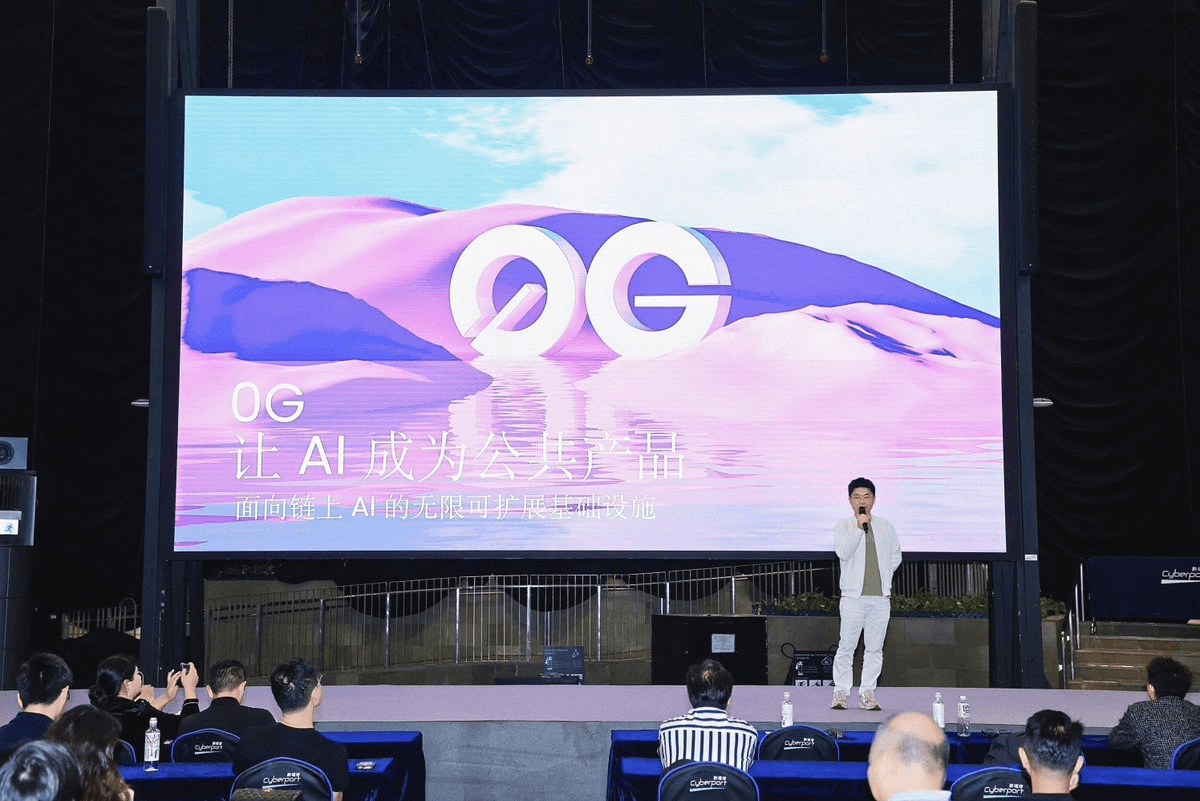
**0G presented its infrastructure vision at a Hong Kong event, positioning itself as the defining infrastructure layer for on-chain AI.** The company draws parallels to previous technology waves: - Internet: TCP/IP - Mobile: App Store - Cloud: AWS - On-chain AI: 0G's infrastructure **Key positioning:** 0G is building "Cloud 3.0" - a decentralized alternative to centralized AI infrastructure. The platform combines distributed compute, blockchain governance, and tokenized participation. **Market context:** According to Forbes, AI represents nearly half of the Cloud 100's $1.1 trillion valuation, but remains centralized. 0G CEO Michael Heinrich argues the next generation of AI infrastructure will shift away from hyperscaler control toward shared compute, storage, and governance networks. The announcement signals 0G's ambition to become the foundational layer for decentralized AI applications.
0G Ships Full AI Infrastructure Stack While Competitors Fragment Across Layers
**The fragmentation problem in AI crypto** Most AI blockchain projects focus on a single infrastructure layer: - Compute-focused projects assume storage will be handled elsewhere - Storage solutions struggle to coordinate inference - Data availability (DA) layers face integration challenges **0G's integrated approach** 0G differentiates itself by delivering a complete stack rather than isolated components. The platform combines: - Chain layer for coordination - Storage for model weights - DA for throughput - Compute for inference This contrasts with the common "GPUs-with-a-token" model that dominates the space. Instead of forcing developers to integrate multiple middleware layers, 0G provides unified AI infrastructure in a single deployment.
🔐 Can You Trust Your AI Agent with Your Crypto Keys?
**The Problem with AI Agents** AI agents now handle sensitive tasks like executing trades and managing portfolios, but there's a critical security gap: you can't verify what they actually computed. **Prompt Injection: The New Threat** - Prompt injection attacks are becoming as dangerous as SQL injection once was - Without proper safeguards, the agent economy relies entirely on blind trust - Your keys, trades, and portfolio decisions are vulnerable **0G's Solution: Sealed Inference** The [0G Compute Network](https://0g.ai) addresses this through sealed inference technology: - Hardware-level enforcement prevents anyone from accessing your data during processing - Not even node operators can see your information - Protects source code, keys, and business logic at the architectural level This isn't about policy promises—it's about building security into the foundation of AI agent infrastructure.